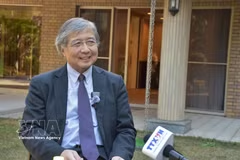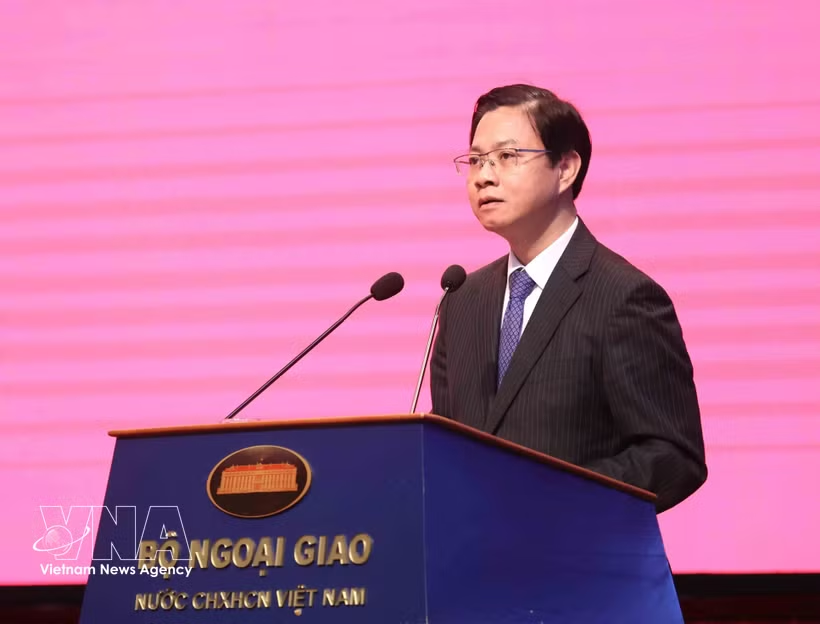
Hanoi (VNA) - Local diplomacy has shifted from participation to shaping, moving beyond mere diplomatic tasks to proactively creating development space for localities and delivering increasingly concrete contributions to the nation’s overall diplomatic strength, Deputy Minister of Foreign Affairs Ngo Le Van told the press ahead of the 33rd Diplomatic Conference and the 22nd National Conference on Foreign Affairs scheduled for August 1-8.
Van said Party, State and people-to-people diplomacy are now tightly coordinated at the local level. With support and coordination local foreign affairs agencies, more than 900 international agreements at the local level have been signed, renewed or kept in force, while over 2,500 international conferences and seminars have been licensed and staged in localities.
Many partnerships have evolved from simple exchanges and friendship activities into cooperation for shared development, from signing frameworks to focusing on implementation, and increasingly toward trade, investment, quality workforce, science and technology, digital transformation, green transition and infrastructure connectivity.
Moreover, border localities have worked closely together to manage and protect boundary lines and markers, maintained exchange and cooperation mechanisms with localities in neighbouring countries, pushed the opening and upgrading of border gates and connectivity in transport and border trade; and gradually introduced new models such as smart border gates.
Many localities have switched their approach to attracting international resources from “attraction” to “selectivity”, prioritising quality and spillover effects over quantity. They are proactively targeting hi-tech, semiconductor, artificial intelligence, innovation, green transition and digital transformation projects, tying investment attraction to technology transfer, workforce training and deeper integration into global supply chains.
At the same time, cultural diplomacy, UNESCO affairs, external information, overseas Vietnamese affairs, mobilisation of foreign non-governmental aid and labour cooperation are being aligned ever more closely with local development needs. In particular, many localities are gradually turning heritage into assets and cultural values into soft power and development resources, while balancing conservation with development.
According to him, the Ministry of Foreign Affairs (MoFA) and Vietnam’s overseas representative agencies have consistently place people, localities and businesses at the centre, accompanying localities not only in expanding relations but increasingly in identifying opportunities, connecting partners, pooling resources and solving specific problems.
They actively advised on fine-tuning mechanisms, creating a more favourable framework for local external relations and global integration.
The ministry has also actively built regional and local development schemes and plans, supported the handling of diplomatic issues arising during the restructuring of administrative units and the rollout of two-tier local administration model; and ensured continuity and smoothness in diplomatic activities, with international relations and commitments inherited and effectively rolled out.
Since 2024, around 270 working delegations led by the minister or ministry leaders have visited and worked with localities, while 24 meetings have been held with local leaders in Hanoi.
The ministry has hosted nine large-scale conferences connecting localities with foreign partners, facilitating nearly 2,000 connections among localities, Vietnamese firms and international partners. It has also run around 700 investment, trade and tourism promotion activities and supported the signing of more than 420 cooperation deals.
The ministry and overseas representative agencies are focusing more deeply on supporting individual localities in markets, partners, policy trends and new standards for green transition, digital transformation and sustainable development; connecting investors, businesses, technologies and experts; and helping localities capitalise on free trade agreements (FTAs), strategic and comprehensive partnership frameworks and international cooperation mechanisms.
In addition, the ministry has accompanied localities across the full spectrum of external relations, from economic and cultural diplomacy, UNESCO affairs and border and territorial issues to consular affairs, citizen protection, overseas Vietnamese affairs, external information and people-to-people diplomacy.
The ministry has played an active role in pooling support for UNESCO designations; helping build cultural, festival and heritage-economy brands; coordinating efforts to demarcate and mark borders, open and upgrade border gates, and connect border localities; and handling consular cases, citizen protection and repatriation.
It has run hundreds of training courses on external relations, global integration, foreign languages, and translation and interpretation skills for thousands of local officials. It has also regularly provided information and forecasts on global and regional developments and introduced international development models to support policymaking and advisory work at the local level.
Looking ahead, the ministry has identified five major priorities. First, the approach should shift from protecting development space to creating development capacity, and from “attracting” to “selecting and upgrading” resources for strategic breakthroughs. Priority should be given to hi-tech projects and technology diplomacy in innovation, digital transformation, AI and strategic minerals, aligned with development strategies and comparative advantages of each locality and area.
Second, it will leverage the combined strength of the three pillars of Party, State and people-to-people diplomacy while supporting localities in proactively and responsibly engaging in international and multilateral cooperation mechanisms suited to their conditions.
Third, it will continue fine-tuning mechanisms for close coordination and joint support among the Government, localities and businesses, with the MoFA serving as a central coordinator and facilitator. Coordination among the ministry, other ministries and sectors, Vietnam’s overseas representative agencies and localities will be stronger through coordination regulations, regular briefings and specific plans, ensuring clear roles, tasks, timelines, responsibilities, deliverables and authority.
Channels will also be developed to help localities and businesses join global value chains and international markets and gain access to capital, technology and quality expertise.
Fourth, local diplomatic units will be consolidated to make them capable, effective and professional, meeting the demands of the new era.
Fifth, information technology and digital transformation in local external relations will be accelerated. The ministry will lead the building of digital platforms, databases and shared information systems, promote data connectivity and sharing between the central and local levels, among localities and with overseas representative agencies; and expand the use of AI and big data in forecasting and early identification of opportunities and challenges, ensuring the country is never caught off guard in any situation, he added./.