Vietnam expands honorary consul network to support development in new era

The foreign ministry said it will continue expanding the honorary consul network by identifying qualified candidates while providing them with updated information on Vietnam’s economic potential and investment opportunities, enabling them to make greater contributions to the country’s development in the new era.

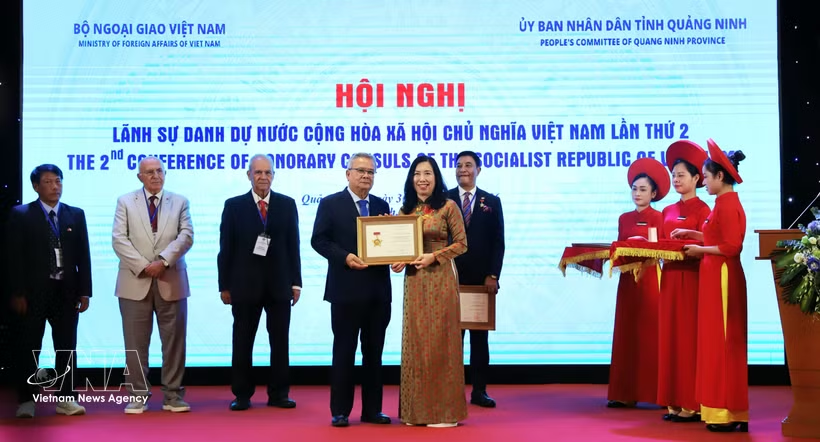
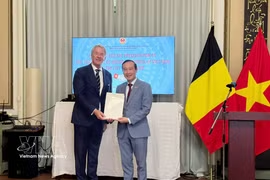
Deputy Minister of Foreign Affairs Le Thi Thu Hang (R) presents the “For the Cause of Vietnam’s Diplomacy” insignia and the Minister of Foreign Affairs’ certificates of merit to outstanding honorary consuls at the conference in Quang Ninh province on July 30. (Photo: VNA)

Quang Ninh (VNA) – Vietnam aims to expand and strengthen its network of honorary consuls abroad to better protect citizens, promote economic diplomacy and mobilise international resources for national development, officials said at the second Conference of Vietnam’s Honorary Consuls Abroad, held in the northern province of Quang Ninh on July 30.

The event, held ahead of the 33rd Diplomatic Conference, focused on implementing the foreign policy orientations adopted at the 14th National Party Congress in support of the country’s long-term development goals for the 2030-2045 period.

Addressing the conference, Deputy Minister of Foreign Affairs Le Thi Thu Hang said the event provided an opportunity to review the effectiveness of Vietnam’s honorary consul network and update participants on the country’s development vision and orientations. Building on this, relevant agencies and honorary consuls of Vietnam will promote practical cooperation to strengthen trade and investment ties, and further improve consular services and the protection of Vietnamese citizens abroad.

Director of the Consular Department under the Ministry of Foreign Affairs Doan Hoang Minh said Vietnam has appointed 22 new honorary consuls and reappointed 32 others since the first conference in 2021. The country now has 48 honorary consuls serving in Europe, the Asia-Pacific, the Middle East and Africa, and the Americas.

Although they serve on a voluntary basis and receive no state salary, honorary consuls have made significant contributions by promoting their personal networks and resources. They played an active role in assisting Vietnamese citizens during the COVID-19 pandemic and amid geopolitical conflicts, including those in Ukraine and the Middle East.
vnanet-consul2.jpg
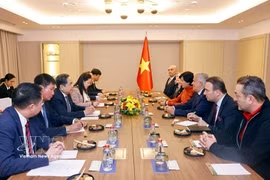
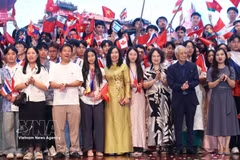
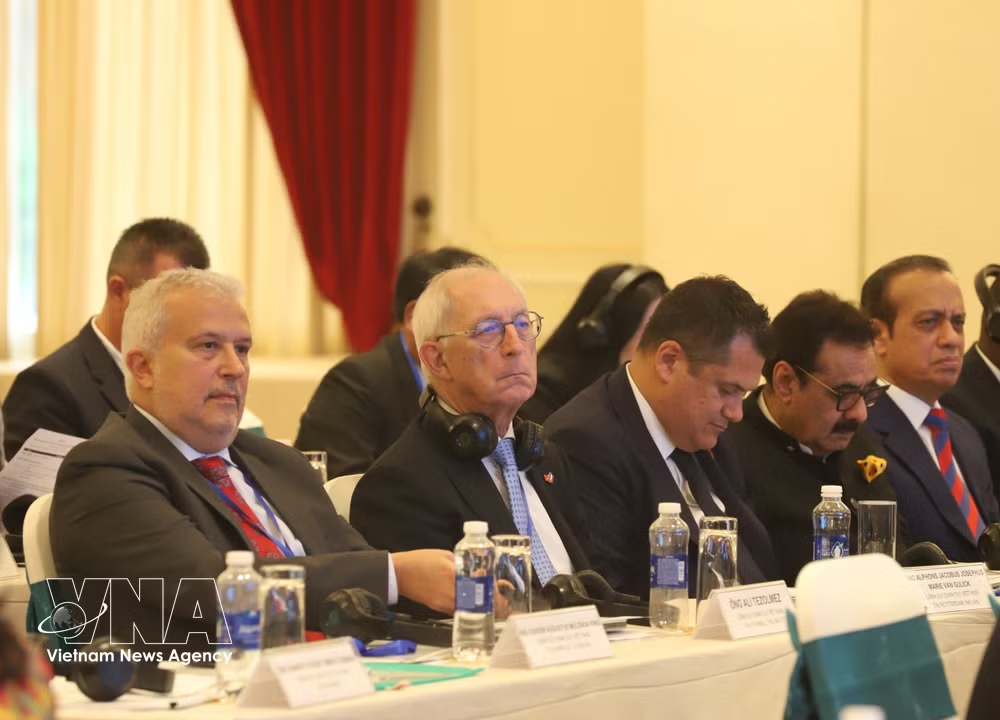
Vietnam's honorary consuls from across the world gather at the second Conference of Vietnam's Honorary Consuls in Quang Ninh province. (Photo: VNA)

Honorary consuls have also contributed to promoting Vietnam’s economic diplomacy and international image. Notable initiatives include support for the ratification of the EU–Vietnam Investment Protection Agreement (EVIPA), the establishment of the Aichi–Vietnam Friendship Association in Japan, and the naming of a street after the Socialist Republic of Vietnam in Belo Horizonte, Brazil.

To facilitate their work, the Ministry of Foreign Affairs proposed new regulations allowing honorary consuls to receive electronic visa exemption cards valid for up to three years.

The ministry said it will continue expanding the honorary consul network by identifying qualified candidates while providing them with updated information on Vietnam’s economic potential and investment opportunities, enabling them to make greater contributions to the country’s development in the new era.

At the conference, Honorary Consuls from Nepal, Brazil, and New Caledonia (France) shared practical experience and discussed measures to further improve the effectiveness of their work.

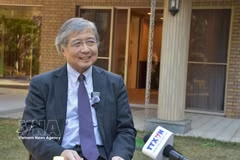
Dinh Jean Pierre, Vietnam's Honorary Consul to New Caledonia, highlighted the importance of transparent and close coordination with overseas Vietnamese associations in protecting citizens, while underscoring efforts to preserve and promote Vietnamese cultural identity within the expatriate community./.
VNA

See more

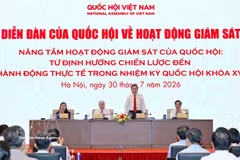
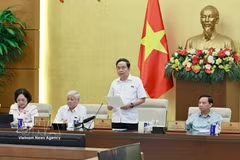
National Assembly Chairman Tran Thanh Man (standing) chairs the legislature's forum on supervision in Hanoi on July 30, 2026. (Photo: VNA)

Ultimate value of oversight lies in delivering tangible change: top legislator

Addressing the NA forum on supervision in Hanoi, the top legislator said it is one of the legislature's three constitutional functions. Supervision serves as a key mechanism for exercising control over State power, ensuring the strict implementation of the Constitution and the law, while also driving institutional reform, strengthening national governance and reinforcing public confidence.

Deputy Minister of Foreign Affairs Le Thi Thu Hang (in yellow) and participants in the Vietnam Summer Camp 2026. (Photo: VNA)

OV resources: From diplomacy's pioneering role to driver of local development

As an inseparable part of the Vietnamese nation, OVs represent a vital source of capital, knowledge, science and technology, management expertise, international networks and influence in their host countries. They are both beneficiaries of the State's support and protection policies and active contributors to Vietnam's foreign affairs, helping connect international resources with the country's and each locality's development needs.

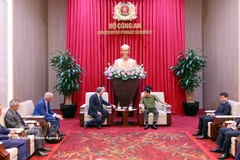
The meeting between Minister of Public Security General Luong Tam Quang and a delegation from Italy's Leonardo S.p.A. led by Daniele Tavano, Director for Global Sales Air Traffic Management Systems in Hanoi on July 29. (Photo: VNA)

High-tech cooperation advanced to strengthen public security

Minister of Public Security General Luong Tam Quang praised Leonardo S.p.A. as one of leading high-tech industrial groups of Italy and Europe, with strengths spanning defence, security, aerospace, helicopters, electronics and digital technologies. He noted the company's extensive experience in cybersecurity, command-and-control systems, radar, sensors, border surveillance and the protection of critical infrastructure.

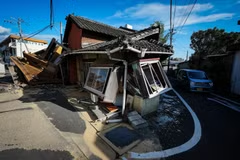
A house was damaged after the earthquake in Kumamoto Prefecture, Japan. (Photo Xinhua/VNA)

Vietnam sends condolences to Japan over earthquake losses

Prime Minister Le Minh Hung on July 29 sent a message of condolences to Japanese Prime Minister Takaichi Sanae over significant losses of life and property caused by a recent earthquake in Kumamoto Prefecture and the Kyushu region.

National Assembly Chairman Tran Thanh Man delivers his closing remarks at the National Assembly Standing Committee's 4th session in Hanoi on July 29, 2026. (Photo: VNA)

National Assembly Standing Committee concludes fourth session

During its fourth session, the National Assembly Standing Committee considered and gave opinions on 28 of the 33 items to be submitted to the NA at its first extraordinary session, as well as two draft laws scheduled for consideration at the legislature's second sitting.

Permanent member of the CPV Central Committee’s Secretariat Tran Cam Tu (R) and CNDD-FDD Secretary General Révérien Ndikuriyo (Photo: VNA)

Vietnam, Burundi cement political trust, substantive ties

During a reception in Hanoi on July 29 for CNDD-FDD Secretary General Révérien Ndikuriyo, who is on an official visit to Vietnam from July 27-31, Politburo member and Permanent member of the CPV Central Committee’s Secretariat Tran Cam Tu believed that that the visit would consolidate political trust, friendship and substantive cooperation between the two parties and countries in the coming time.

Prime Minister Le Minh Hung (R) and Sisay Leudetmounsone, Politburo member, Secretary of the Central Committee of the Lao People's Revolutionary Party (LPRP) and head of its Organisation Commission, in Hanoi on July 29, 2026. (Photo: VNA)

PM receives head of Lao Party's Organisation Commission

Prime Minister Le Minh Hung on July 29 received Sisay Leudetmounsone, Politburo member, Secretary of the Central Committee of the Lao People's Revolutionary Party (LPRP) and head of its Organisation Commission, who is on a working visit to Vietnam.

NA Chairman Tran Thanh Man speaks at the meeting (Photo: VNA)

NA Standing Committee debates revisions to real estate business law

Chairman Man said the amendment of the Law on Real Estate Business must move in lockstep with a clean-up of rules governing land, housing, investment, planning, construction and finance. The amendments, he said, must fully codify principles laid out in the Party Central Committee’s third plenum resolution on land-law reform while making the legal framework coherent, free of overlap and more enforceable.

☕ Afternoon briefing on July 29

☕ Afternoon briefing on July 29

The national teleconference held to study, disseminate and implement the resolutions adopted at the 14th Party Central Committee’s recent third meeting, the issuance of the national programme on child protection and child labour prevention and reduction for 2026–2030, and one Vietnamese killed in the July 28 earthquake in Japan’s Kumamoto prefecture are among news highlights on July 29.

Vansy Kuamua (right), member of the Lao People's Revolutionary Party (LPRP) Central Committee and Deputy Head of its Commission for Propaganda and Training, receives Deputy Editor-in-Chief of the Communist Review of Vietnam Nguyen Ngoc Ha on July 28. (Photo: VNA)

Vietnam, Laos enhance cooperation in Party theoretical work

The Communist Review will continue to work closely with its Lao counterpart to translate the concept of "strategic cohesion" in Vietnam–Laos relations into concrete actions, in line with the orientation set by the high-ranking leaders of the two Parties.

Politburo member, Secretary of the Party Central Committee, Chairman of the Party Central Committee's Commission for Policies and Strategies Nguyen Thanh Nghi speaks at the national conference to disseminate and implement resolutions adopted at the third plenum of the 14th Party Central Committee on July 29. (Photo: VNA)

Party resolution sets roadmap for renewing national development model

Under the new development model, Vietnam will be self-reliant, innovative, humane, sustainable and globally integrated, with people at the heart of development. Science and technology, innovation, digital transformation and artificial intelligence are designated as the main growth drivers, while higher productivity and more efficient resource allocation serve as core principles.