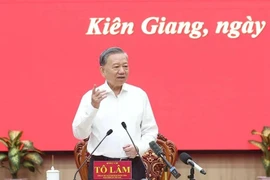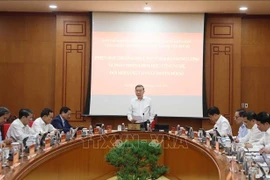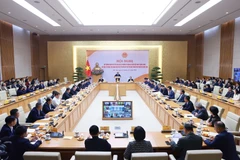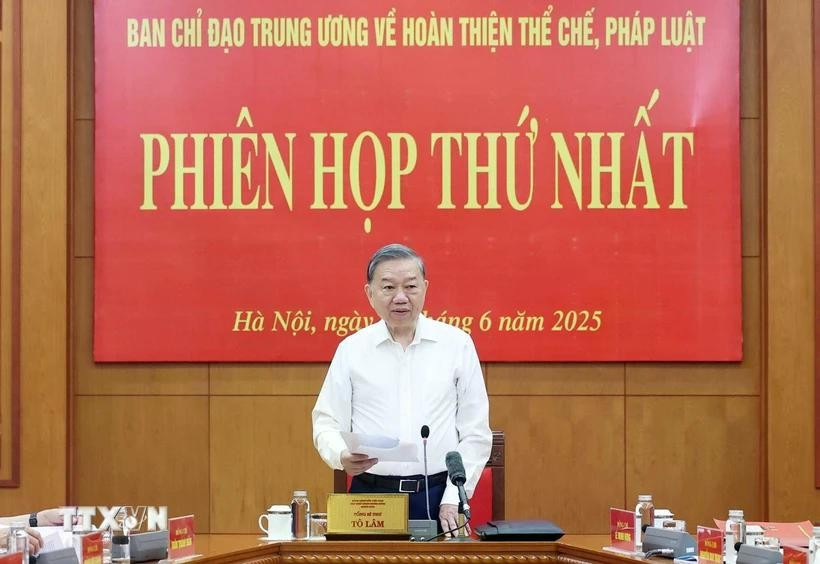
Hanoi (VNA) – The improvement of laws and institutions must pave the way for development and encourage all people and businesses to take part in the socio-economic and national development process, said Party General Secretary To Lam, head of the central steering committee for perfecting institutions and laws, while chairing the first meeting of the committee in Hanoi on June 5.
Participants focused on reviewing and providing guidance on several key documents and issues. These included the draft working regulations of the committee, the assignment of responsibilities to its members, the 2025 work programme, the collection of public feedback on proposed amendments to the 2013 Constitution, a report on legal reforms related to decentralisation, and a draft plan to review and settle legal bottlenecks.
In his concluding remarks, General Secretary Lam emphasised that the committee must focus on strategic, high-impact issues outlined in Resolution No. 66-NQ/TW issued on April 30, 2025 by the Politburo on renovating law-making and law enforcement to meet the requirements of national development in the new era, prioritising urgent matters and accelerating progress toward achieving the 2025 targets, particularly removing legal bottlenecks hindering development.
The Party chief called for the active engagement of each member of the committee, and encouraged the use of recommendations from legal professionals, academics, and the business community to ensure that all measures to complete the institutional and legal frameworks are both scientifically grounded and practically viable. He also stressed the need to avoid talking without action or letting personal interests infiltrate legal work.
The leader further demanded that each task must be clearly assigned, with specific accountability and measurable indicators for tracking progress. The implementation must be swift, transparent, and based on data, he stressed.
He directed the committee to continue guiding the amendment process for the 2013 Constitution according to schedule, laying a solid legal foundation for administrative reorganisation and institutional restructuring.
He also reaffirmed the Party’s directive role in translating policies into laws, urging ministries and agencies to take full ownership of legislative drafting and uphold high-quality legal standards within their jurisdictions.
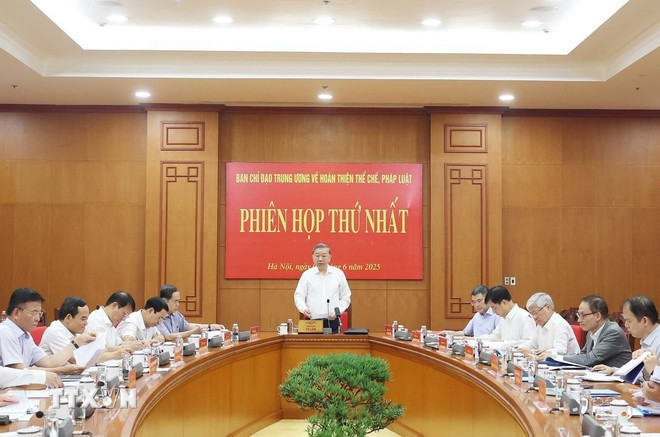
General Secretary Lam stressed the need to remove legal contradictions, overlaps, and impractical provisions, especially those that create multiple interpretations or obstruct implementation. Priority should be given to settling legal obstacles in finance, investment, science and technology, innovation, and digital transformation, he stated.
He highlighted the significance of fundamental shift in legislative thinking from a "control-based" mindset to one of "development facilitation", and from passive to proactive governance, adding that laws should help unlock the nation's potential and seize emerging opportunities.
The Party chief also emphasised the importance of improving legal enforcement and building culture of law observance. He warned against complacency, where regulations are passed but not enforced, leading to the situation where there is enthusiasm at the top but indifference at lower levels in law enforcement.
He urged strengthening the workforce, promoting ethical, reform-minded, and knowledgeable officials, and accelerating the application of AI and digital technologies in the legislative work. The development of a comprehensive legal database linked with the national data centre must also be prioritised.
General Secretary Lam further emphasised the vital oversight roles of the Party, the Vietnam Fatherland Front, socio-political organisations, and the public in monitoring the implementation of Resolution 66. Listening to those directly impacted - people and businesses - will help detect regulatory shortcomings and improve the legal system’s relevance, he stated.
The leader affirmed that legal and institutional reform is a complicated, intellectual, and deeply committed process requiring consensus throughout the political system and wider society, adding that the steering committee must not only offer directions but also drive genuine, transformative changes.
At the session, the committee approved its draft working regulations, the assignment of responsibilities, the 2025 work programme, and the plan for addressing legal bottlenecks. The Party Committee of the Ministry of Justice, as the standing body of the committee, was tasked with incorporating feedback and submitting final drafts for official approval./.