Hanoi (VNA) – Party General Secretary To Lam has urged leaders of agencies, units and localities to strengthen direction and translate Resolution No. 57-NQ/TW into reality, in line with their specific conditions, while expand training in science, technology, innovation, and digital skills for civil servants, and fostering a culture of innovation across the political system.
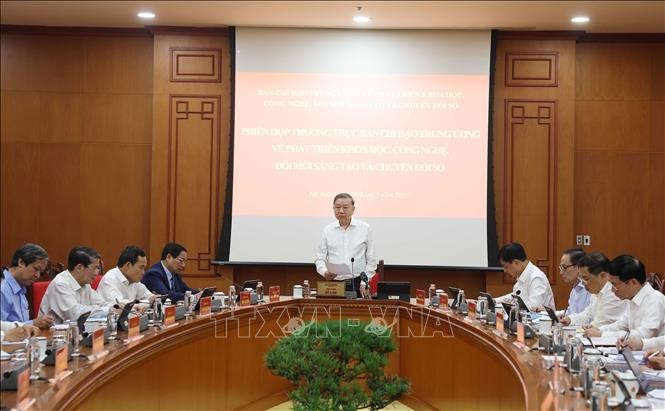
Chairing a meeting of the standing board of the Central Steering Committee for the Development of Science, Technology, Innovation, and Digital Transformation in Hanoi on May 29, General Secretary Lam, who is head of the steering committee, praised the efforts by ministries, sectors, units and agencies in implementing Resolution No. 57-NQ/TW issued on December 22, 2024 by the Politburo on breakthrough development in science, technology, innovation, and national digital transformation.
He noted that in the first five months of this year, ministries, sectors, units and agencies have promptly performed assigned tasks, particularly government and parliamentary bodies. These included institutional and policy development, addressing critical bottlenecks, and piloting the three-party cooperation model among the State, training institutions and businesses.
Other achievements included promoting the use of population data, providing online public services, and ensuring seamless network infrastructure from central to local levels, to support local digital transformation, he said.
However, the Party chief pointed to shortcomings and bottlenecks, which, if left unresolved, will hinder progress and fail to meet expectations of people and businesses, potentially impacting national innovation and digital development goals.
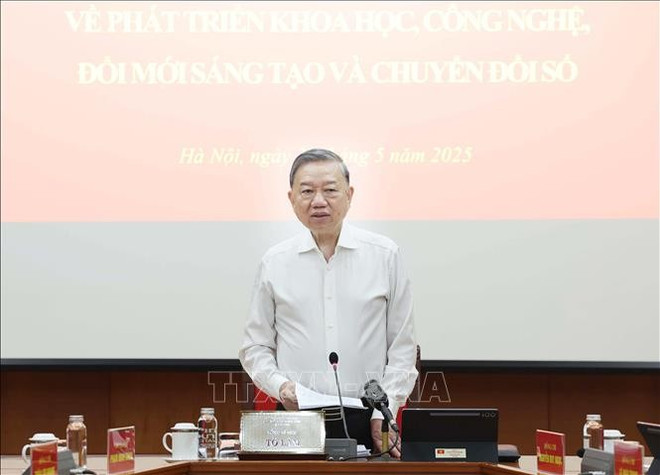
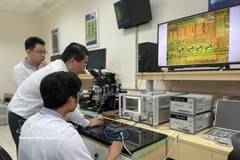
He underscored that the most critical bottleneck remains institutions. Key shortcomings include a lack of clear identification of strategic technologies suited to Vietnam’s context; an absence of targeted policies for the three-party cooperation model; weak technological infrastructure, particularly laboratories and research hubs; disjointed platforms and fragmented data systems; and slow digital transformation in the business sector, reducing productivity and competitiveness.
Meanwhile, the State's management in science, technology, and education has remained outdated, while data to support research and policy planning is insufficient and lacks systematisation, the leader added.
Emphasising that 65 overdue tasks have remained unresolved across ministries, agencies, and localities, he requested that they must be urgently addressed in June to ensure completion of overall tasks in the first six months of this year and the whole year.
He asked the steering committee’s standing board to work directly with the National Advisory Council and relevant bodies to monitor progress and resolve issues, maintaining regular briefings to ensure task completion and quality. Responsibility must be clearly assigned, especially to leaders, he stressed.
Along with accelerating the implementation of Resolution 57, ministries, sectors and localities were urged to improve management capacity and increase the proportion of technical experts in leadership contingents.
General Secretary Lam requested the Party Central Committee's Office to enhance communications on the outcomes of Resolution 57 and highlight successful cases, while asking the Party Central Committee’s Inspection Commission to strengthen oversight for effective implementation.
He directed the Government and National Assembly's Party Committees to work with relevant ministries and legislative bodies to finalise key laws on science, digital technology, state budget, investment, and teachers for approval, aiming to remove legal bottlenecks and support development. The leader also instructed ministries to resolve challenges in applying the three-party cooperation model, developing smart cities, and expanding high-tech zones.
Emphasising the importance of strategic technologies for the country's development, the Party chief requested the Ministry of Science and Technology to continue to urgently coordinate closely with relevant ministries, agencies and sectors to complete a strategic technology list. The list must be based on scientific methods, ensuring transparency, consistency, closely following national strategies, solving major problems of the country, directly serving Vietnam’s development goals until 2030-2045.
Developing the list not merely relies on existing advantages but also reflects breakthrough in mindset, accepting risks in new, high-potential fields, he said, adding that it must thoroughly grasp Resolution 57, ensuring the autonomy and self-reliance of Vietnam in developing strategic technologies.
According to the Party leader, based on the approved list, the Ministry of Science and Technology will continue to coordinate with ministries, agencies, localities, and enterprises to immediately select key strategic tasks and technology products, and then develop a detailed implementation plan for each task and each pioneering product. Such plans must clarify the unit in charge of financial resources, specific financial mechanisms, incentives for basic scientific research, for application, policies and specific roadmaps for output products, requirements for high-quality human resources, international integration.
Regarding the promotion of science-technology, innovation and digital transformation activities in enterprises, the General Secretary assigned the Ministry of Science and Technology to coordinate with ministries, agencies and localities in proposing competent authorities to issue policies for domestic enterprises to apply scientific and technological advances in implementing national key projects; developing a science and technology trading floor; researching and promulgating solutions to increase the localisation rate for scientific-technological products, innovation, and transformation.
On international cooperation, he assigned the Ministry of Foreign Affairs to coordinate with relevant agencies to promote the sharing of international experience models on science and technology development, innovation, digital transformation, focusing on solutions to remove institutional obstacles, attract resources and transfer technologies./.