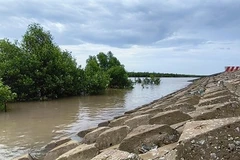
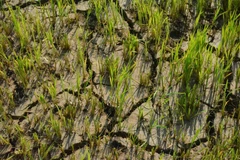
Saltwater intrusion in rivers has damaged the rice crop in Cà Mau's Thoi Binh district (Photo: VNA)
 HCM City (VNS/VNA)- Though saltwater intrusion in the Mekong Delta was predicted tocome earlier and with higher level of salinity than thatrecorded in the 2015-2016 dry season, the damages to farming areasare expected to be less serious as authorities and farmers have takenmeasures to cope with the situation in the 2019-2020 dry season.
Saltwater intrusion with asalinity rate of four grammes per litre is expected to enter 50-95kilometres deep into the delta’s main rivers from February 11-15, anincrease of 3-11 kilometres against the same period in 2016, according tothe National Centre for Hydro-Meteorology Forecasting.
In Tra Vinh province, saltwaterintrusion has entered deep into fields, damaging many rice fields.
Do Trung, Director of the TraVinh Irrigation Work Exploitation and Management One Member Limited Company,said the company has operated 48 sluices to prevent saltwater intrusionand store fresh water, but saltwater has entered early this year andreached 60-70 km deep into rivers and canals with a salinity rate of 3-10parts per thousand.
More than 10,000ha of thewinter-spring rice in the province face water shortage and 50 percentof the area could be completely damaged, he said.
In Soc Trang province, saltwaterintrusion and drought have affected more than 2,100ha of rice, up 760hacompared to the end of last month, according to the provincial Department ofAgriculture and Rural Development.
Lam Hoang Hiep, Vice Chairmanof the Soc Trang People’s Committee, said the salinityrate had reached 7-8 parts per thousand in some areas, affecting thelives of locals and agricultural production. The committee has asked theprovince’s districts to take measures to cope with the situation in eachlocality, he added.
Nguyen Hoang Hiep, Deputy Ministerof Agriculture and Rural Development, said in September the ministry askeddelta authorities to plant the 2019-2020 winter-spring rice a monthearlier than usual to cope with drought and saltwater intrusion.
Before the beginning of thewinter-spring crop, authorities in the delta instructed farmers not to grow thewinter-spring rice in areas that could be affected by saltwater intrusion.They also urged rice farmers to switch to drought-resistant crops.
The delta was also instructedto reduce the winter-spring rice area to 1.5 million hectares, down 100,000haagainst normal years, he said.
For fruit cultivation,farmers have built embankments to store irrigation water and have even usedhuge plastic bags with a capacity of 20-30cu.m each to store irrigationwater, he said.
“The damage to fruit trees isnot expected to be serious,” he said.
The delta’s localities havealso added more water pipes to secure the supply of water for locals sinceSeptember, he said.
Tra Vinh province, forinstance, has built more than 60km of new water pipes and stored fresh water inreservoirs and canals.
Most households in Tien Giang provincewhich cannot access tap water have water containers with a capacity of2-3cu.m each to store enough water for drinking and eating during the dryseason.
The delta, whichincludes 12 provinces and Can Tho city, is the country’s largestrice, fruit and seafood producer.
In the 2019-2020 dry season,the delta’s provinces and Can Tho began dredging irrigationcanals to store fresh water andupgraded and built irrigation systems prior to thebeginning of the saltwater intrusion.
Hiep said that construction ofmany irrigation projects in the delta have been put into use four to 14months earlier than scheduled.
Last month, the delta put intouse many irrigation projects that prevent saltwater intrusion and holdfresh water on a farming area of 300,000ha, he said.
As many as 100,000ha of riceand 130,000ha of fruit are expected to be affected by saltwater intrusion and100,000 households will face a shortage of daily use water.
In the 2015-2016 dryseason, saltwater intrusion and drought caused the loss of one milliontonnes of paddy in the delta, and 500,000 households in the deltasuffered a shortage of daily use water./.
VNA