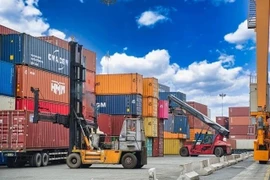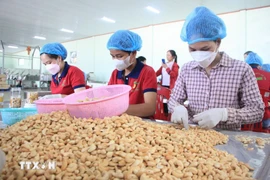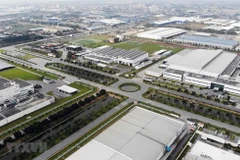
Hanoi (VNA) - Following a record-breaking 2025, with Vietnam’s total import-export turnover hitting 920 billion USD, the country enters 2026 with an ambitious new objective of export earnings to 546–550 billion USD, equivalent to a growth rate of 15–16%. For Vietnam, this will require a strong shift from volume to value.
The ambitious target was highlighted at the 2026 Export Promotion Conference held on January 29 by the Ministry of Industry and Trade (MoIT).
Pressure from new peak
Addressing the event, Tran Thanh Hai, Deputy Director of the MoIT’s Agency of Foreign Trade, described 2025 as a landmark year, marking the first time Vietnam’s total trade turnover surpassed 900 billion USD. The achievement not only crowned more than three decades of international integration but also created momentum for the next phase of growth.
Vietnam’s exports stood at approximately 470 billion USD, edging closer to the 500-billion-USD mark. In terms of structure, electronics, machinery, and equipment continued to account for the largest share, followed by textiles and garments and footwear. Notably, coffee emerged as a bright spot among agro-forestry-fishery products in 2025, delivering high export value. Major export markets remained key partners, including the US, China, the Republic of Korea, Japan, and ASEAN member states.
However, Hai acknowledged that as trade turnover reaches unprecedented levels, structural limitations have become increasingly apparent.
Growth driven by expansion in scale alone has little room left, while shocks from markets, policy shifts, and global supply chains are becoming more unpredictable. Heavy reliance on a few major markets such as the US and China exposes exports to vulnerabilities arising from international trade and policy fluctuations, he noted.
Under the Government’s Resolution No. 01/NQ-CP dated January 8, 2026, the export growth target for 2026 has been set at 15–16% year-on-year. Achieving 546–550 billion USD in export turnover will require concerted efforts from ministries, sectors, localities, and the business community from the outset of the year.
Transitioning the export growth model from quantity to quality, and adding value and intrinsic capacity are critical facets to achieving the growth targets.
A strategic shift toward depth and greening
To sustain double-digit growth, the Ministry of Industry and Trade has identified key priorities centred on deepening growth drivers through science, technology, and innovation. Developing foundational industries and securing raw material supplies are seen as essential to reducing dependence on external sources.
At the same time, Vietnam will continue negotiating new-generation free trade agreements (FTAs) and upgrading existing ones to diversify and expand market access. Cross-border e-commerce is also expected to play an increasingly important role, alongside renewed trade promotion efforts and stronger national branding.
Particular emphasis is placed on the need for Vietnamese goods to swiftly adapt to increasingly stringent international standards on environmental protection and emissions. Addressing structural bottlenecks in logistics and reducing associated costs are likewise critical to enhancing competitiveness.
Nguyen Anh Son, Director of the MoIT’s Agency of Foreign Trade, affirmed that the ministry stands ready to incorporate feedback from ministries, associations, and enterprises to propose breakthrough policies to the Government. The overarching goal is to remove institutional and logistical bottlenecks, help enterprises maximise the benefits of FTAs, and lay a solid foundation for sustained, high-quality export growth in 2026 and beyond.
Vietnamese goods are now present in more than 200 countries and territories worldwide. With proactive enterprises and coordinated policy solutions, export and import activities will remain prominent drivers of the national economy in the years ahead./.