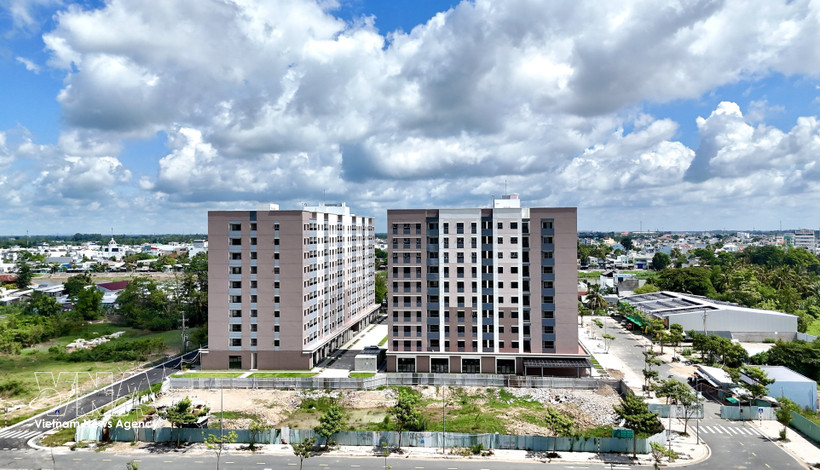
Hanoi (VNA) – The Government has introduced a consolidated legal framework to accelerate the development of social housing, aiming to expand home ownership opportunities for low-income earners while ensuring greater transparency and efficiency across the sector.
The newly issued document integrates and updates provisions guiding the implementation of the Housing Law, particularly those related to the development and management of social housing. Under the document, Decree No. 100/2024/ND-CP is amended and supplemented by Decree No. 261/2025/ND-CP and Decree No. 54/2026/ND-CP, which took effect on February 9, 2026.
The adjusted decree provides detailed and synchronised regulations covering the entire lifecycle of social housing projects, from project preparation and investor selection to incentive mechanisms, as well as procedures for sale, lease-purchase and operational management. It also applies to worker accommodation and housing for armed forces personnel.
Notably, the scope of regulation has been broadened to include land allocation within commercial housing projects, construction investment phases, and access to preferential credit through the Vietnam Bank for Social Policies. This is expected to create a consistent and transparent legal foundation for the effective implementation of social housing projects nationwide.
A key highlight of the new framework is a range of incentives designed to attract private sector participation. Developers of social housing projects are entitled to a maximum profit margin of 10% on the social housing component. They are also exempt from land use fees and land rental for the entire project area, without having to undergo land valuation procedures or apply for exemptions.
In addition, investors are allowed to allocate up to 20% of residential land within a project for commercial housing development or use up to 20% of the total floor area for commercial and service purposes. These provisions are intended to help offset costs and lower the selling prices of social housing units. Developers can also access preferential loans covering up to 80% of total investment for projects dedicated solely to rental housing.
Regarding land resources, provincial-level People’s Committees are tasked with allocating land funds for social housing development. In special-grade and Grade I, II and III urban areas commercial housing projects must reserve 20% of serviced residential land for social housing. If this requirement cannot be met on-site, developers are required to provide land at alternative locations or make financial contributions equivalent to the land value to local budgets for reinvestment.
For homebuyers, preferential credit policies remain a central pillar. Eligible beneficiaries can access loans from the Vietnam Bank for Social Policies at an annual interest rate of 5.4%, with repayment terms of up to 25 years. Income eligibility thresholds have also been adjusted, allowing single individuals earning up to 20 million VND (about 760 USD) per month and households with a combined income of up to 40 million VND per month to qualify for social housing purchase or lease-purchase schemes.
To ensure the policy reaches the right beneficiaries, strict procedures for application review have been introduced. Local Departments of Construction are responsible for verifying and publicly disclosing lists of eligible applicants on official portals, helping to prevent misuse and enhance transparency.
The decree also strengthens regulations on worker housing in industrial zones, including stringent requirements on environmental standards and technical infrastructure. Notably, projects must include a minimum 10-metre green buffer zone to improve living conditions and safeguard workers’ health.
The issuance and implementation of these regulations reaffirm the Party and State’s commitment to social welfare, while contributing to a more stable, transparent and sustainable real estate market, with the ultimate goal of ensuring adequate housing for all people./.