Construction of Hanoi – Quang Ninh high-speed railway set to kick off on April 12

A groundbreaking ceremony for the strategically significant Hanoi–Quang Ninh high-speed railway project will take place on April 12 at the Ha Long Xanh Station site in Quang Ninh province.

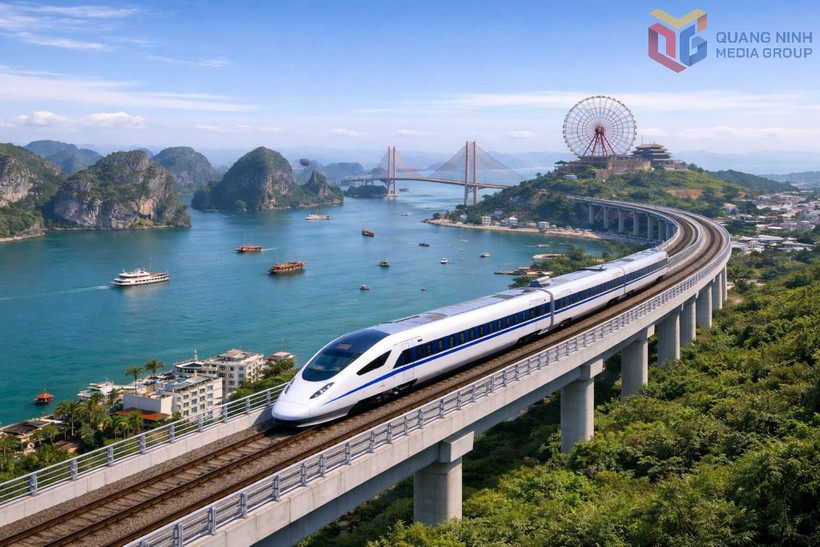
The construction of Hanoi – Quang Ninh high-speed railway is scheduled to begin on April 12. (Photo: Quang Ninh Media Group)

Quang Ninh (VNA) – A groundbreaking ceremony for the Hanoi – Quang Ninh high-speed railway project is scheduled to take place on April 12.

The event will be held at the construction site of Ha Long Xanh Station in Tuan Chau and Viet Hung wards, Quang Ninh province. The project is regarded as a key inter-regional transport infrastructure initiative with strategic importance for local socio-economic development.

The provincial People's Committee has requested that the ceremony be organised in a solemn, safe, efficient and cost-effective manner, making the best use of available resources and ensuring close coordination between the project investor – the Vinspeed High-Speed Railway Investment and Development JSC and relevant departments, agencies and localities.

The railway will be a double-track, 1,435mm standard-gauge, electrified line with a total length of about 120km and a maximum design speed of 350kph. It will run through four cities and provinces, namely Hanoi, Bac Ninh, Hai Phong and Quang Ninh, starting at Co Loa Station in Hanoi and ending near the Tuan Chau public park area in Quang Ninh.

Five stations are planned along the route – Co Loa, Gia Binh, Ninh Xa, Yen Tu and Ha Long Xanh – together with a depot at Ha Long Xanh for technical services, maintenance and train storage. The section passing through Quang Ninh will be about 39.3km long, extending from the boundary with Hai Phong to the Ha Long Xanh station and depot area.

The project will be implemented under a public–private partnership (PPP) model with an estimated total investment of about 147.37 trillion VND (5.8 billion USD), excluding roughly 10.27 trillion VND for land clearance funded by the State budget. The project is expected to be completed and put into operation in 2028.

Beyond its transport function, the project helps translate the province's 2026 development theme of promoting regional connectivity, advancing sustainable growth and building a modern, synchronised transport infrastructure system. It also underscores the strong commitment of the Party and the State to creating new momentum for the next phase of development, attracting investment, and deepening international integration../.

VNA

See more

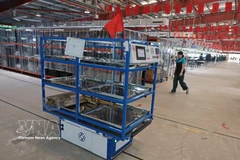
Robots automatically transport materials from the warehouse to the production line at Maxport Limited Vietnam (Photo: VNA)

Ho Chi Minh City’s industrial sector draws wave of technology investment

Ho Chi Minh City targets a 10.5% increase in the Index of Industrial Production (IIP) in 2026. To this end, the sector will roll out measures such as promoting industrial trade in overseas markets, strengthening supply-demand linkages, supporting supporting industries to raise localisation rates, and organising supplier-matching events.

At the tourism promotion conference for the Mekong Delta held in Malaysia on March 18. Photo: VNA)

Mekong Delta tourism targets Malaysian market

To truly attract Malaysian visitors, tourism services in the Mekong Delta must pay close attention to cuisine. Malaysian tourists, particularly Muslims, are highly concerned about the availability of Halal food. This is considered a “key” for Mekong Delta provinces to effectively welcome Muslim travellers.

FrieslandCampina’s plant – one of Asia's pioneering facilities in adopting a green production model. (Photo: VNA)

Green exports reshape rules of global trade

Vietnam is gradually recalibrating its overseas market development strategy to align export expansion with sustainable development goals. Market development should not only sustain export growth but also help unlock new growth spaces while strengthening the long-term sustainability of exports.

Overseas remittances are viewed as an important resource for socio-economic development. (Photo: VNA)

Ho Chi Minh City steers remittances into technology, innovation

Ho Chi Minh City targets mobilising at least 500 billion VND from remittances and social resources by 2026, while supporting at least 100 enterprises in accessing preferential credit. By 2027, the figure is expected to reach at least 1 trillion VND, with the number of supported firms doubling, including at least 30% of projects in green technology, energy efficiency, and emissions reduction.

A key highlight of the new social housing framework is a range of incentives designed to attract private sector participation. (Photo: VNA)

New policy framework boosts social housing development

The adjusted decree provides detailed and synchronised regulations covering the entire lifecycle of social housing projects, from project preparation and investor selection to incentive mechanisms, as well as procedures for sale, lease-purchase and operational management. It also applies to worker accommodation and housing for armed forces personnel.

The domestic market, with over 100 million people, holds great potential for Vietnamese businesses. (Photo: VNA)

“Vietnamese Goods Vitality” event boosts domestic consumption, digital outreach

The event is among a series of initiatives planned for 2026 to stimulate the consumption of locally made products. Beyond serving as a showcase for goods, it is designed as a platform connecting businesses, consumers and key opinion leaders (KOLs), thereby enhancing the visibility of Vietnamese brands amid rapid digital transformation.