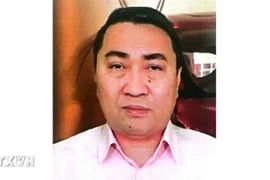
Hanoi (VNA) - The People’s Court of Hanoi on December 31 sentenced Nguyen Van Dai to 17 years in prison for “making, storing, distributing, spreading information and documents aimed at sabotaging the State of the Socialist Republic of Vietnam” under Clause 2, Article 117 of the Penal Code.
Dai, born in 1969, a Vietnamese national, had his last permanent residence in Bach Mai ward of Hanoi and is currently residing in Germany. Before this case, he had two criminal convictions. In November 2007, he was sentenced to four years' imprisonment and four years’ probation for “conducting propaganda against the State of the Socialist Republic of Vietnam” under Article 88 the 1999 Penal Code, a conviction for which his criminal record has not been expunged. In April 2018, the Hanoi People’s Court sentenced him to 15 years in prison and five years’ probation for “activities aimed at overthrowing the people’s administration” in lien with Article 79 of the 1999 Penal Code. He was later granted a temporary suspension of his prison sentence under a court decision issued in June 2018. The court ruled to combine the remaining sentence of 12 years, six months and eight days from the 2018 judgment with the new sentence, forcing Dai to serve a total of 29 years, six months and eight days in prison. The prison term will be calculated from the date of enforcement.
As an additional penalty, the court imposed five years of probation, consolidated with the probation penalty under the 2018 judgment, to be served after completion of the prison term. In this case, Dai is wanted by the Ministry of Public Security’s Investigation Security Agency under a wanted notice issued on December 5, 2025. The Hanoi People’s Court called on Dai to surrender and appear in court to exercise his right to self-defence. As he failed to do so, the court conducted the trial in absentia in accordance with the law.
All legal procedures in the case were announced through the mass media. The court also appointed lawyers to defend Dai.
According to the indictment by the Supreme People’s Procuracy, from July 21 to November 7, 2025, Dai used nine accounts and channels to create, post and disseminate numerous articles and video clips on social media containing distorted and defamatory content against the people’s administration, fabrications and misinformation aimed at causing public anxiety and opposing the State of the Socialist Republic of Vietnam. Among these materials, 11 videos and one article were concluded to contain such violations.
The court found that Dai’s actions seriously infringed upon national security, caused public concern, and affected Vietnam’s reputation in the international arena. The first-instance judgment affirmed that the indictment was well-founded and lawful, describing the case as particularly serious. The ruling held that a strict sentence was necessary to punish the offender and serve as a deterrent and general prevention measure.
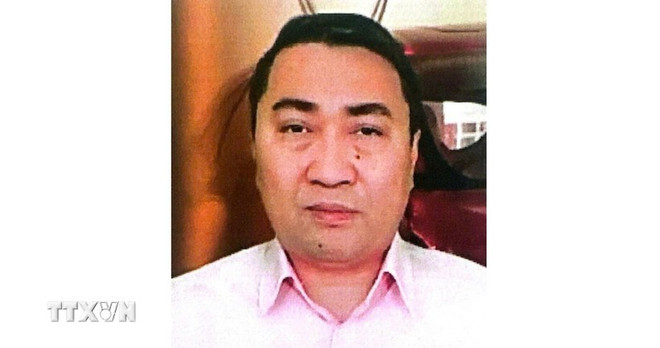
Also on December 31, the Hanoi People’s Court also opened a first-instance trial of defendant Le Trung Khoa (born in 1971, of Vietnamese nationality. His last permanent residence before departure was in Dong Da ward, Hanoi, and he is currently residing in Germany.
There are also three co-defendants, all prosecuted by the Supreme People’s Procuracy for “making, storing, distributing, and spreading information and documents, aimed at sabotaging the State of the Socialist Republic of Vietnam” under Article 117 of the Penal Code. The court sentenced Le Trung Khoa to 17 years in prison. The other defendants - Do Van Nga (born in 1977, residing in Gia Lai province), Huynh Bao Duc (born in 1984, residing in Ho Chi Minh City), and Pham Quang Thien (born in 1978, residing in Hanoi) to seven years’ imprisonment, six years and six months in jail, and five years and six months, respectively, for the same offence.
Among the four defendants, Khoa is subject to a wanted notice issued by the Ministry of Public Security’s Investigation Security Agency on December 5, 2025. The Hanoi People’s Court called on him to surrender and appear in court to exercise his right to self-defence. As he failed to do so, the court conducted the trial in absentia in accordance with the law. A lawyer was also appointed to defend Khoa.
According to the indictment, since 2016, Khoa had used 12 pages and channels to post numerous articles and video clips on social media containing distorted and defamatory contents against the people’s administration, fabrications causing public anxiety, and material smearing the reputation of Party and State leaders, to oppose the State of the Socialist Republic of Vietnam.
Of the materials examined, authorities concluded that 21 video clips and 10 articles contained such violations. Although aware of the unlawful nature of the contents and its anti-State purpose, the co-defendants Nga, Duc and Thien nevertheless assisted Khoa by writing articles, editing videos or performing other supporting tasks. Specifically, Nga wrote nine articles, Duc edited and inserted images into four video clips, and Thien wrote one article.
The trial panel held that the indictment was well-founded and lawful. It found that the defendants’ acts seriously infringed upon national security and negatively affected social order and safety, particularly in cyberspace. Khoa was identified as the mastermind and ringleader, directly posting and disseminating the majority of the illegal contents, while the other defendants acted as accomplices.
The court concluded that the offences were particularly serious, causing social concern and harming Vietnam’s reputation in the international arena, and that strict penalties are necessary to uphold the rule of law, educate the offenders and serve as a general deterrent./.