📝 OP-ED: Planned hospital fee waiver – A big step forward in ensuring social welfare for all

​Universal hospital fee exemption will bring sweeping benefits including improved access to healthcare, earlier detection and treatment of illnesses, more efficient use of health financing, and reduced financial pressure on households.

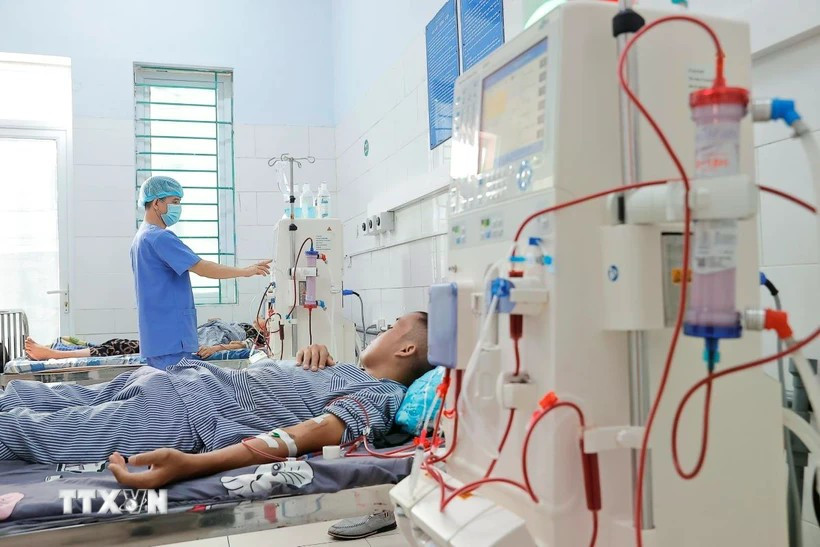
Patients receive hemodialysis at Ha Giang provincial General Hospital. (Photo: VNA)

Hanoi (VNA) - Following a recent decision to abolish tuition fees for all public school students, Vietnam is preparing to take another historic step, waiving hospital fees for the entire population, aiming to ensure the benefits of socio-economic development are directly enjoyed by all citizens.

At a recent meeting with the Government’s Party Committee and central agencies responsible for public health, Party General Secretary To Lam tasked the Government’s Party Committee with drafting a roadmap to gradually reduce the financial burden of healthcare. The aim is to implement universal hospital fee exemption between 2030 and 2035.

According to Deputy Minister of Health Tran Van Thuan, universal hospital fee exemption will bring sweeping benefits including improved access to healthcare, earlier detection and treatment of illnesses and more efficient use of health financing. With reduced financial pressure on households, this would in turn, contribute to poverty reduction, enhanced labour productivity and promote stronger GDP growth.

In the shorter term, from 2026 to 2030, the Ministry of Health plans to ensure that 90% of the population has full access to preventive services, including vaccinations, reproductive and maternal-child health, mental health support, school-based healthcare and regular screenings. Universal annual health check-ups are also planned, supported by electronic health records to manage individual health over a lifetime.
kham-benh.jpg
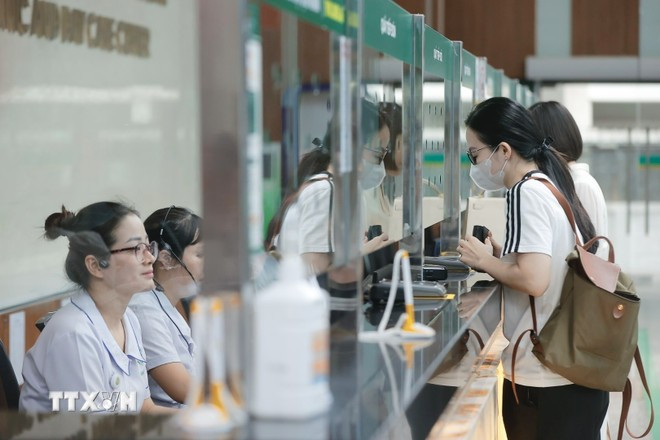
People register medical treatment and examination services at a hospital. (Photo: VNA)

By 2035, with a projected population of 100 million and an estimated cost of 250,000 VND (9.6 USD) per check-up, the annual State budget required for basic health screening would be around 25 trillion VND (962.47 million USD).

Looking further ahead to 2045, Vietnam aims to build a health system that meets all public needs for care, protection and well-being, one that eliminates out-of-pocket payments for insured medical services and places the country among the world’s leading nations in health-related social security.

This universal healthcare policy follows in the wake of another major welfare reform.

On February 28 this year, the Politburo decided to waive tuition fees for all children in public schools, from three-month-old infants in nursery care, through to high school students, starting with the 2025–2026 academic year. The measure will cost the state approximately 30 trillion VND annually.

For the current 2024–2025 school year, Vietnam has about 23.2 million students.

Education has long been a top priority for the Party and State.

Annual spending on education amounts to between 17 - 19% of the national budget, higher than in many more developed countries, such as the United States (13%) and Indonesia (17.5%) and close to Singapore (19.9%).

A resolution, issued in 2013, set the target for education spending at a minimum of 20% of the budget. In 2024, Vietnam allocated nearly 381 trillion VND to education and training.

Vietnam achieved universal kindergarten education for five-year-olds in 2017. Today, all 63 provinces and cities meet national standards for primary education coverage.

Alongside education, Vietnam’s healthcare system has received substantial investment.

Since 2008, public health spending has accounted for between 7-8% of the State budget. Overall healthcare spending, including private expenditure, has consistently reached 6% of GDP since 2015.

As of 2024, the country had nearly 432,000 health professionals, with a ratio of 14 doctors per 10,000 people. There are 1,645 hospitals nationwide, including 34 at the central level and nearly 500 at the provincial level. Life expectancy has risen dramatically, from 38 years in 1945 to 60 in the late 1970s, and to 74.5 years today.
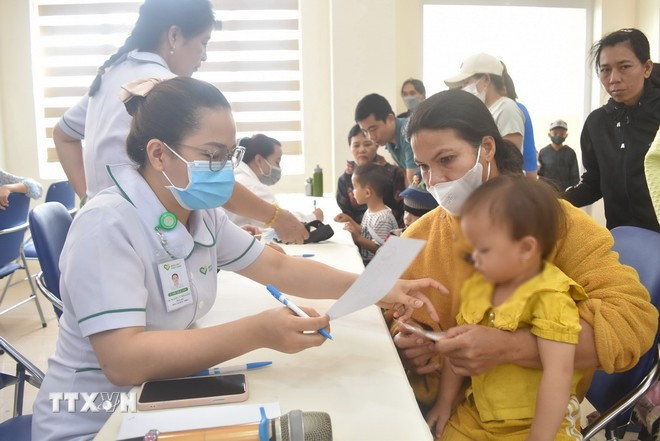
tre-em-kham-benh-2627.jpg
Children get health checkups (Photo: VNA)

This progress reflects the broader economic transformation of the nation.

In 1974, the combined economy of the northern and southern regions was worth under 22 billion USD.

During 1976–1980, GDP growth was just 1.4% annually, with a contraction in 1980.

By 2024, GDP had surged to 476.3 billion USD, nearly 129 times the 1975 figure, making Vietnam the world’s 24th-largest economy by purchasing power parity.

According to IMF forecasts, GDP will reach 506 billion USD in 2025. Average income rose from just 96 USD in 1989 to 1,120 USD in 2009, marking Vietnam’s rapid transition to middle-income status.

In 2024, per capita GDP reached 4,700 USD, 58.75 times higher than in 1975. The country now ranks fifth in Southeast Asia, 14th in Asia, and 33rd globally in terms of GDP.

The above figures demonstrate the policy of the Party and State - developing the country is for the people to enjoy, in the spirit of the speech of General Secretary To Lam at the conference on deploying tasks for 2025 for the Government and local authorities on January 8, 2025: "The fruits of growth must come to all people in a harmonious, fair, equal, and encouraging way for development."

The policy of "rich people - strong country" was affirmed by President Ho Chi Minh right after the Democratic Republic of Vietnam was founded.

In the "Letter to the People's Committees of regions, provinces, districts and villages" published in the Cuu Quoc (National Salvation) Newspaper on October 17, 1945, he clearly stated: "If the country is independent but the people do not enjoy happiness and freedom, then independence is meaningless."

The documents of the 13th National Party Congress (January and February 2021) added the phrase "people benefit" to the already familiar motto of action "people know, people discuss, people do, people check, people supervise" to become "people know, people discuss, people do, people check, people supervise, people benefit"./.
VNA

See more

A police officer guides a citizen on how to use VNeID app. (Photo: VNA)

Shift to data-driven administrative procedures needs acceleration

Under a draft decree replacing Decree 63, authorities will have to proactively pull information from databases and records for informational or technical procedures. Applicants would no longer be required to resubmit documents, and certification or information requests could not be turned into discretionary licensing through an “ask – give” mechanism.

Cuban journalist Luis Manuel Arce Isaac, author of the article published in Mexico’s Voces del Periodista magazine. (Photo: Screenshot/VNA)

Mexican journalist praises Vietnam’s profound transformation

According to the article, Vietnam’s progress over the past decades has turned President Ho Chi Minh’s aspiration for a country that would be more dignified and more beautiful into reality in ways that have far exceeded what was initially envisioned.

The Liaison Board of the Vietnamese Community in Singapore organises the annual Mid-Autumn Festival to strengthen community bonds and spread Vietnamese language and culture. (Photo: VNA)

Continued efforts made to nurture love for homeland through mother tongue

From language classrooms and community activities to digital platforms, Vietnamese is being preserved through increasingly diverse approaches. More than a means of communication, the mother tongue carries memories, culture and affection for the homeland. Ensuring that Vietnamese remains naturally present in the daily lives of overseas Vietnamese is therefore an important way to nurture their lasting bond with the Fatherland.

Deputy General Director of the Vietnam News Agency Doan Thi Tuyet Nhung (fifth, right) and representatives of regional news agencies and media organisations attend the launch of the Asia-Pacific Media Partnership Organising Committee at the Asia-Pacific Media Forum. (Photo: VNA)

VNA attends Asia-Pacific Media Forum in Shenzhen

Participants in the forum highlighted the need to increase coverage of the region's rapid opening-up and integration, provide comprehensive information on the progress and achievements of cooperation among economies across various fields, and help create a favourable environment for regional development.

Ngo Phuong Ly (right), the spouse of General Secretary of the Communist Party of Vietnam Central Committee and President To Lam, and Kyu Kyu Hla, the spouse of Myanmar President Min Aung Hlaing, visit Van Phuc silk village on September 5. (Photo: VNA)

First ladies of Vietnam, Myanmar visit Van Phuc silk village

Ngo Phuong Ly, the spouse of General Secretary of the Communist Party of Vietnam Central Committee and President To Lam, said the two countries share similarities in silk weaving and can enrich their cultural heritage through exchanges and experience sharing.

Prime Minister Le Minh Hung join students and teachers of the Muong Khuong Inter-level Primary and Secondary Boarding School, Lao Cai province, in the opening ceremony of the 2026–2027 academic year on September 5. (Photo: VNA)

PM urges substantive education reform in 2026–2027 school year

PM Le Minh Hung called on the education sector to continue making strong changes in management mindset and teaching methods, putting learners at the centre, and viewing schools as the foundation, teachers as the driving force, families as a source of support and society as a resource accompanying education development.

General Secretary of the Communist Party of Vietnam Central Committee and President To Lam (Photo: VNA)

Top leader extends message to education sector on new school year

Party General Secretary and President To Lam expressed confidence that with the nation’s traditional fondness for learning, the dedication of teachers and the aspirations of the younger generation, the 2026–2027 academic year will open a new chapter of progress for the country’s education sector.

Students attend the opening ceremony for the 2026–2027 academic year at the primary school campus of the Gia Quat Primary and Secondary School in Hanoi on September 5, 2026. (Photo: VNA)

Students across Vietnam begin 2026–2027 academic year

This milestone school year marks a pivotal transition from laying the groundwork for reform to delivering substantive changes as the country pushes ahead with implementing Politburo Resolution No. 71-NQ/TW on breakthroughs in education and training development.

Team K91 members depart to carry out their mission. (Photo: VNA)

Search efforts continue for Vietnamese fallen soldiers in Cambodia

During the 2026-2027 dry season, Teams K70, K71, K72 and K73 will continue their search and repatriation mission, striving to fulfil the target based on 185 pieces of information concerning 761 graves. Each team is expected to collect at least 100 sets of remains during each deployment.

Mai Nguyen Tuyet Hoa, First Secretary in charge of education affairs at the Vietnamese Embassy in Russia speaks at the closing ceremony (Phôt: VNA)

AI application boosts Russian language training in Vietnam

The programme introduced updated methods for teaching Russian as a foreign language while focusing on the application of digital technology and AI in lesson design to enhance the professional capacity and adaptability of Russian-language teachers amid changes in modern education.