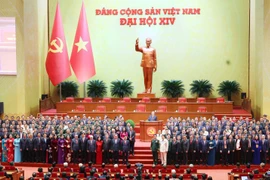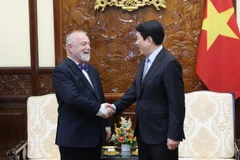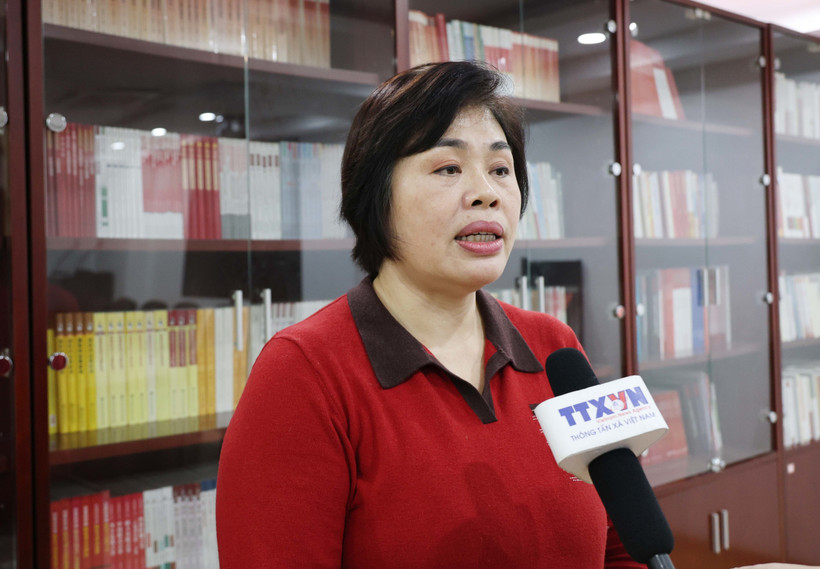
Hanoi (VNA) – Relationship between the Communist Party of Vietnam (CPV) and the Communist Party of China (CPC) constitutes a crucial component of overall Vietnam – China relations, playing a leading political and strategic role, according to Professor Pan Jin’e, a senior researcher at the Academy of Marxism under the Chinese Academy of Social Sciences (CASS).
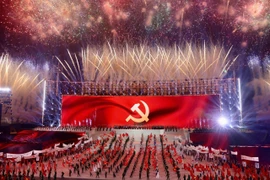
In an interview with VNA correspondents in Beijing, Professor Pan noted that the political report of the 13th Party Central Committee to the 14th National Party Congress of the CPV identifies Party-to-Party relations as one of the core pillars of Vietnam’s diplomacy. This strategic orientation represents both a continuation of the country’s policy of independence, self-reliance and multilateral cooperation, while adding strategic autonomy during the 14th Party term, including the formation of a three-tier Party-to-Party cooperation framework.
Based on the outcomes of the 14th National Party Congress and the practical progress made over the past two years in building the Vietnam – China community with a shared future of strategic significance, Professor Pan said that relations between the two Parties are expected to maintain strong momentum and continue playing a guiding role.
She added that future Party-to-Party exchanges are likely to shift from theoretical understanding to mutual learning in governance experience, while the focus of bilateral relations will evolve from maintaining shared ideology to fostering strategic cooperation.
Professor Pan stressed that the diplomatic orientation set out by the 14th National Party Congress is well aligned with efforts to deepen Vietnam – China relations. As friendly socialist neighbours, Vietnam and China are working to further substantiate the Vietnam – China community with a shared future in a more practical and in-depth manner. This not only reflects Vietnam’s commitment to multilateralisation and diversification in its foreign relations, but also helps enhance its voice in regional and global governance through bilateral cooperation.
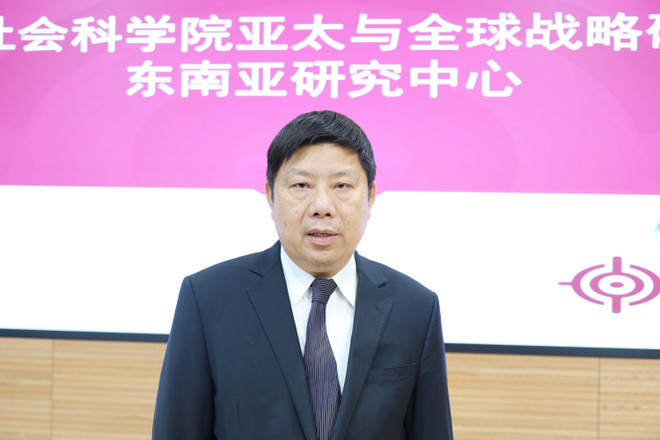
Meanwhile, Professor Xu Liping, Director of the Centre for Southeast Asia Studies at the Institute of Global and Asia-Pacific Studies under CASS, said Vietnam – China relations are currently at their best since the establishment of diplomatic ties.
He underlined the need for the two Parties to strengthen Party-to-Party exchanges to elevate bilateral relations to a new level and make the community with a shared future more substantive and effective.
Xu outlined several priorities, including intensifying top-level diplomacy and maintaining reciprocal visits between the General Secretaries of the two Parties, and enhancing exchanges on governance to continuously innovate Party leadership theory and safeguard the Party’s ruling capacity.
He also proposed deepening training and capacity-building cooperation for Party members and cadres to strengthen leadership competence, integrity and effectiveness, and promoting exchanges on revolutionary traditions, particularly by organising systematic study visits for young Party members to historical revolutionary sites in both countries./.