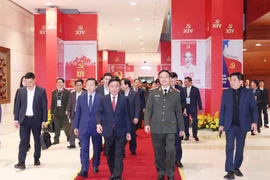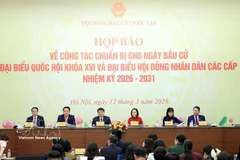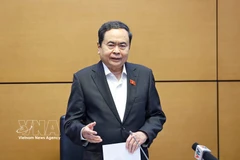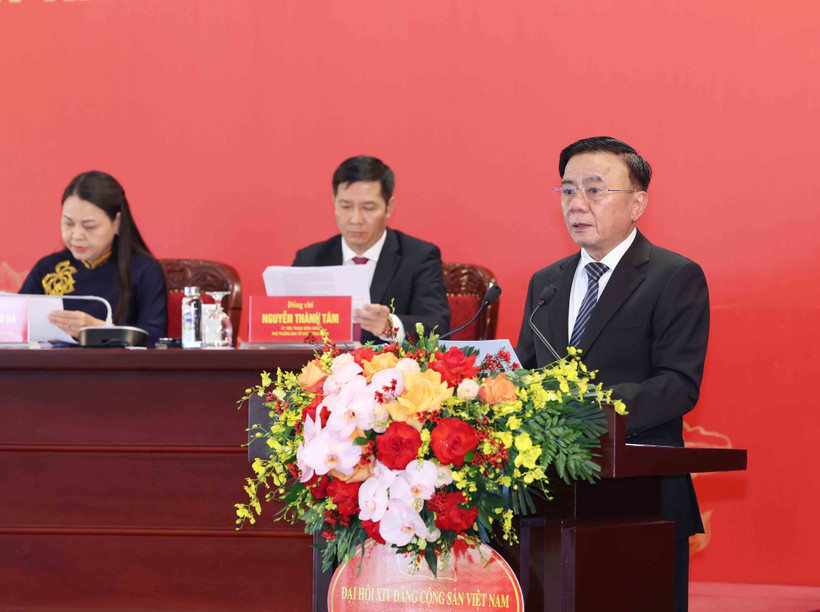
Hanoi (VNA) – The personnel preparation for the 14th Party Central Committee has been carried out in the principle of democratic centralism and a coordinated, scientific and transparent manner, ensuring a balance between standards and structure, Politburo member and Permanent member of the Party Central Committee’s Secretariat Tran Cam Tu said on January 14.
Tu, who is also head of the organising sub-committee of the 14th National Party Congress, made the affirmation at an international press conference on the congress, scheduled for January 19–25, with the participation of 1,586 delegates representing more than 5.6 million Party members nationwide.
According to the official, the congress will discuss and adopt key documents, including the political report of the 13th Party Central Committee; a report reviewing theoretical and practical issues of Vietnam’s socialist-oriented renewal process over the past 40 years; another summarising 15 years of implementation of the Party statutes from 2011 to 2025 and proposing directions for its amendment and supplementation; along with a report reviewing the leadership and direction of the 13th Party Central Committee.
He said under the decisive direction of the Party Central Committee, the Politburo and the Secretariat, led directly by Party General Secretary To Lam, the preparatory work for the upcoming congress has been completed with a spirit of renewal.
The official highlighted the integration of three reports - the political report, the socio-economic report and the Party-building report - into a single, unified political report.
Notably, for the first time, the documents are accompanied by action programmes, ensuring the Resolution can be rolled out immediately after the congress. The draft documents were circulated for public consultation, drawing nearly 14 million contributions, underscoring strong alignment between the Party’s will and public support, he said.
Tu emphasised that the quality and effectiveness of work outputs, as well as officials’ contributions, would serve as key benchmarks in evaluating, assigning and deploying personnel.
He affirmed that preparations have been largely completed, with logistical arrangements carefully put in place.
Security and safety measures have been implemented decisively and comprehensively, while information and communications efforts were rolled out early, helping reinforce confidence among officials, Party members and the public in the congress, foster unity within the Party and build broad social consensus.
Affirming that Vietnam always values the goodwill and support of international friends, the official said formal notifications have been sent to political parties and diplomatic missions have been invited to the opening and closing sessions.
On the media front, about 600 domestic journalists and nearly 80 international reporters are expected to cover the congress.
Politburo member, President of the Ho Chi Minh National Academy of Politics (HCMA), and Chairman of the Central Theory Council Nguyen Xuan Thang outlined the new features of the congress.
He said rather than focusing solely on economic institutions, the congress documents take a more comprehensive approach, extending to culture, society, people, national defence and security, foreign affairs, Party building, and the political system, he said.
On the goal of rapid and sustainable national development, he said the concept carries several new elements, notably a stronger emphasis on environmental issues. He highlighted three key pillars - economy, society and environment - alongside the role of cultural identity and political stability.
Another notable and overarching new element in the draft documents is the establishment of a clearly defined new growth model designed to adapt to major global shifts, including digital transformation, green transition, energy transition and changes in human resources.
The draft documents also set out new development perspectives related to culture and people - not only as the spiritual foundation, endogenous strength and driving force of national development - and, for the first time, underscore national defence and security, alongside foreign affairs and deeper integration, as core and ongoing priorities, Thang said./.
VNA