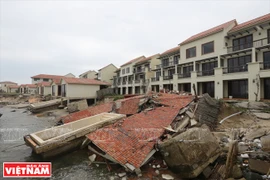
A beach resort on Cua Dai beach is damaged by erosion. The most beautiful beach in Hoi An has been eroded on an 8km section since 2004. Illustrative image (Photo: VNA)
 Quang Nam (VNS/VNA) - Theappearance of a 15ha sandbank, 1.8km off the Cua Dai Beach since early thisyear offers a chance to research changing riverhead flows and sandsedimentation at lower lands, according to experts.
The emergence of the sandbank could lead to solutions to help save Cua DaiBeach, 5km from UNESCO-recognised world heritage site Hoi An city, from seriouserosion over past decades.
Representatives of central Quang Nam province and the Ministry of Natural Resourcesand Environment, in cooperation with experts from the Netherlands, surveyed thesandbank on Thursday, and scientific seminars will be held in the coming time toseek solutions to stop the erosion of Cua Dai Beach.
Vice Chairman of Hoi An people’s committee, Nguyen The Hung, said the city andthe central natural disaster prevention agency would set up an observationsystem on the sandbank within the next year.
Hung said effective solutions on stopping beach erosion will be based onscientific conclusions on the riverhead flow and sand sediment process.
According to Quang Nam province, the sandbank developed due to the Thu Bon Riversystem and was badly affected by climate change as well as a rising sea level.
Experts said the sandbank, 1km long and 200m wide, was 2m higher than sealevel, and grass was found growing on the sand.
They said sand sediment possibly kept moving southward of Cua Dai Beach in thearea of Duy Hai commune of Duy Xuyen district.
Cua Dai Beach, one of the most beautiful beaches in Hoi An, has been eroded ona section of 8km from 2004, in which a 3km section is seen as serious and willwash away soon.
Experts said the beach erosion partly resulted from the development of 33 beachresorts on a 62km coast line from Tien Sa Beach (in Da Nang) to Quang Nam.
The rapid building of 42 hydro-power plants on the riverhead system in QuangNam also prevented sand sedimentation at lower river areas.
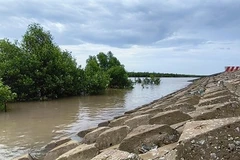
The province built up a 1.3km concrete dyke system, Geotube sandbag dyke and70,000cu.m of sand and sludge filling up the beach to protect the coast fromdamage.
A latest report from the city showed that 20ha of public beach has been washedaway due to rising sea levels and changes to the river flow in the Thu Bon Riverestuary since 2013.
Hoi An and the Agency for Development of France (AFD) conducted a survey ofbeach nourishment of Cua Dai in 2018.
French-Vietnamese architect Bui Kien Quoc blamed the erosion on theconstruction of resorts on the beach and the lack of proper environmentalassessments before dredging the Thu Bon estuary.
The city has been seeking funds to replant 140ha of Nipa palm (a species ofpalm native to the coastlines) along the Thu Bon River to reduce sand erosionin Cua Dai beach.
Cua Dai beach stretched out 200m just 10 years ago, but now it has narrowed to40m due to erosion. — VNS/VNA
VNA