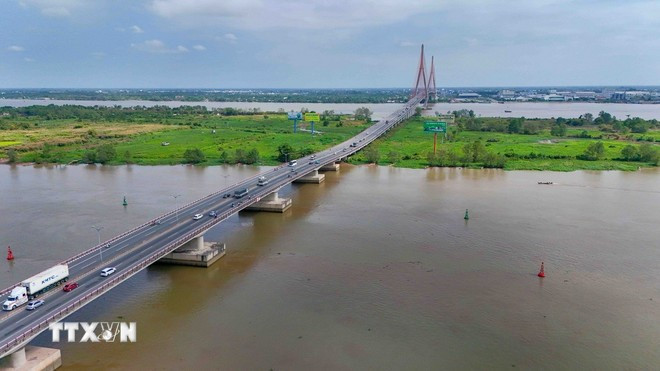
HCM City (VNA) - In the near future, after the reorganisation and merger, the Mekong Delta region will have six provincial-level administrative units, down from the current 13. These newly formed localities are expected to better harness the region's potential and advantages to accelerate development.
Maximising dual advantages
According to the national policy on administrative unit reorganisation, the southwestern region will form five provinces and one centrally-run city: Tay Ninh (merging Tay Ninh and Long An), Dong Thap (merging Dong Thap and Tien Giang), Vinh Long (merging Ben Tre, Vinh Long, and Tra Vinh), An Giang (merging Kien Giang into An Giang), Ca Mau (merging Bac Lieu into Ca Mau), and Can Tho City (merging Soc Trang and Hau Giang into Can Tho).
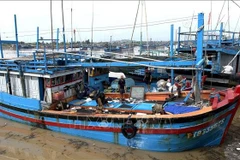
All six newly formed localities share common strengths, with large, fertile plains mainly located within the Mekong River basin, as well as other rivers like the Vam Co and Soai Rap rivers. Notably, most of these localities have coastlines. Dong Thap, Vinh Long, and Can Tho have access to the East Sea, while An Giang faces the West Sea. Ca Mau, on the other hand, has access to both the East and West Seas. Most coastal areas in the region have set the goal of developing sea-based economy as a key industry, with Ca Mau and Kien Giang (soon to be part of new An Giang province) being planned as the nation’s major centres for the maritime economy by 2030, with a vision toward 2050.
Dr. Nguyen Thi Thuy Phuong, Director of the Mekong Institute for Application of Science Technology and Training (MEFAST), analysed that the plain and the sea are dual advantages that the newly formed localities in the Mekong Delta must capitalise on and fully tap. This is a special advantage, with fertile agricultural land for large-scale farming, available land for industrial and construction development, and a long coastline that is conducive to developing the maritime economy. This will help expand the region's transportation and logistics infrastructure, better connecting the region to the East Sea and improving links with regional hubs such as Ho Chi Minh City and Can Tho.
Innovating management organisation for new development spaces
The merger of two or three localities into a new province or city requires a transformation in management methods and operational structures. According to experts, the new management system needs to be flexible, with a focus on harmoniously developing both surrounding and central areas. Development planning and spatial organisation should follow functional regional zoning, rather than dividing provinces and city based on old administrative boundaries. The new province could be organised according to a "dynamic triangle" model.
As for newly merged Vinh Long province, the central part could be planned as existing Vinh Long province, with administrative, logistics, and coordination functions, while the coastal gateway area could be the territory of Tra Vinh province, focusing on the development of renewable energy industries, seaports, and fisheries, and the agricultural and ecotourism area could be Ben Tre province where the focus would be on fruit cultivation, rural and ecological tourism, agriculture, and rural development, said Phuong.
The limitation in human resources was also highlighted by Nguyen Van Ut, Chairman of the Long An provincial People's Committee, in his general assessment of Long An and Tay Ninh. He noted that in recent times, the two provinces have brought into full play their advantages to achieve positive results in economic development. However, there are still challenges and limitations, especially infrastructure "bottlenecks", which fails to meet development needs, especially in terms of transportation infrastructure capable of linking inter-provincial and regional areas.
The demand for investment capital is huge, yet mobilising resources remains difficult. Additionally, the high-quality human resources needed for development are still insufficient, Ut pointed out.
The integration of each locality's advantages to create dual advantages for the six new Mekong Delta localities will provide a solid foundation for forming large-scale production, supply, and logistics chains.
The connection of resources within and outside the region, both domestically and internationally, is expected to contribute to enhancing competitiveness, improving the workforce quality, attracting investment, and driving the economic development of the Mekong Delta region, enabling it to grow faster and catch up with other economic regions across the country./.