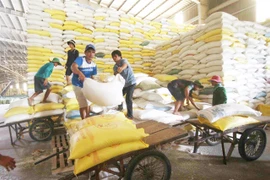
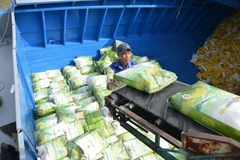
Rice for export being stockpiled at SongHau Food Company in Can Tho city (Photo: VNA)
 Hanoi (VNS/VNA) - High hopes are pinned on Vietnam’s rice exports in2021 when major export markets such as the Philippines and Africa continue tosign contracts to buy rice from Vietnam, while many others have greatdemand for fragrant rice and sticky rice – which are advantageous staplesof Vietnamese enterprises.
Thebilateral and multilateral free trade agreements between Vietnam and othercountries such as the EU-Vietnam and the UK-Vietnam FTAs with preferential tariffswould create favourable conditions for Vietnamese rice to compete withthat from rival countries, the Vietnam Food Association said.
Accordingto the Vietnamese Trade Counsellor in the UK Nguyen Canh Cuong, rice shipmentsto the country this year will sharply rise against 2020. He added more UK firmswill purchase Vietnamese rice under the UK-Vietnam FTA, creating a chance forVietnamese rice to expand its market share in the UK this year.
In2019, rice exports from Vietnam to the UK had a leap forward with a turnovergrowth of 376 percent. That meant the UK has great potential as a rice exportmarket for Vietnam.
Inorder to tap into the advantages under FTAs, rice export giants suchas Intimex JSC, Loc Troi Group, VRICE Co, Trung An High Technology AgricultureJSC are planning to seek new customers in markets where Vietnam hadsigned FTAs, especially in the UK.
TheMinistry of Industry and Trade said it would provide riceexport firms with information about the market demand situation in atimely manner while implementing trade promotion activities to help Vietnameserice exporters better access customers.
Detailed informationabout the regulations and barriers under these FTAs’ commitments will be alsooffered by the ministry so that businesses can improve theirunderstanding and draw up suitable business plans.
Aspart of its efforts to facilitate Vietnam's rice exports, the VAF has built uponline sales channel and participated in online trade seminars todevelop the rice industry.
Itsuggested rice exporters focus on high quality products with good exportresults, ensuring food hygiene and safety to be able to enter fastidiousmarkets such as Europe, America and Canada.
Expertshave said that if Vietnam wants to maintain rice export growth in 2021 it needsto focus on building a complete rice value chain and controlling quality inproduction, processing, and distribution.
Accordingto the Ministry of Agriculture and Rural Development, Vietnam’s rice outputtotalled 42.8 million tonnes in 2020, down about 0.2 percent because of theshrinkage of some 192,000 hectares in farming areas. However, the productivityrose 50kg per hectare from a year earlier.
Theareas of high-grade rice varieties have expanded to 74 percent, compared to 50 percentin 2015, as a result of the country’s efforts in improving the value ofthe Vietnamese rice.
Thanksto that, the shipments of high-grade rice made up more than 85 percent of thetotal, resulting in the growth of average rice price from 440 USD pertonne in 2019 to 496 USD per tonne in 2020.
Thecountry exported 6.15 tonnes of rice for 3.07 billion USD last year, down3.5 percent in volume but up 9.3 percent in value year-on-year.
ThePhilippines was Vietnam's leading rice importer, making up 34 percent ofthe total. Rice exports to this market in 2020 reached 2.22 million tonnesand 1.06 billion USD, up 4 percent in volume and 19.3 percent invalue compared to 2019.
Otheroutlets with significant export growth in 2020 were Indonesia,(nearly triple 2019's figure) and China, up 93 percent year-on-year.
VFAVice Chairman Do Ha Nam described 2020 as a successful year for Vietnam’srice exports, which he attributed to increasing demand in many countries andthe improved competitiveness of Vietnamese rice around the world.
Amidthe difficulties posed by the ongoing COVID-19 pandemic, rice exporters quicklymade appropriate adjustments and actively sought new markets while fullytapping into the advantages brought about by FTAs.
TheEU-Vietnam FTA had created a major opportunity for Vietnamese rice toenter European markets and then make inroads into other choosy markets, Namsaid./.
Thebilateral and multilateral free trade agreements between Vietnam and othercountries such as the EU-Vietnam and the UK-Vietnam FTAs with preferential tariffswould create favourable conditions for Vietnamese rice to compete withthat from rival countries, the Vietnam Food Association said.
Accordingto the Vietnamese Trade Counsellor in the UK Nguyen Canh Cuong, rice shipmentsto the country this year will sharply rise against 2020. He added more UK firmswill purchase Vietnamese rice under the UK-Vietnam FTA, creating a chance forVietnamese rice to expand its market share in the UK this year.
In2019, rice exports from Vietnam to the UK had a leap forward with a turnovergrowth of 376 percent. That meant the UK has great potential as a rice exportmarket for Vietnam.
Inorder to tap into the advantages under FTAs, rice export giants suchas Intimex JSC, Loc Troi Group, VRICE Co, Trung An High Technology AgricultureJSC are planning to seek new customers in markets where Vietnam hadsigned FTAs, especially in the UK.
TheMinistry of Industry and Trade said it would provide riceexport firms with information about the market demand situation in atimely manner while implementing trade promotion activities to help Vietnameserice exporters better access customers.
Detailed informationabout the regulations and barriers under these FTAs’ commitments will be alsooffered by the ministry so that businesses can improve theirunderstanding and draw up suitable business plans.
Aspart of its efforts to facilitate Vietnam's rice exports, the VAF has built uponline sales channel and participated in online trade seminars todevelop the rice industry.
Itsuggested rice exporters focus on high quality products with good exportresults, ensuring food hygiene and safety to be able to enter fastidiousmarkets such as Europe, America and Canada.
Expertshave said that if Vietnam wants to maintain rice export growth in 2021 it needsto focus on building a complete rice value chain and controlling quality inproduction, processing, and distribution.
Accordingto the Ministry of Agriculture and Rural Development, Vietnam’s rice outputtotalled 42.8 million tonnes in 2020, down about 0.2 percent because of theshrinkage of some 192,000 hectares in farming areas. However, the productivityrose 50kg per hectare from a year earlier.
Theareas of high-grade rice varieties have expanded to 74 percent, compared to 50 percentin 2015, as a result of the country’s efforts in improving the value ofthe Vietnamese rice.
Thanksto that, the shipments of high-grade rice made up more than 85 percent of thetotal, resulting in the growth of average rice price from 440 USD pertonne in 2019 to 496 USD per tonne in 2020.
Thecountry exported 6.15 tonnes of rice for 3.07 billion USD last year, down3.5 percent in volume but up 9.3 percent in value year-on-year.
ThePhilippines was Vietnam's leading rice importer, making up 34 percent ofthe total. Rice exports to this market in 2020 reached 2.22 million tonnesand 1.06 billion USD, up 4 percent in volume and 19.3 percent invalue compared to 2019.
Otheroutlets with significant export growth in 2020 were Indonesia,(nearly triple 2019's figure) and China, up 93 percent year-on-year.
VFAVice Chairman Do Ha Nam described 2020 as a successful year for Vietnam’srice exports, which he attributed to increasing demand in many countries andthe improved competitiveness of Vietnamese rice around the world.
Amidthe difficulties posed by the ongoing COVID-19 pandemic, rice exporters quicklymade appropriate adjustments and actively sought new markets while fullytapping into the advantages brought about by FTAs.
TheEU-Vietnam FTA had created a major opportunity for Vietnamese rice toenter European markets and then make inroads into other choosy markets, Namsaid./.
VNA