Room for green economic development from forest carbon credits

As climate change intensifies and the global push toward net-zero emissions gathers pace, Vietnam is gradually shaping its carbon market, with forestry identified as a key pillar thanks to forests’ long-term capacity to absorb and store carbon dioxide. With extensive forest resources, Gia Lai province is emerging as a locality with strong potential to develop forest carbon credits, helping turn ecological assets into drivers of green economic growth.

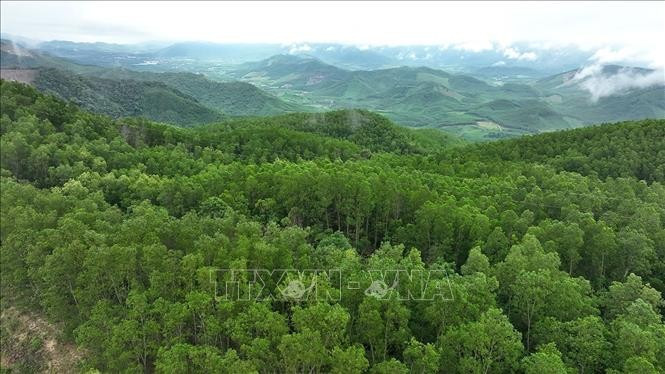
An area of large-timber plantation forest in Van Canh commune under the management of the Van Canh Forest Protection Unit. (Photo: VNA)

Gia Lai (VNA) – As climate change intensifies and the global push toward net-zero emissions gathers pace, Vietnam is gradually shaping its carbon market, with forestry identified as a key pillar thanks to forests’ long-term capacity to absorb and store carbon dioxide. With extensive forest resources, Gia Lai province is emerging as a locality with strong potential to develop forest carbon credits, helping turn ecological assets into drivers of green economic growth.

Gia Lai covers more than 2.15 million hectares, including nearly 988,000 hectares of forest land. Of this, over 692,700 hectares are natural forests and more than 295,100 hectares are planted forests.

Beyond their vital role in environmental protection, climate regulation and disaster prevention, these forests are regarded as a substantial “carbon capital”, providing a solid foundation for participation in domestic and international carbon credit markets.

According to Truong Thanh Ha, Deputy Head of the Gia Lai Forest Protection Department, the province’s large forest area and diverse ecosystems create favourable conditions for forest carbon credit programmes. However, he stressed that development must follow a methodical approach, strictly comply with legal regulations, align with carbon market mechanisms, and ensure a balance of interests among the State, businesses and local communities.

Studies and practical experience in the Central Highlands indicate that each hectare of forest can absorb around 4–6 tonnes of carbon dioxide annually, depending on forest type and condition. With an average of about 5 tonnes per hectare per year, Gia Lai’s forests are estimated to absorb nearly 4.9 million tonnes of carbon dioxide each year. If converted into carbon credits and traded under appropriate mechanisms, this volume could become a significant economic resource, enhancing forest value and generating sustainable income for forest owners.

Ngo Van Thang, Director of Kon Ka Kinh National Park, said the park manages nearly 42,000 hectares of forest, mainly natural forests rich in biodiversity. He noted that linking forest protection and development with financial mechanisms from carbon credits not only strengthens conservation funding but also improves livelihoods for communities living near forests. Activities such as forest protection contracts, support for sustainable livelihoods and ecotourism development help encourage local people to remain closely connected with forests and view protection as both a responsibility and a long-term benefit.

In recent years, Gia Lai has actively joined national and international initiatives to reduce greenhouse gas emissions from forests. The Department of Forestry and Forest Protection is currently advising the Ministry of Agriculture and Environment on the development and implementation of the Emission Reductions Purchase Agreement (ERPA) for the Central Highlands and south central regions, including Gia Lai, under the LEAF Coalition framework.

At the local level, the Gia Lai Department of Agriculture and Environment has coordinated with relevant agencies, experts and the Forest Inventory and Planning Institute to conduct surveys, verification and appraisal of emission reduction results in selected communes and among forest owners. Communication efforts on the carbon market and carbon credit mechanisms have also been strengthened to ensure transparency and community consensus.

Beyond the ERPA programme, the province is considering expanding cooperation and developing additional forestry-related carbon credit projects in line with national carbon market orientation and local conditions.

Authorities believe that forest carbon credits can create new, sustainable revenue sources for the State and forest owners, incentivise forest protection and development, and improve livelihoods for local people, particularly ethnic minority communities. Converting the ecological value of forests into economic value through carbon credits is seen as a pathway aligned with green growth and circular economy goals, supporting sustainable development in the years ahead in Gia Lai province./.
VNA

See more

Nghe An intensifies measures to address EC’s yellow card (Photo: VNA)

Nghe An steps up measures to address EC’s yellow card

Thanks to the coordinated implementation of these measures, Nghe An has completed all 19 key task groups required for efforts to have the European Commission’s “yellow card" on Vietnam's seafood industry lifted.

Tran Thi Chang, President of the Malaysia-Vietnam Friendship Association (Photo: VNA)

Vietnam’s Doi Moi success fuels pride among OVs in Malaysia

Tran Thi Chang, President of the Malaysia-Vietnam Friendship Association, said she is particularly struck by Vietnam’s ability to sustain rapid growth while safeguarding its cultural identity and traditional values. Numerous tangible and intangible heritages have earned UNESCO World Heritage status, and the distinct cultures of Vietnam’s 54 ethnic groups remain protected and upheld, contributing considerably to national progress.

Staff members receive applications from citizens and businesses at the Ho Chi Minh City Public Administration Service Centre. (Photo: VNA)

HCM City launches Public Administrative Service Centre

The People’s Committee of Ho Chi Minh City held a ceremony on December 31 to make debut its Public Administrative Service Centre, marking a significant step forward in advancing administrative reform and building a modern, efficient and people-oriented public administration.

The Vietnamese community in Singapore lay flowers at the bust of President Ho Chi Minh at the Asian Civilisations Museum to mark the 80th anniversary of the August Revolution and National Day (September 2). (Photo: VNA)

Broader consultation policy with overseas Vietnamese receives positive response

According to Ho Quynh Lan, leader of the Vietnam Business Association in Singapore and deputy head of the liaison board of the Vietnamese Community in the city-state, the Party and State’s decision to open broader channels for policy consultations demonstrates greater openness and democracy of the Vietnamese Government.

The dedicated bicycle lane along Mai Chi Tho street in An Khanh ward, Ho Chi Minh City (Photo: sggp.org.vn)

HCM City opens first bike lane along Mai Chi Tho street

Once operational, the dedicated bicycle lane is poised to function not only as transportation infrastructure but also to enhance environmental quality and foster a more civilised urban mobility landscape in Ho Chi Minh City

The Vietnamese community in Germany organises a fundraising event to support people affected by Storm Bualoi at home. (Photo: VNA)

OVs translate nation-building aspirations into tangible contributions

Ho Ngoc Thang, a former senior specialist at Germany’s Federal Office for Migration and Refugees, said that timely and appropriate guidelines have helped foster patriotism and great national unity, translating OVs’ desire to contribute to nation-building into practical initiatives.

Under a resolution adopted by Quang Ngai provincial People’s Council at its 8th session on December 30, owners who dismantle their fishing vessels will receive a one-off support payment equivalent to 40% of the vessel’s assessed value at the time of valuation (Photo: VNA)

Quang Ngai to offer subsidies for decommissioning, fisheries transition

Vessels measuring from 6 to under 12 metres in length in Quang Ngai will be eligible for support of up to 50 million VND (1,903 USD) each; those from 12 to under 15 metres up to 100 million VND; from 15 to under 20 metres up to 200 million VND; and those 20 metres and longer up to 300 million VND.

Rachel Nguyen Isenschmid, Secretary-General of the Swiss-Viet Economic Forum (Photo: baodautu.vn)

OV community confident in homeland's future: SVEF Secretary-General

Aside from policies and resolutions, the creation of forums and channels through which OVs can contribute opinions to national development reflects the Party and State's consistent viewpoint that the OV community form an inseparable part of the great national solidarity bloc.