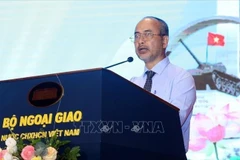
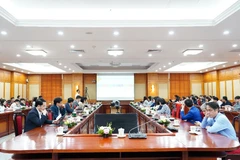
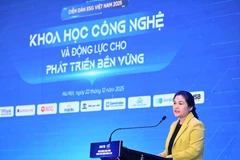
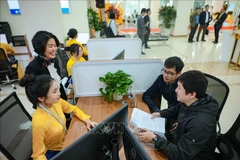
SAV promotes digitalisation-based auditing - Illustrative image (Photo: VNA)
Hanoi (VNA) - State Audit of Vietnam (SAV) has adopted practical and effective measures to promote the application of information technology in auditing, contributing to improving the effectiveness of the task.
The law revising and supplementing some articles of the Law on State Audit was approved at the 8th session of the 14th National Assembly, allowing the SAV to access the national database and electronic data systems of audited entities as well as agencies, organisations, and individuals related to auditing activities.
This makes it easier for audit agencies to collect information and documents related to the content and scope of audits.
It is expected to help the sector realise its goal of reducing the number of personnel conducting auditing activities and shortening the audit duration and time working directly at audited agencies, contributing to making the task more transparent and precise.
The Strategy for the Development of State Audit in the 2020-2030 Period with a Vision to 2035 focuses on professional audit training to create qualified auditors with professional ethics and the ability to use advanced technologies in auditing activities in the digital age.
SAV’s auditors have applied software in the audit of land planning and management in urban areas, which were complicated, as well as in compensation and support for resettlement when implementing projects.
For example, Global Mapper and Map Tiler software helped auditors read and analyse numerical data on land use planning maps, determine boundaries of land plots, and establish the actual land status compared with land use planning. Both software have helped save time and increase accuracy.
The SAV has digitalised a large volume of records from more than 500 audits conducted in 2017, 2018, and 2019, with approximately 9 million pages being digitised, classified, and stored in the electronic form.
IT application in audit activities also reflects the SAV’s pioneering role in its capacity as the Chair of the Asian Organisation of Supreme Audit Institutions (ASOSAI) for the 2018-2021 tenure. Apart from directing ASOSAI’s activities, the SAV has gradually affirmed its position with international audit organisations and ASOSAI members in terms of reform conducted via specific commitments and actions.
One goal set for the 2026-2030 period is to conduct regular annual audits of budget balances at ministries, centrally-run agencies, provinces, and centrally-run cities. Audits of operations, specialised audits, information technology audits, and audits of the environment will be promoted, with these to account for 30-40 percent of all audits each year. Attention will also be paid to detecting loopholes in mechanisms, policies, and laws.
The SAV will work to move from conventional auditing procedures to digital auditing based on big data, with the support of artificial intelligence (AI), in a proactive manner, and improve auditing capacity to meet the requirements of the Government’s management of administration work and the supervision work of the National Assembly and People’s Councils.
Regarding international cooperation, professional integration will be the key pillar, towards the goal of quickly narrowing the gap in professional capacity between the SAV and its counterparts in the region and the world. Multilateral cooperation will be geared towards raising the SAV’s position in the international community through joining in the implementation and drafting of common auditing standards and rules.
Meanwhile, bilateral cooperation will focus on the sharing of experience and technology to enhance the SAV’s capacity. The SAV will organise various coordinated audits, send or receive auditors for training, and conduct cross-assessments with regional and global supreme audit agencies.
The strategy and overall architecture of IT development of the SAV in 2019-2025 and vision to 2030 set specific goals and a road map for applying IT in all activities, towards moving the traditional audit process to digital means by using advanced digital technologies./.