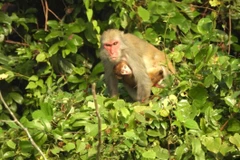
Hanoi (VNA) – Da Nang is not only renowned as the most modern city in the central region of Vietnam that boasts beautiful long beaches, it is also attractive to nature lovers thanks to its Son Tra Peninsula, which is home to the threatened red-shanked douc – “Queen of primates”.
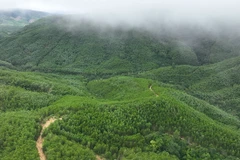
Son Tra Peninsula, known as a “green lung” regulating climate in Da Nang city, provides a habitat for a large number of red-shanked doucs.
Named “Queen of primates” by the International Union for Conservation of Nature (IUCN), the species of Old World monkey is included in Group 2B of the Vietnam Red Data Book, which covers the wild animals that haven’t been on the brink of extinction but at risk of becoming endangered if management, exploitation and use of them for commercial purposes are not tightened, and listed as critically endangered with unlimited protection status.
Every day at sunrise or sunset, many nature lovers began their trips to take beautiful photos of the red-shanked douc.
In Da Nang, an organisation called “Hoi anh Vooc Son Tra” (Son Tra Photographers Association for Douc Langurs) was set up, gathering both professional and amateur photographers who have taken thousands of unique pictures of the species.
The love for the red-shanked douc has turned them into special guards for the “Queen of primates” in Son Tra.
Walking on a road skirting a mountain in Son Tra, Mai Ho Xuan, a photographer of douc langurs, gave others a signal for quiet and pointed towards the dense foliage on the top of the mountain.
Hiding in the foliage, the monkeys suddenly stopped their moves and looked around when hearing human voices. They only continued playing and seeking food when they felt safe.
 The red-shanked douc only come out to seek food when the strong sunlight abates (Photo: VietnamPlus)
The primary food of the red-shanked douc is young leaves of Indian almond, banyan, hollong and chestnut trees.
The animals often live in groups and always follow directions of their leaders which are strong males whose herds include females and their infants.
Official data show that Son Tra currently harbours more than 400 red-shanked doucs that are divided into many herds living across the peninsula.
Visitors can only spot the primates in the early morning, between 5:30am and 9am, or the late afternoon, between 4pm and 6pm, when the sunlight is not strong as they will come out to seek food.
Son Tra Peninsula attracts a great number of travellers, especially on the weekend, many of whom are photographers and nature lovers.
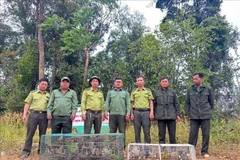
Notably, if they find any threats to the species, they will immediately report to authorities so that timely countermeasures can be taken.
[Black shanked douc langurs found in Ninh Thuan]
Thanks to authorities’ attention and nature lovers, it is hoped that the number of red-shanked doucs will increase so that the kingdom of the “Queen of primates” will develop further and become a unique tourist destination in Da Nang city.
Son Tra Peninsula, around 10km to the northeast of the city’s centre, is part of Son Tra district and has a total area of more than 60sq.km.
The Son Tra Nature Reserve on this peninsula, covering more than 4,400ha of land, is the only place in Vietnam that boasts rich ecological values right in an inner district of a city.
Statistics show that this is the habitat of about 980 vascular plant species and 380 rare mammal species. The sea surrounding this peninsula is also home to important coral and seagrass ecosystems./.