Hanoi (VNS/VNA) - Shifting to renewable energy and modern technologies is no longer a policy option but an inevitable direction for Vietnam to ensure energy security, environmental protection and sustainable development.
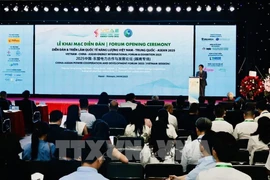
That was the key message at the forum 'Energy technology in the new era – essential foundation for rapid and low-carbon growth', held in Hanoi on July 29. The event, hosted by VnEconomy, attracted more than 150 delegates from ministries, sectors, institutes, universities, international organisations, and leading energy enterprises.
Dr Ta Dinh Thi, Vice Chairman of the National Assembly’s Committee for Science, Technology and Environment, said Vietnam was undergoing rapid change amid Industry 4.0 and facing global challenges such as pollution, climate change, energy insecurity and resource depletion. This context required a decisive transition in the energy sector, based on science, technology, and innovation.
According to the Ministry of Industry and Trade, electricity demand in Vietnam is growing rapidly and is expected to increase by 8-10% per year over the next decade. Meanwhile, traditional domestic energy sources are depleting, and since 2015, Vietnam has begun to import electricity. The country is also highly vulnerable to climate change, with estimated losses of up to 3.2% of GDP annually.
To address these challenges, Vietnam has taken important steps to promote energy transition. Resolution No 55-NQ/TW of the Politburo, issued in 2020, sets out the national energy development strategy through 2030, with a vision to 2045. It outlines goals to build a strong, self-reliant, and modern energy sector, develop energy science and technology and enhance the domestic energy industry.
Currently, the Party is conducting a mid-term review of this resolution to develop a new strategy and vision in line with new trends and tasks.
At the legislative level, the National Assembly has passed several laws and amendments related to energy transition. These include the revised Law on Electricity (2024), the Law on Atomic Energy (2025), the revised Law on Economical and Efficient Use of Energy (2025) and the Law on Science, Technology and Innovation (2025).
Vietnam’s energy development roadmap is also shaped by the Power Development Plan VIII (PDP8) and its adjusted version, which prioritise renewable energy. By 2030, the share of renewable energy (excluding large hydropower) is expected to reach 28–36% of installed capacity. By 2050, it is projected to increase to 74–75%.
Thi emphasised that science and technology would play a central role in this transition. He proposed five groups of breakthrough solutions for developing the energy sector in the new era.
These include developing domestic renewable energy industries with a focus on wind, solar, and biomass; researching and developing future energy technologies such as green hydrogen, green ammonia, energy storage, carbon capture and storage, and carbon recycling; applying digital technology and AI to smart grid management and demand response; improving institutions and policies, particularly on electricity pricing and green finance; and building a complete energy industry ecosystem including human resources and support for domestic enterprises.
He added that the recent Resolution No 57-NQ/TW of the Politburo on promoting science, technology, innovation, and digital transformation to 2030 and beyond provided a timely political basis for accelerating energy transition.
Thi called on scientists, experts and businesses to continue contributing policy recommendations to the National Assembly and Government.
“With the right direction, breakthrough solutions, and the active participation of the whole political system and society, Vietnam will build a strong, self-reliant, and modern energy sector to meet the demands of national development in the new era,” he said.
Dr Phan Xuan Dung, Chairman of the Vietnam Union of Science and Technology Associations (VUSTA), also stressed that science and technology would be key to addressing energy challenges and promoting socio-economic development. He said Vietnam’s energy industry had made positive progress, but still faced many challenges, especially in modernising infrastructure and applying new technologies.
“To seize opportunities, we need to build policies to promote technology transfer, research, and innovation, especially by connecting scientists, universities and enterprises,” he said.
Dao Quang Binh, Vice Chairman of the Editorial Council and Secretary General of VnEconomy, said the forum aimed to share experiences and seek feasible solutions to build a sustainable and resilient energy system. He noted that the current power shortages in some localities showed that a stable and green energy supply was becoming an urgent issue.
Delegates at the forum discussed a wide range of topics, from policy and legal frameworks to scientific and technological solutions for energy development. They focused on how to apply new technologies, remove institutional barriers, and mobilise resources for the energy transition.
The forum was expected to provide practical inputs to support policymaking and encourage the development and application of advanced energy technologies to meet the country’s low-carbon growth goals./.
VNA