Hanoi (VNA) – For more than a thousand years, the furnaces of Tra Dong village in Thieu Trung commune, Thanh Hoa province, have burned without rest, forging not only exquisite bronze artefacts but also a legacy that defines an entire region’s identity.
Renowned for its majestic bronze Buddha statues, resonant temple bells, and intricately carved ritual objects, Tra Dong is more than a craft village. It is a living museum of Vietnamese history and culture.
With a history spanning over a millennium, Tra Dong ranks among Vietnam’s oldest and most celebrated bronze-casting villages.
Local legend credits Nguyen Minh Khong, also known as Ly Quoc Su – a revered Zen master from the Ly Dynasty (1009 – 1225), as the spiritual founder who introduced the art of bronze casting to the villagers. Others believe the craft was passed down by a master artisan named Khong Minh Khong, whose legacy of metallurgical wisdom still shapes the village today.
Through countless generations, the secrets of alloy composition, mold creation, and carving have been meticulously preserved and passed only from parent to child within the village.
During feudal times, Tra Dong was famous for supplying fine bronze objects to royal courts and temples across the country. Its artisans cast everything from Buddhist ceremonial instruments to royal household items. The village’s reputation became intertwined with grand cultural and spiritual works that carried both artistic and national significance.
What sets Tra Dong bronze apart is the delicate harmony between traditional technique and natural material. Artisans here rely on clay molds, a method demanding patience and nearly flawless craftsmanship.
Each creation begins with a wax or soft model to determine its shape and spirit. The mold – made from a mixture of clay, rice husk ash, and other secret additives – is then baked in a charcoal furnace. The fineness and resilience of the mold determine the smoothness of the finished bronze.
Forming the alloy is the next crucial step in the process. Melted at thousands of degrees Celsius, the bronze is blended with tin, zinc, and lead in proportions refined through centuries. These formulas produce the distinctive deep amber hue and exceptional durability that define Tra Dong Bronze, as well as ensure the molten metal flows perfectly into even the smallest details of the mold.
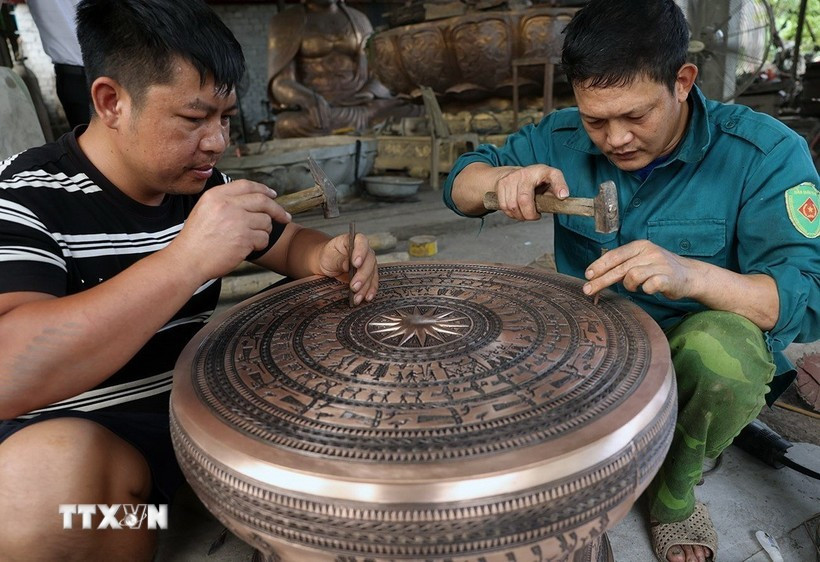
The most crucial steps – pouring, cooling, and finishing – demand precision in terms of time and temperature. Once the mold is broken, each piece is cleaned, polished, and hand-carved with delicate motifs that breathe life into the metal. It is this human touch – the lines etched by a steady hand – that gives every artefact the local distinction.
A fine example of the artisans’ mastery is the bronze statue of Amitabha Buddha at Thay Pagoda, which showcases their exceptional skill in shaping spiritual imagery. Tra Dong bells, known for their warm, far-reaching resonance, are sought after by temples nationwide. Its altars and ritual sets, adorned with intricate patterns, remain treasured for both beauty and craftsmanship.
Whenever historic relics are restored or ancient artefacts replicated, Tra Dong artisans are often chosen to lead the work, ensuring authenticity and fidelity to the nation’s heritage.
Despite the influx of mass-produced goods, Tra Dong’s furnaces have not gone cold. The village remains vibrant, with dozens of households continuing the craft – from religious objects to fine art sculptures, souvenirs, and even custom-made bronze portraits.
In 2010, the artisans of Tra Dong were commissioned to cast 100 bronze drums in celebration of the 1,000th anniversary of Thang Long – Hanoi, a symbolic tribute linking their ancient craft to the capital’s millennium of history.
Their dedication was officially recognised on September 4, 2018, when the Ministry of Culture, Sports and Tourism listed the traditional bronze casting of Che Village (Tra Dong) as a national intangible cultural heritage. The honour, one of only eight awarded that year, reaffirmed the craft’s cultural value and spurred new efforts in preservation and craft tourism./.