Hanoi (VNA) – The United Nations Development Programme (UNDP) has announced its 2025 Human Development Report (HDR) titled "A matter of choice: People and possibilities in the age of AI," placing Vietnam in the high human development category.
According to the report, which evaluates human development progress based on the Human Development Index (HDI), tracking achievements in health, education and income, Vietnam’s HDI in 2023 reached 0.766, ranking 93rd out of 193 countries and territories. This marked a substantial leap from 0.499 in 1990, representing a 53.5% increase, a notable trajectory of growth over more than three decades.
This year’s report paints a sobering picture globally, showing that progress in human development has stagnated at an unprecedented level. Instead of a steady recovery following the severe 2020–2021 crisis, the current pace of improvement has fallen far short of expectations. Excluding the COVID-19 pandemic years, this is projected to be the slowest global growth in human development since 1990.
Addressing the launching in Hanoi on May 12, Ramla Khalidi, UNDP Resident Representative in Vietnam, highlighted that the impact of artificial intelligence (AI) on human wellbeing is not predetermined. The UN urges governments and societies to deliberately shape AI so it serves people, rather than the other way around.
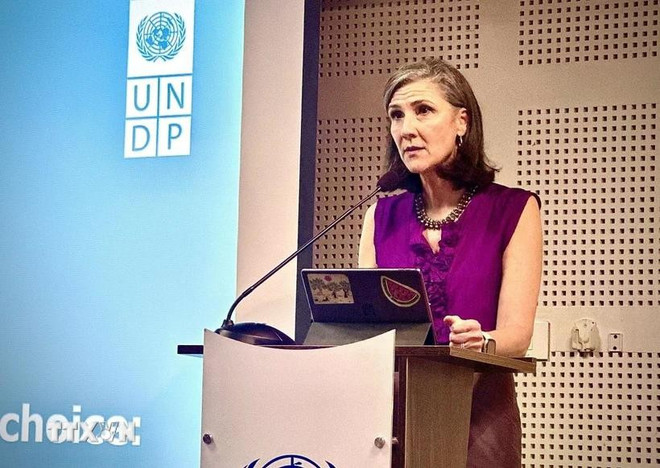
For Vietnam, Khalidi underscored the urgency and reality of this challenge, as the country undergoes rapid digital transformation and pursues a bold vision for its future. AI is increasingly central to national discussions about Vietnam’s development path.
While Vietnam’s HDI is comparatively high, Khalidi pointed out persistent disparities across regions and population groups, she stressed, adding that the country still lags behind the top-performing ASEAN nations. In this context, AI holds the potential to help close these gaps, but can just as easily widen them if left unchecked, she held.
The official emphasised that Vietnam must act now to avoid falling into this divide. She welcomed the nation’s forward-looking AI policies, such as Resolution No. 57-NQ/TW, issued on December 22, 2024 by the Politburo on breakthroughs in science, technology, innovation, and national digital transformation; and the Prime Minister’s Decision No. 127/QD-TTg, which sets out a national AI strategy to 2030. These policies not only provide a legal framework for adopting emerging technologies but also enable Vietnam to develop AI capabilities in a way that reflects its own values and priorities, she commented.
She described Prime Minister Pham Minh Chinh’s call to train 100,000 engineers as a bold move. His message - AI must be safe, ethical, and inclusive - sets the right tone, the UNDP representative noted.
Khalidi reaffirmed the UNDP’s commitment to supporting Vietnam in achieving its AI goals, ensuring the technology becomes a force for equity, sustainability, and human advancement both domestically and globally.
The launching ceremony also brought together scientists, policymakers, tech experts, businesses, and delegates to explore how AI can drive human development while aligning with the Sustainable Development Goals and Vietnam’s national digital transformation strategy./.