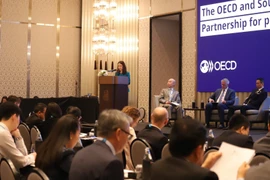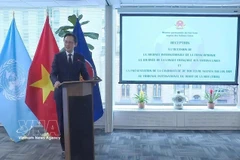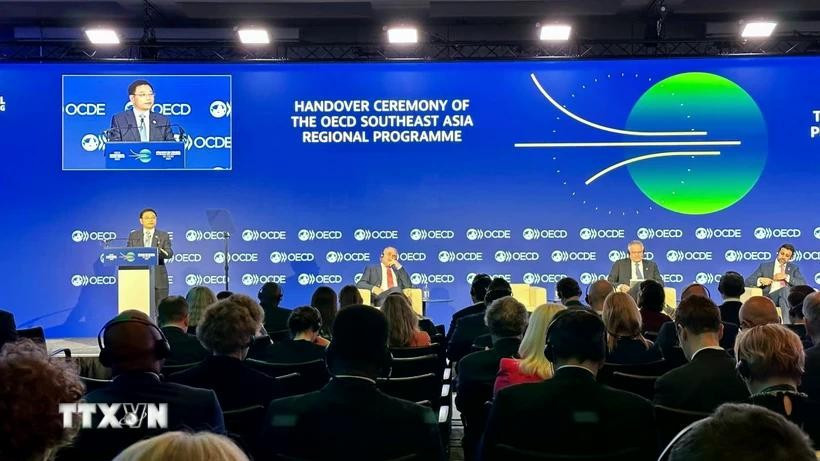
Paris (VNA) – Vietnam and Australia, the co-chairs of the OECD Southeast Asia Regional Programme (SEARP), handed over the programme’s leadership to Canada and the Philippines during the OECD Ministerial Council Meeting (MCM) 2025 that took place in Paris on June 3.
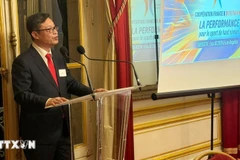
Addressing the event on behalf of the Vietnamese Government, Finance Minister Nguyen Van Thang affirmed that the SEARP is a strategic initiative that supports economic reform, promotes sustainable growth, and strengthens connectivity between the Organisation for Economic Cooperation and Development (OECD) and the Association of Southeast Asian Nations (ASEAN), one of the world’s most dynamic regions.
As co-chair alongside Australia for the 2022–2025 term, Vietnam guided SEARP through a turbulent period marked by the aftermath of the COVID-19 pandemic, climate change, and global supply chain challenges, he noted.
The official underlined that Vietnam and Australia steadfastly advanced substantive cooperation, transforming SEARP into a regional programme with far-reaching impact. Under their leadership, SEARP identified three core priorities - short-term recovery, medium-term reform, and deeper integration with the OECD, alongside four key focus areas - economic resilience, private sector reform, trade and investment liberalisation, and green-digital transformation. These efforts have yielded remarkable results, he stated.
Firstly, the signing of the inaugural Memorandum of Understanding between the OECD and ASEAN established a legal foundation and propelled cooperation through working groups, data sharing, and technical support. This was hailed as a breakthrough in creating a long-term cooperation framework between the two organisations.
Secondly, the successful organisation of the Southeast Asia Forum in Hanoi in 2022 launched an annual ministerial-level dialogue mechanism between the OECD and the region focused on policy and development. The forum has become a vital platform for sharing experience, policies, and common values.
Thirdly, SEARP implemented the Prospectus for the first time - a pragmatic cooperation plan addressing green and digital transformation, inclusive growth, and productivity enhancement. These projects have not only directly benefited Southeast Asian countries in modernising their economies but also generated scalable cooperation models with global relevance, said Minister Thang.
Notably, during the past term, Vietnam hosted two ministerial forums in Hanoi on supply chain resilience and high-quality investment. It also signed a memorandum of understanding and an action plan with the OECD focused on competition, investment, green transition, and tax policy.
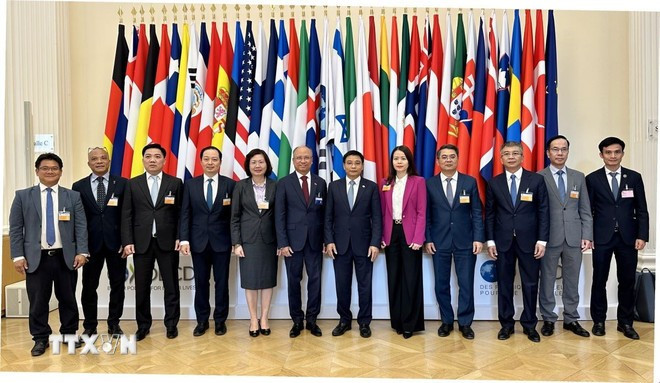
Vietnam takes pride in working with partners to elevate SEARP into a regional cooperation pillar with a long-term, practical vision, he said, emphasising that the country has demonstrated proactive, responsible, and creative leadership, helping bring the OECD and ASEAN closer together to share common values and build a rules-based economic order.
Welcoming Canada and the Philippines as the new co-chairs, Minister Thang expressed confidence in their ability to successfully fulfil the role. He pledged that Vietnam will continue to accompany, actively contribute, and build towards a sustainably developed Southeast Asia, more closely connected to the international community.
He thanked the OECD Secretary-General and member countries for their support in fostering cooperation between the organisation and Vietnam as well as other Southeast Asian countries, expressing his belief that SEARP will continue to be a driving force linking ASEAN and the OECD towards a green, digital and human-centred future.
The SEARP has been in operation for over a decade, serving as a crucial platform connecting OECD member countries with Southeast Asia—one of the main engines of global growth, with a combined GDP exceeding 3 trillion USD. Since its launch in 2014, Southeast Asian nations have doubled their compliance with OECD instruments and increased their participation in the organisation’s bodies. To date, ASEAN member states have made 67 legal commitments to OECD instruments.
Notably, the initiation of talks for Thailand and Indonesia to join the OECD in 2024 marks a new chapter in OECD–ASEAN relations. This process not only benefits the two countries but also enhances diversity within the OECD, bringing fresh perspectives on national and regional issues to global policy discussions.
At the MCM 2025, participants reaffirmed the critical role of trade, investment and innovation as pillars of prosperity, and engaged in discussions on global cooperation priorities. Key agenda items included enhancing adaptability, inclusive and sustainable development, and strengthening open markets and rules-based global trade systems. Delegates also explored how the digital economy can drive shared prosperity and how forward-thinking policies can underpin sustainable, inclusive growth.
This year’s gathering also served as a platform to deepen regional collaboration and knowledge-sharing, with a particular emphasis on synergy between regional programmes, especially in Latin America and the Caribbean.
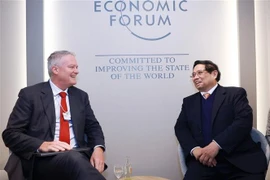
At the handover ceremony, OECD Secretary-General Mathias Cormann praised Southeast Asia’s dynamic economic role and growing relevance in global supply chains. He emphasised SEARP’s importance in aligning ASEAN countries with international standards and sharing best practices to attract investment, improve connectivity, and address tax avoidance.
Meanwhile, ASEAN Secretary-General Kao Kim Hourn also highlighted SEARP’s success as a practical, meaningful bridge - not just in form, but in substance -between the two regional blocs./.