Hanoi (VNA) – Vietnam, with its ambition to become a new hub in Asia’s semiconductor supply chain, is taking the first steps in building a high-quality human resources ecosystem to serve the digital economy.
Professor Usagawa Tsuyoshi, a leading Japanese semiconductor expert and special adviser to the Vietnam Japan University (VJU), said the Vietnamese Government’s goal of training at least 50,000 semiconductor professionals by 2030 is achievable if the State, businesses, and universities coordinate effectively.
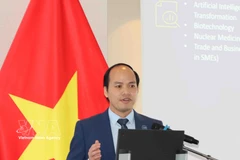
At a press briefing on October 14 introducing Japan’s semiconductor technology and bilateral cooperation in this field, Usagawa cited a recent survey as showing that Japan’s eight largest corporations will need about 40,000 new semiconductor engineers over the next decade.
The figure highlights the scale of skilled workers that advanced economies must mobilise to sustain their semiconductor supply chains, a field known for both high profitability and risk, he said.
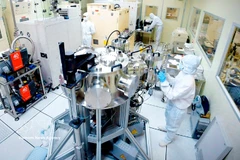
Vietnam is now believed to be well-positioned to develop this industry. A 2024 Deloitte report shows that the country currently has over 40 enterprises involved in the semiconductor value chain, mainly in Hanoi, Ho Chi Minh City, and Da Nang. Most focus on chip design, research and development (fabless) and outsourced semiconductor assembly and test (OSAT), while wafer fabrication (fab) remains absent. Expanding into more complex stages such as advanced packaging and wafer production is seen as essential to build a complete manufacturing base.
Usagawa, also an honorary professor at Kumamoto University and a Japan International Cooperation Agency (JICA) expert, said the VJU’s bachelor’s programme in semiconductor engineering, launched in September 2025, will support Vietnam’s semiconductor human resources development strategy.
The five-year programme plans to enroll 100 students annually and train about 400 engineers by 2030. It is one of Vietnam’s first specialised programmes developed in partnership with the University of Tokyo and Kumamoto University, two leading Japanese institutions in semiconductor technology, with support from Japan’s university semiconductor alliance.
Associate Professor Bui Nguyen Quoc Trinh, Director of the Semiconductor Engineering Programme at the VJU, noted that the field demands strong practical skills and interdisciplinary thinking. The Vietnam National University – Hanoi, which oversees the VJU, currently has four units engaging in semiconductor-related training, including the VJU, the University of Science, the University of Engineering and Technology, and the Information Technology Institute, along with the Institute of Advanced Materials and Semiconductors, established in 2024.
He said this ecosystem is enabling closer cooperation between universities, research institutes, and enterprises to bridge the gap between training and industry needs.
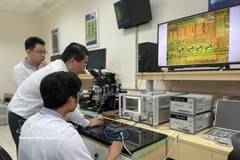
Experts believe that the “university – enterprise – research institute” partnership model is crucial for developing a sustainable semiconductor workforce. Project-based learning and corporate internships are seen as effective methods to help graduates meet job requirements.
Major Vietnamese corporations such as Viettel and FPT have already entered the field, designing chips for telecommunications, Internet of Things (IoT), and artificial intelligence (AI). Notably, Viettel is pursuing plans to build Vietnam’s first chip fabrication plant, expected to fill a key gap in the national supply chain.
The Ministry of Information and Communications is finalising a national semiconductor development strategy to 2045, aiming to place Vietnam among the world’s top ten semiconductor design centres and train 50,000 engineers by 2030.
Experts say Vietnam now holds a “golden opportunity” to build its semiconductor talent pool, a critical factor for advancing its position in the global technology value chain. However, they emphasise that beyond training sufficient personnel, the country needs a general strategy while its education institutions should further expand training for related industries to ensure manpower supply for the market./.