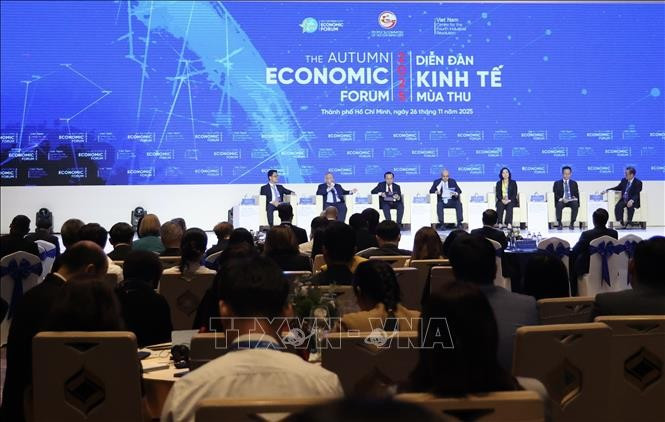
HCM City (VNA) – Experts have emphasised the need for effective capital mobilisation mechanisms and practical support policies for businesses to achieve sustainable green transition, citing the updated Nationally Determined Contribution (NDC) estimates which showed that Vietnam will require around 28 billion USD for its green transition by 2030.
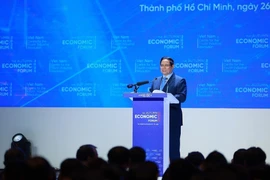
Speaking at a high-level policy dialogue held on November 26 as part of the Autumn Economic Forum 2025 in Ho Chi Minh City, economist Dr. Tran Du Lich, the coordinator of the dialogue, noted that in the current context of global competition, any country slow to pursue dual transformation - green transition and digital transformation - risks falling behind.
The forum highlighted a clear message - the Party and Government have identified the urgent need to accelerate both transitions.
Lich said a comprehensive review of the existing policy framework revealed an extensive list of regulations on green and digital transition, reflecting Vietnam’s proactive approach beyond international commitments.
Deputy Minister of Finance Do Thanh Trung said the ministry has issued a set of criteria consisting of 72 indicators measuring the level of “greenness” across sectors, aligned with international standards, including the EU taxonomy.
However, he stressed the need for a dedicated set of criteria tailored to businesses to enable practical assessment and support mobilisation of green finance. The Ministry of Finance (MoF) is developing data collection templates to build a centralised database, serving as the basis for identifying green businesses in line with domestic and international standards. It is also coordinating with ministries to design short-term support mechanisms, particularly preferential credit. Existing policies include a 2% interest rate support scheme and regulations on green finance and environmental taxes and fees, he noted.
Developing criteria for green businesses is challenging, he added, as it requires balancing integration demands with business capacity, especially small and medium-sized enterprises, which are most vulnerable when applying ESG standards. The ministry is simultaneously assessing and designing pilot support mechanisms to issue the criteria as soon as possible, enabling businesses to access financial and policy support.
Enormous capital requirements
Recent studies indicate a vast financing need. A joint report by the HCM City Institute for Development Studies and international partners estimates that the city alone will need about 990 trillion VND (nearly 38 billion USD) for its green transition and digital transformation over the next decade, averaging 4 billion USD annually. Meanwhile, Vietnam’s NDC update estimates a national requirement of roughly 28 billion USD for green transition by 2030.
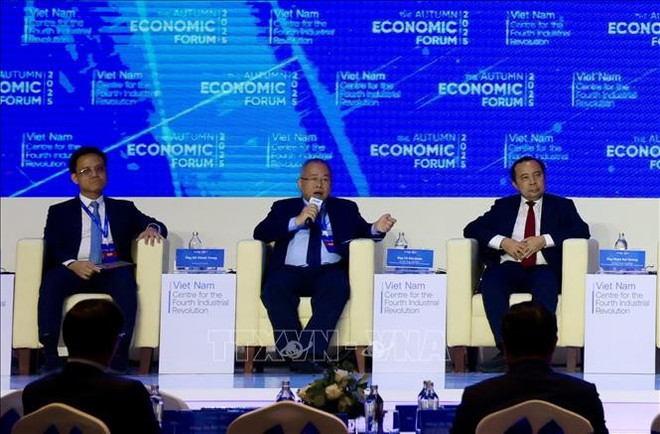
Trung said the ministry is working on three groups of measures - developing the green finance market, allocating state budget resources for green objectives, and expanding international capital mobilisation alongside legal reforms. The MoF will continue coordinating with ministries and localities to secure the resources needed for green growth nationwide, including in key economic hubs such as HCM City.
He noted that green credit is rising rapidly. By the end of 2024, the value of green bonds issued by Vietnamese enterprises was estimated at 1–2 billion USD. Outstanding green credit reached nearly 700 trillion VND, up more than 25% from 2023 and accounting for about 6% of total credit in the economy.
Besides corporate resources and credit institutions, Trung said the State budget plays a critical role through interest rate support programmes, public investment and fiscal policies. The MoF is drafting the 2026–2030 public investment plan with a projected scale of more than 8 quadrillion VND, including central and local budgets and the city’s own investment, the official said.
Capital will focus on sustainable development goals such as green transport infrastructure, smart urban systems and environmental protection projects. At the same time, the ministry is engaging with bilateral and multilateral financial institutions to mobilise additional funding for green growth.
A key task is to improve the legal framework for the capital market, including promoting the government bond market's development, enhancing listing and trading mechanisms, adjusting fees, and revising related regulations.
Trung stated that the MoF expects the green capital market, especially government green bonds, to become an important fundraising channel alongside bank credit, corporate bonds and foreign loans./.