Vietnam proposes cooperation priorities at China-ASEAN Ministerial Roundtable

Vietnam proposed maintaining and strengthening the role of the annual ministerial conference as a key mechanism to address common issues and develop concrete action initiatives, conducting joint in-depth research programmes on pressing topics such as smart cities, climate change adaptation, and heritage preservation in the digital environment at the 2025 China-ASEAN Ministerial Roundtable on Construction.

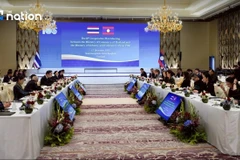
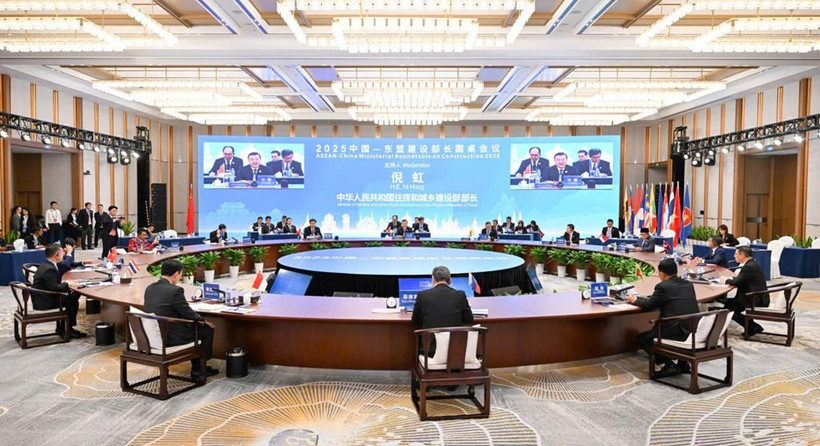
A view of the 2025 China-ASEAN Ministerial Roundtable on Construction, in Guilin, Guangxi province, China. (Photo: The Ministry of Construction)

Hanoi (VNA) – Deputy Minister of Construction Nguyen Tuong Van proposed three key areas of cooperation at the 2025 China-ASEAN Ministerial Roundtable on Construction, which was held on September 15 in Guilin, Guangxi province, China.

Speaking at the plenary session, Van highlighted Vietnam’s achievements, experience, and orientations in housing and urban development. He reaffirmed Vietnam’s commitment to actively and responsibly participating in regional cooperation mechanisms, notably the ASEAN Smart Cities Network (ASCN).

Given the region’s shared challenges, especially the impacts of climate change on urbanisation, the Vietnamese official proposed maintaining and strengthening the role of the annual ministerial conference as a key mechanism to address common issues and develop concrete action initiatives. It also suggested joint in-depth research programmes on pressing topics such as smart cities, climate change adaptation, and heritage preservation in the digital environment.

He also suggested enhancing the exchange of practical experience in applying technology and digital intelligence to build smart, resilient, and livable cities.
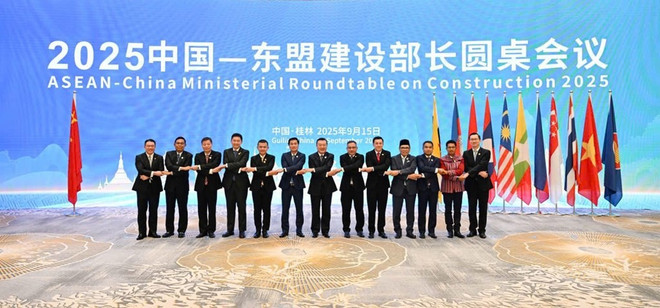
Delegates pose for a group photo at the 2025 China-ASEAN Ministerial Roundtable on Construction, in Guilin, Guangxi province, China. (Photo: The Ministry of Construction)

Delegates pose for a group photo at the 2025 China-ASEAN Ministerial Roundtable on Construction, in Guilin, Guangxi province, China. (Photo: The Ministry of Construction)

In a spirit of frank and open dialogue, participants heard insightful remarks presented by the Minister of Housing and Urban-Rural Development of China, ministers and heads of delegations from ASEAN member states. They reviewed effective cooperation outcomes in training human resources, scientific–technological exchange, harmonising construction standards, and implementing joint investment projects.

Delegates agreed to adopt the “Guilin Initiative”, which is expected to lay a foundation for a new phase of deeper and more substantive cooperation, aiming to build a shared sustainable and prosperous development future.

The conference served as a forum for ASEAN member states and China to share visions and experience, and propose strategic cooperation solutions in housing and urban development. Its success reaffirmed the importance of the ASEAN–China cooperation mechanism while underscoring Vietnam’s strong commitment to working with other nations to build a dynamic, resilient, and inclusive Asia./.
VNA

See more

Malaysia considers establishing strategic petroleum reserve

Malaysia considers establishing strategic petroleum reserve

Malaysia, which was previously a net exporter, has now become a net importer due to declining domestic production and rising consumption, with demand estimated at around 800,000 barrels per day compared to production of about 400,000 barrels per day.

Indonesia to halt diesel imports from July

Indonesia to halt diesel imports from July

The move is part of the Indonesian Government’s efforts to strengthen national energy independence by utilising palm oil as an alternative fuel, said Agriculture Minister Andi Amran Sulaiman.

Malaysia’s growing microplastics crisis is largely self-inflicted, driven by domestic waste, weak recycling practices and everyday plastic use, said experts. (Photo: New Straits Times)

Malaysia seeks solutions to microplastic crisis

Microplastics originating from domestic waste and wastewater are increasingly entering the food chain, posing serious threats to seafood safety and the livelihoods of coastal communities.

The new mass emergency alert system SG Alert, which will be used during emergencies such as major fires, chemical or terror incidents, seen on an Apple and Android device on Apr 17, 2026. (Photo: CNA)

Singapore launches new national emergency alert system

SG Alert in Singapore uses cell broadcast technology, enabling alerts to be delivered within seconds without requiring mobile data or collecting personal information. Unlike conventional SMS, which may be delayed during network congestion or depend on internet connectivity, the system ensures fast and reliable message delivery. Alerts can be sent islandwide or targeted to specific affected areas.

Malaysia establishes ‘war room’ to ensure water security

Malaysia establishes ‘war room’ to ensure water security

The establishment of the war room reflects the Malaysian government’s commitment to shift from a reactive approach to a more proactive, data-driven one in managing national water challenges, particularly amid increasingly unpredictable weather conditions caused by global climate change

Indonesia diversifies supply sources to ensure energy security

Indonesia diversifies supply sources to ensure energy security

Indonesia is facing significant supply pressure as crude oil consumption reaches approximately 1.6 million barrels per day, much lower than the domestic production at only around 600,000 barrels per day, forcing the country to rely heavily on imports.