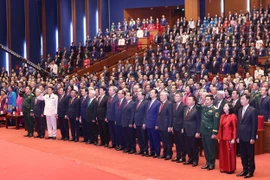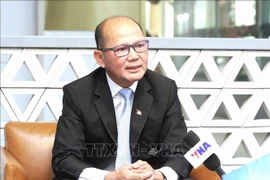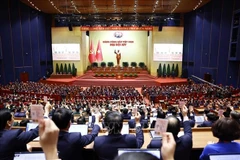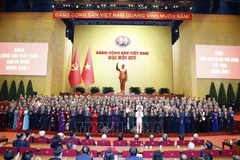
Hanoi (VNA) - The 14th National Congress of the Communist Party of Vietnam (CPV) is not merely a domestic political event, but one that carries profound significance in comprehensively repositioning Vietnam on the global geopolitical and economic map, said a Malaysian scholar.
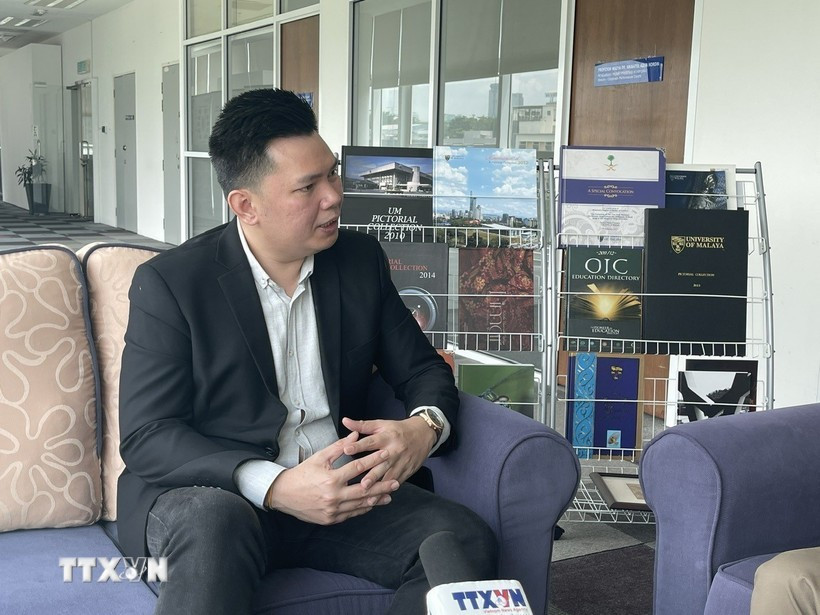
Collins Chong Yew Keat, an analyst on foreign, security, and strategic affairs at University of Malaya (UM), held that amid a world undergoing rapid transformation marked by complex and unpredictable changes, Vietnam has emerged as a model of stability and flexible adaptability.
Commenting on Vietnam’s stature in the new phase, he noted that Vietnam is now regarded as one of the most disciplined and credible balancers within ASEAN, particularly at a time when the bloc is witnessing divergent approaches toward major powers. The consistency in policy orientation, combined with strategic restraint and strong institutional cohesion, has enabled Vietnam to forge a distinct and influential diplomatic identity on the international stage.
The Malaysian expert emphasised that the foundation of this solid position lies in a strategy that allows Vietnam to expand its strategic space without becoming dependent on any single centre of power. Over the years, Vietnam has deepened relations with all major poles while firmly maintaining autonomy in key decision-making. The upgrading of relations with the United States, along with other mid-sized and major partners, serves as clear evidence of Vietnam’s capacity to engage deeply in global processes while preserving the necessary strategic balance.
From a regional perspective, Collins affirmed that Vietnam plays a critical role in mitigating the disruptive impacts of great-power competition on ASEAN, while contributing to strategic stability by embedding itself deeply within global production networks and supply chains.
He further stressed that in regional issues regarding the East Sea, Mekong subregional cooperation, and Myanmar, Vietnam’s position following the 14th National Congress is expected to continue demonstrating selective proactiveness and close alignment with multilateral institutions. In the East Sea, Vietnam has consistently been among ASEAN’s most steadfast members in upholding international law, sovereignty, and regional stability based on the 1982 United Nations Convention on the Law of the Sea (UNCLOS), without escalating tensions.
Regarding Mekong cooperation, Vietnam is shifting toward a system-level coordinating role, linking water security, food security, and climate change adaptation. This reflects a more integrated and comprehensive security mindset among Vietnam’s leadership in the new term, moving beyond narrow military-centric approaches. Even on the Myanmar issue, Vietnam’s cautious and pragmatic approach - prioritising ASEAN unity - demonstrates a strategic vision aimed at safeguarding the bloc’s collective leverage.
Economically, Vietnam’s role following the 14th National Congress is expected to serve as an “anchor” for the region’s next development phase under the ASEAN Vision 2045. Collins pointed out that neighbouring countries such as Malaysia view Vietnam not only as a fast-growing economy, but also as a stable force amid intense geopolitical competition. Vietnam is anticipated to become a connectivity-driven economy, helping ASEAN integrate more deeply into global trade flows and supply chains. Notably, Vietnam’s success in transitioning toward a development model based on productivity, human capital, and institutional strength, rather than merely headline growth figures, will have strong spillover effects on the overall credibility of the ASEAN Community.
One particularly notable aspect of Vietnam’s future position is its role as a geopolitical hinge between the Asian mainland and Southeast Asia’s maritime space, directly connected to the East Sea and the Pacific Ocean. With its unique geographic location, Vietnam is seen as a gateway for connectivity corridors from Central and South Asia, via the Mekong subregion, to the region’s strategic maritime routes.
According to Collins, as global supply chains accelerate diversification and resilience-building, Vietnam’s industrial corridors and logistics infrastructure are emerging as strategic nodes in cross-regional production networks. In the longer term, as Arctic shipping routes gradually take shape, Vietnam’s gateway position to the East Sea is likely to be further reinforced, transforming its seaports and industrial corridors into key transshipment hubs linking Europe and Central Asia with the Indo-Pacific.
Vietnam’s strategic value following the 14th National Congress has far surpassed conventional indicators of production or GDP growth. Collins assessed that Vietnam’s core value lies in its potential to become a new “central connectivity node” in global trade and geopolitics. The presence of a resilient, innovative, and responsible Vietnam not only ensures national prosperity but also strengthens ASEAN’s legitimacy and relevance in an era of fragmentation and power reconfiguration. This is the historic role Vietnam is assuming - contributing to a peaceful, stable, and deeply connected region in the decades ahead./.
See more
☀️ Morning digest on January 28
Party General Secretary To Lam and Prime Minister Pham Minh Chinh's working visit to Quang Ninh, activities of Party General Secretary and President of Laos Thongloun Sisoulith during his state visit to Vietnam, and a meeting to brief foreign diplomatic missions and international organisations on the 14th National Party Congress's outcomes are among news highlights on January 27 evening.
People - centre of all policymaking in Vietnam: Egyptian journals
Liga Hispano and Elsoot identified a central and foundational highlight of the Congress documents as the consistent affirmation that “the people are the centre, the subject, the goal, the driving force and the resource of development.”
Vietnam poised to drive regional growth: Malaysian expert
A Malaysian expert said Vietnam’s high and sustainable growth hinges on a productivity boost, stronger domestic value creation, and a robust innovation and R&D ecosystem, with successful reforms key to achieving these ambitious targets.
Ho Chi Minh City promotes friendship, cooperation with Chinese localities
Ho Chi Minh City currently maintains friendship and collaboration with eight Chinese localities. China is now the third-largest investor among 152 countries and territories investing in the city.
Front leader meets Lao Party General Secretary, President
The VFF and its member organisations always regard the preservation and further development of Vietnam–Laos relations as both a responsibility and a heartfelt mission.
Top Lao leader leaves Hanoi, concluding state visit to Vietnam
The state visit to Vietnam by the top Lao leader was a resounding success, reaffirming that the great friendship, special solidarity, comprehensive cooperation and strategic cohesion between the two countries will continue to grow further. This relationship will be preserved as a priceless shared asset of the two nations and passed on to future generations.
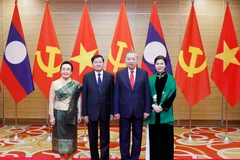
Spouses of Vietnamese, Lao Party leaders visit Ninh Binh
The delegation visited and offered incense at the temple of Princess Nhoi Hoa in Thai Son hamlet, Tay Hoa Lu ward, a provincial-level historical and cultural relic associated with the long-standing friendship between Vietnam and Laos.
Cuban scholar highlights turning point in Vietnam’s development process
The 14th National Party Congress reflects Vietnam's determination to move into a new stage of development amid a complex and unstable international environment. Through this event, the country reaffirmed the importance of continuous transformation and the necessary pragmatism not only in its foreign relations strategy but also in governance, management, and national leadership.
Senior Party official bids farewell to top Lao leader
Lao Party General Secretary and President Thongloun Sisoulith said that the visit was highly successful, affirming that the great friendship, special solidarity, comprehensive cooperation, and strategic cohesion between Vietnam and Laos will continue to grow stronger. He emphasised that this relationship would be preserved as a shared and invaluable asset of the two nations and passed on to future generations.
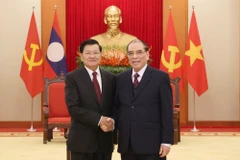
Top Lao leader visits former Party General Secretary in Hanoi
The special Vietnam-Laos relationship, diligently nurtured by Vietnamese President Ho Chi Minh and Lao Presidents Kaysone Phomvihane and Souphanouvong, is an invaluable common asset and a vital factor for the existence and development of both nations.
Quang Ninh must become model of green development, innovation, int’l integration: Party chief
Quang Ninh province should proactively and actively pursue international integration and deepen its participation in regional and global value chains, step up economic diplomacy, and promote its image and investment climate, thereby gradually positioning Quang Ninh as a destination for strategic investors and a regional hub for tourism, services and innovation.
Foreign diplomatic missions, international organisations briefed on 14th National Party Congress’s outcomes
Many ambassadors and heads of diplomatic missions shared views and assessments of Vietnam’s recent development achievements, and extended their best wishes and expectations for the country’s future development direction.
Lao leader’s Vietnam visit further nurtures special ties: Lao media
Despite increasingly complex and unpredictable regional and international developments, the great friendship, special solidarity, comprehensive cooperation, and strategic cohesion between Vietnam and Laos continue to be nurtured and strengthened across all fields.
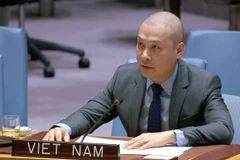
Vietnam backs all peace initiatives in line with int’l law, UN Charter: official
As a responsible UN member state, Vietnam stands ready to work together with other members and partners to build and strive for a more just, stable and prosperous world for all nations and peoples.
Lao media highlights President Thongloun’s Vietnam visit
Vietnam and Laos committed to improving the quality of cooperation and deepening strategic collaboration, enhancing close coordination in defence and security, creating favourable conditions to accelerate economic connectivity, particularly by expediting the early implementation of the Vientiane–Hanoi expressway project.
☕ Afternoon briefing on Janaury 27
The following is a brief review of the day’s events as reported by the Vietnam News Agency.
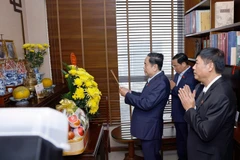
NA Chairman commemorates late Party, State, NA leaders, visits former leadership
Chairman Man offered incense and expressed profound gratitude to the late great intellectual and outstanding representative of the people. He affirmed that Bui Bang Doan’s life, career and moral integrity stand as a shining example of patriotism, integrity and wholehearted devotion to the Fatherland and the people, laying an important foundation for the fine traditions of Vietnam’s National Assembly.
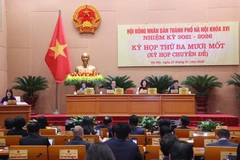
Hanoi adopts 100-year master plan resolution
With ambitions that extend well beyond the next century, the capital is expected to unlock new space, potential and opportunities to drive economic breakthroughs, including the pursuit of double-digit growth, commensurate with its status as the capital of a future high-income developed country.
Party chief extends Tet greetings to coal miners in Quang Ninh
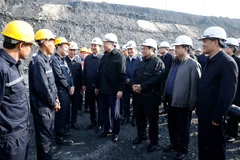
Party General Secretary To Lam and a Party Central Committee delegation on January 27 morning visited and extended Lunar New Year (Tet) greetings to workers of the coal industry in the northern province of Quang Ninh.
State President requests well-organised activities for Lunar New Year
President Luong Cuong underlined the importance of thorough preparations to ensure a safe, healthy, and economical Tet, thereby fostering momentum for the successful implementation of the Resolution of the 14th National Party Congress right from the early months of 2026.