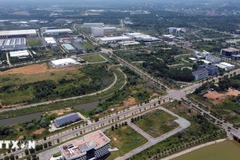
Hanoi (VNA) - Despite downward revisions for the Asia-Pacific region, the Asian Development Bank (ADB) has forecast Vietnam’s economy to grow robustly at 6.3% in 2025, driven by strong exports and rising foreign investment.
The ADB lowered growth projections for developing Asia-Pacific economies due to weaker export prospects amid rising US import tariffs, global trade instability, and softening domestic demand.
Contrary to regional trends, Vietnam’s economy is expected to remain resilient in 2025, according to the bank’s Asian Development Outlook (ADO) July 2025 released on July 23.
Vietnam’s GDP growth projected at 6.3%
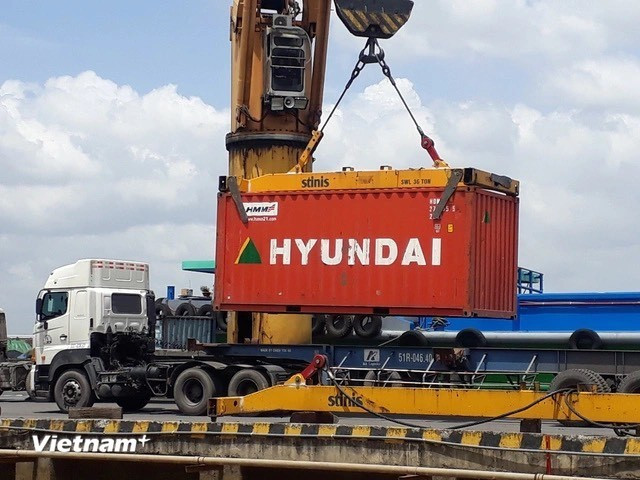
ADB analysts noted that Vietnam’s economic outlook for both 2025 and 2026 remains strong, despite short-term risks posed by tariff pressures. Vigorous import-export growth and a surge in foreign direct investment (FDI) disbursement helped drive the economy in the first half of 2025.
Committed FDI rose by 32.6%, while disbursed FDI increased by 8.1% year-on-year, a clear indication of international confidence in Vietnam’s economic prospects.
Public investment disbursement also reached its highest level since 2018, at 31.7% of the annual plan, representing a 19.8% increase compared to the same period last year. Accelerated exports in response to tariff-related uncertainty further contributed to trade growth, although this momentum is unlikely to continue in the second half of the year.
A recent US trade agreement imposed higher import tariffs on Vietnamese goods, expected to dampen export demand through 2025 and 2026. The Purchasing Managers’ Index indicates industrial production slowed from late 2024.
Despite these risks, swift domestic reforms could offset external shocks by strengthening internal economic drivers. Vietnam’s GDP growth forecast is revised down slightly to 6.3% in 2025 and 6.0% in 2026. Inflation is expected to ease to 3.9% in 2025 and 3.8% in 2026, according to the report.
Regional Asia-Pacific outlook revised downward
The ADB projected developing Asia-Pacific economies to grow 4.7% in 2025, 0.2 percentage points lower than April, and 4.6% in 2026, reflecting pressures from escalating US trade tensions, geopolitical conflicts, potential supply chain disruptions, rising energy prices, and a downturn in China’s property market.
ADB Chief Economist Albert Park noted that Asia and the Pacific have shown resilience amid external challenges, but economic prospects are weakening amid growing risks. Strengthening fundamentals and promoting trade liberalisation and regional integration remain essential.
China’s growth forecast remained at 4.7% for 2025 and 4.3% for 2026, supported by stimulus measures despite real estate and export challenges. India is expected to grow at 6.5% in 2025 and 6.7% in 2026, slightly down due to trade uncertainties and US tariffs.
The report said that Southeast Asia faces sharper impacts from worsening trade conditions, with growth forecast lowered to 4.2% in 2025 and 4.3% in 2026, down about 0.5 percentage points from earlier estimates.
In contrast, forecasts for the Caucasus and Central Asia were raised to 5.5% for 2025 and 5.1% for 2026, due to expected increases in oil production.
Inflation across developing Asia and the Pacific is projected to moderate, aided by lower oil prices and strong agricultural output. Inflation is now forecast at 2.0% for 2025 and 2.1% for 2026, down from earlier projections./.