Hanoi (VNA) – Despite severe natural disasters and the ongoing efforts to have the European Commission’s “yellow card” on illegal, unreported and unregulated fishing (IUU), Vietnam’s fisheries sector has demonstrated notable resilience. Through a flexible development strategy, the industry has marked a decisive shift from a production-focused mindset to one centred on sustainable economic value.
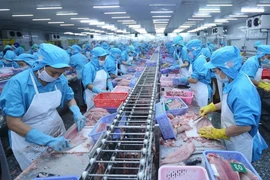
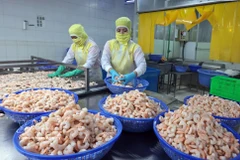
Last year, total aquatic product output reached 9.95 million tonnes, while export turnover set a new record of 11.3 billion USD, comfortably surpassing the target. These results provided a foundation for 2026 ambitions: total output of over 10 million tonnes and export earnings of approximately 11.5 billion USD.
Exports exceeding plan by 7.8%
Compared with the 2025 annual targets, total aquatic product output rose by 2%, with capture output up 0.8% and aquaculture increasing by 2.8%. Export revenue reached 11.3 billion USD, 7.8% above the planned 10.5 billion USD and 12.7% higher than the 2024 figure of 10.04 billion USD.
According to representatives from the Department of Fisheries and Surveillance, the strong export performance stems from well-directed strategies, particularly a focus on deep processing and higher value-added products.
Its general director Tran Dinh Luan highlighted the protection and development of aquatic resources as a defining feature of last year. The release of juvenile stock to regenerate marine resources has become a regular, sustained activity across localities rather than a symbolic campaign.
On tackling IUU fishing, the department advised the Ministry of Agriculture and Environment to submit to the Prime Minister a directive on preventing fishermen from entering foreign waters. It also helped devise an action plan to address the EC’s recommendations ahead of its fifth inspection.
Meanwhile, fisheries surveillance forces have strengthened patrol coordination, while digital technologies are increasingly embedded in fishing operations. Short- and long-term fishing ground forecasts are now available to support fishermen at sea. A number of larger enterprises operating fleets of between 20 and 30 vessels have adopted improved preservation techniques, reducing post-harvest losses and enhancing product value.
Building momentum in 2026
Luan said the sector aims to maintain aquaculture area at over 1.32 million hectares, achieve output of over 10 million tonnes, and secure export turnover of around 11.5 billion USD this year.
Assessing the broader picture, Deputy Minister of Agriculture and Environment Phung Duc Tien described the sector’s positive growth in both output and export value in 2025 as “remarkable”, given the “double storm” of extreme weather and mounting trade barriers.
For 2026, he outlined three strategic priorities.
First is the completion of institutions and infrastructure. The Department of Fisheries and Surveillance is tasked with reviewing and refining legal documents to remove bottlenecks and create a more transparent regulatory framework for businesses and fishermen. Investment in upgrading fishing ports and anchorage areas will be accelerated to enhance logistics capacity and strengthen traceability systems.
Second is the promotion of science, technology and digital transformation across capture fisheries and aquaculture. This includes reorganising production along value chains, developing industrial-scale offshore aquaculture, improving seed quality, reducing costs, and enhancing resilience to climate change.
According to Tien, with resource-based growth now largely exhausted, the time has come to pursue growth driven by knowledge and innovation. Therefore, closer collaboration is needed between research institutes, universities and enterprises to apply advanced technologies in hatchery production, offshore farming and deep processing to increase the value of each shrimp and fish.
Finally, the removal of the IUU “yellow card” remains an urgent political priority, with no room for retreat.
Tien regarded 2026 as a pivotal year. With renewed momentum and a more sustainable development mindset, Vietnam’s fisheries sector is expected to press ahead, achieve its export target, and further consolidate its standing in international markets./.