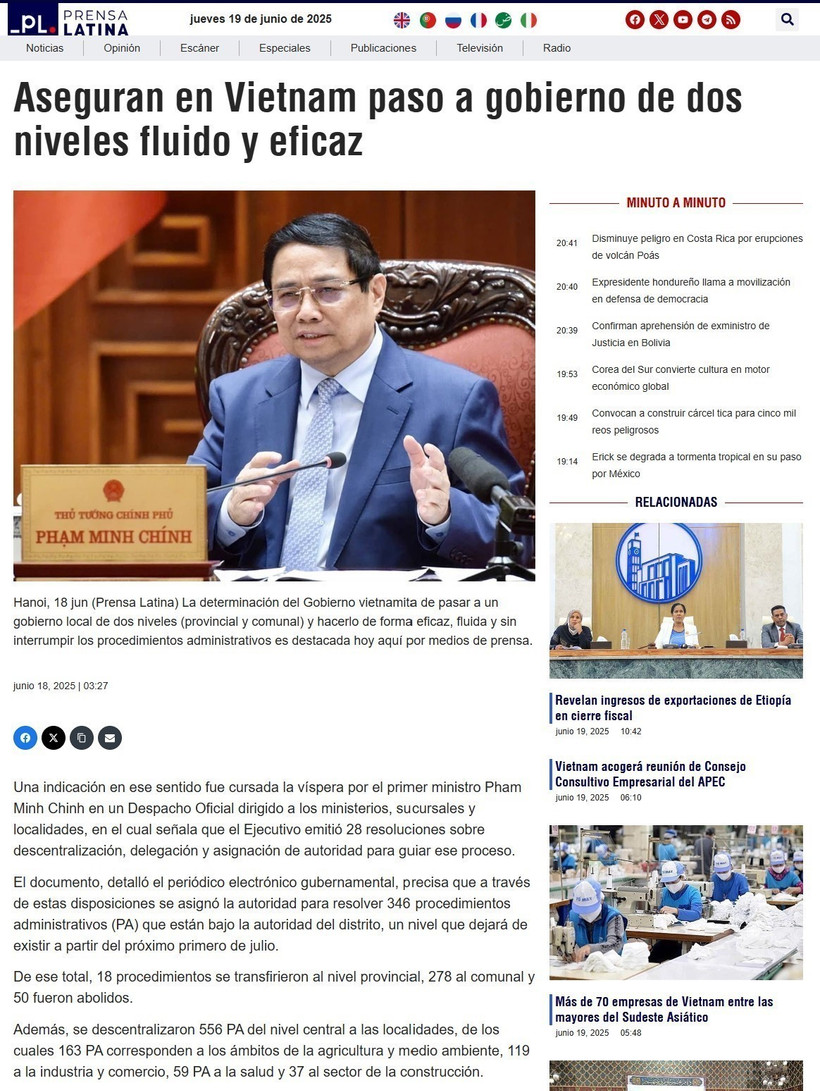
Havana (VNA) – The Latin American News Agency Prensa Latina has run extensive coverage praising Vietnam's determination to push ahead with administrative reform as the country is shifting to a two-tier local government model for a more efficient political apparatus.
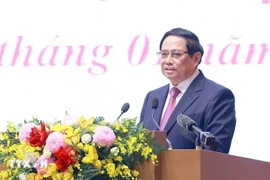
The agency’s recent article on Vietnam’s assurance of smooth and effective transition to a leaner structure highlighted Prime Minister Pham Minh Chinh’s latest directions on implementing 28 resolutions regarding the decentralisation and delegation of authority. Accordingly, among 346 administrative procedures previously handled at the district level, 18 will be transferred to the provincial level for settlement, 178 to the communal level, and 50 eliminated.
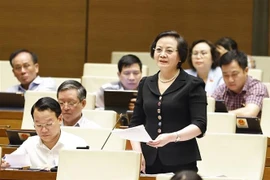
Prensa Latina has shown particular interest in the Southeast Asian country's efforts to simplify administrative procedures. The writing quoted Minister of Home Affairs Pham Thi Thanh Tra's statement at the National Assembly as confirming that local authorities are fully prepared to implement the new two-tier local government model. Since officials and civil servants represent the crucial factor determining the success of this reform effort, it is necessary to restructure and improve human resources quality for the complete transition from traditional administrative management to people-centred governance.
In another article published on June 17, Prensa Latina cited Deputy Finance Minister Ho Sy Hung's affirmation that the reform will expand space for socio-economic development, promote the attraction of high-tech projects, semiconductor manufacturing, and green industry investments. Meanwhile, Deputy Minister of Home Affairs Truong Hai Long emphasised that the new model will save the state budget while facilitating investment and inter-regional infrastructure development.
With continuous institutional reforms, Vietnam is progressively realising its goal of building a modern and transparent administrative system centred on citizens and businesses. The two-tier local government model is expected to make a significant contribution to the country's sustainable development process, according to the news agency./.
See more
Thai tourism to face big challenges due to Middle East conflicts
Thailand’s tourism sector has been directly affected and is facing severe volatility, both in terms of travel costs and tourist numbers after one week of Middle East conflicts, according to President of the Tourism Council of Thailand (TCT) Chai Arunanondchai.
Malaysia counts on domestic demand as key growth pillar
The central bank of Malaysia (Bank Negara) expects to keep inflation at a moderate level and maintain the overnight policy rate (OPR) at 2.75% through 2026.
Japan to cooperate with Malaysia on rare earth refining
Japan will provide technological support to Malaysia in the field of rare earth refining as part of efforts to diversify supply chains.
Indonesia takes another step forward in elephant conservation
All conservation institution managers and tourist attractions that own elephants in Indonesia are required to stop offering elephant riding attractions to visitors.
Indonesia to hasten ethanol blending amid surging global oil prices
Indonesia will accelerate the mandatory blending of bioethanol into fuel as global oil prices surge, its Energy and Mineral Resources Minister Bahlil Lahadalia said on March 9.
Southeast Asia to face warmer-than-usual early summer
Across most of maritime and mainland Southeast Asia, home to more than half a billion people, temperatures will be above average for the March–May period.
Thailand unveils “10 Plus” strategy to weather global instability
Deputy Prime Minister and Finance Minister Ekniti Nitithanprapas said the policy package focuses on concrete economic measures, including initiatives to help low-income households, elderly citizens and small businesses reduce debt, thereby supporting national economic growth.
Indonesia considers fuel subsidy price hike amid rising global oil prices
The Indonesian government continues to target economic growth between 5.5% and 6% in the coming years, following an expansion of 5.11% last year.
Thailand takes strong action against complicity in cybercrime
Airin Phanrit, Deputy Spokesperson for the Prime Minister’s Office, said the damage caused by call centre scams is evident, with some Thais involved in fraudulent activities against their compatriots, including receiving money to open mule accounts. She urged the public, especially young people, not to be tempted by small sums of money to register SIM cards or give personal information to fraudsters for use in online criminal activities.
Indonesia seeks WTO approval to suspend concessions to EU
The dispute dates back to 2018, when the EU issued a directive restricting the inclusion of crop-based biofuels in member states’ renewable energy targets and set a roadmap to phase out palm oil-based biofuels by 2030, citing concerns over the sustainability of palm oil production.
Vietnam reaffirms commitment to promoting nuclear disarmament, non-proliferation
Nguyen expressed his concern over the current international security environment, stressed the importance of advancing disarmament efforts, and called on countries to strengthen solidarity and multilateralism to build trust and shared understanding on this issue.
ASEAN financial integration helps businesses grow: conference
ASEAN has significant financial resources from pension funds to the tune of 4.4 trillion USD and insurance institutions of 5.1 trillion USD that could be utilised to support regional development.
Cambodia strengthens control over retail fuel sales
Cambodia’s Ministry of Commerce has called on the public and fuel station operators across the country to avoid hoarding fuel and to strictly follow technical safety standards in the sale and storage of petroleum products to prevent safety risks and ensure a stable supply.
Laos identifies 10 key tasks to build independent, self-reliant economy
Laos will step up agricultural production to ensure food security, meet domestic demand and expand exports; encourage the development of agro-processing industries, including those related to rubber, aquatic products, cassava and sugarcane, as well as fertiliser and animal feed production, in order to increase added value and create jobs in rural areas.
Singapore passes new anti-vaping law with jail terms of up to 20 years
Under the new regulations, adults who involve young people or vulnerable individuals in smuggling or supplying Kpods could face up to 20 years in prison and up to 15 strokes of the cane.
ASEAN faces startup funding drought risks
ASEAN's startups raised 1.16 billion USD in October-December 2025, slightly down from the same quarter a year earlier. For the full year, funding increased 18% to 5.4 billion USD, but that was still about a fourth of the level seen in the peak year of 2021.
Indonesia steps up waste sorting at source
Waste sorting at source, combined with modern treatment technologies and stronger community participation, will play a decisive role in reducing pollution and building a sustainable waste management system in Indonesia in the coming years.
Laos marks International Women’s Day
The Lao People’s Revolutionary Party and the Lao Government have established policies and legal frameworks to promote women’s development, safeguard women’s rights and interests, and advance gender equality.
Indonesia sets age limits on digital platforms to protect children
Minister of Communication and Digital Affairs Meutya Hafid said Government Regulation No. 17 of 2025 on Electronic System Governance for Child Protection, known as PP Tunas, will delay access to high‑risk platforms until age 16, while lower‑risk services will be available from age 13.
Indonesia looks to expand engineering workforce amid AI push
President of the Institution of Engineers, Indonesia (PII) Ilham Akbar Habibie said the number of engineers per one million people in Indonesia remains low. The country currently has about 2,500 engineers per one million people, compared with around 9,500 in Vietnam – nearly four times higher. He described Vietnam as a typical example of how a nation can rely on engineering to strengthen its economy and drive robust economic growth.