VNU-HCM aims to be among Asia’s top 100 universities

The university announced adjustments to several targets in its development strategy for the 2026–2030 period with an ambition to make breakthroughs in both academic training and scientific research.

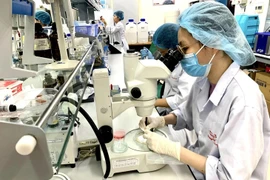
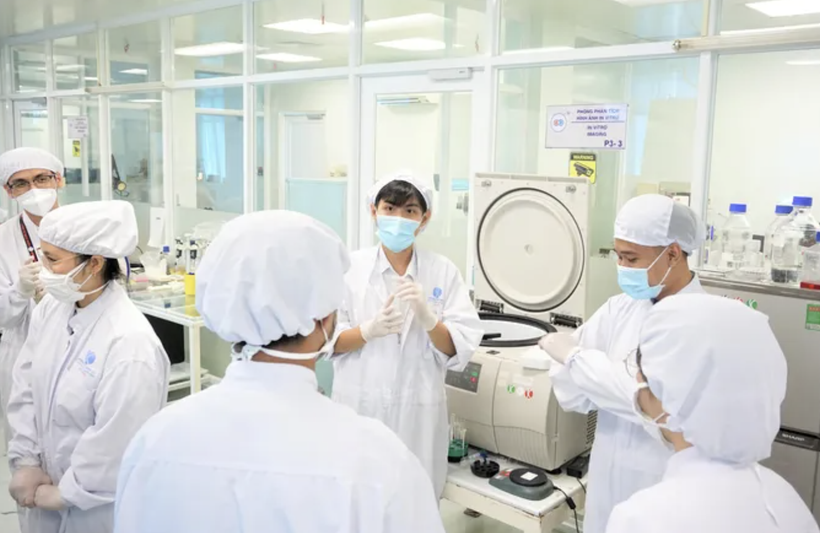
Experts working at the stem cell laboratory of the University of Science under the Vietnam National University, Ho Chi Minh City. (Photo: sggp.org.vn)

HCM City (VNA) – The Vietnam National University, Ho Chi Minh City (VNU-HCM) aims to enter the top 100 higher education institutions in Asia by 2030.

The goal was unveiled at its 2025 annual conference on December 26.

At the event, the university announced adjustments to several targets in its development strategy for the 2026–2030 period with an ambition to make breakthroughs in both academic training and scientific research.

Prof. Dr Nguyen Thi Thanh Mai, President of the VNU-HCM, said the university will strengthen its cooperation with businesses and state agencies, expand international partnerships, and advance education reform as part of its bid to reach the Asian Top-100 ranking.

The promotion of “trilateral” cooperation among the university, businesses, and state agencies is intended to translate research outputs into real-world applications while mobilising support resources more effectively. Priority will be given to developing basic sciences linked with strategic technologies, thereby training elite human resources and creating impactful scientific and technological products.

The VNU-HCM will also continue to deepen international integration by expanding collaboration with leading global universities, research institutes and corporations, attracting foreign experts, and providing opportunities for lecturers and students to learn and work in advanced academic environments. It will play the core role in organising the city's annual science and technology forums and workshops with a high degree of internationalisation. The goal is to connect global knowledge, technology, businesses, and investors, thus gradually shaping an international innovation environment.

For the 2026–2030 period, the VNU-HCM aims to recruit an additional 1,500 PhD-qualified lecturers and experts, with half of all PhD-holders attaining the rank of professor or associate professor. System-wide, it plans to publish 41,200 papers indexed in Scopus, secure 100 international patents, establish eight basic science laboratories incorporating strategic technologies, and complete and effectively run an innovation centre.

In training, it targets English-medium instruction for 60% of STEM programmes and an on-time graduation rate of 70%. It also plans to build one to two international-standard hospitals to support teaching, research, and medical services.

By the end of 2024, the VNU-HCM employed 3,677 lecturers, including 1,323 PhD holders, 41 professors, and 349 associate professors. Talent-attraction schemes have also drawn 71 leading scientists and 58 visiting professors from prestigious foreign universities.

In 2025, the university continued to lead the nation in international scientific publications, with 3,288 papers — up 120 from 2024 — and 11 patents. It also signed 1,237 contracts on science – technology services with revenue totalling 269.67 billion VND (10.2 million USD).

However, it acknowledged that the share of research outputs with commercial potential remains modest, with technology-transfer revenue yet to match the capacity of businesses and the city.

The VNU-HCM also plans to accelerate education reform and digital transformation, developing a smart learning environment that fosters creativity and lifelong learning. Experiential, research-based, and industry-linked learning models will be expanded, while student assessment will increasingly move from standardised testing to multi-dimensional evaluation based on learning outcomes, innovation, and professional experience.

More than 30 years after its establishment, the VNU-HCM remains Vietnam’s largest higher-education system and continues to strengthen its standing in international university rankings. It is currently placed 801–850 globally in QS World 2026 and 175th in Asia in QS Asia 2026, while also leading the nation in Scopus-indexed publications and internationally accredited programmes./.
VNA

See more

Hanoi's sex ratio at birth stands at around 110 boys per 100 girls in 2025. (Photo: VNA)

Hanoi strengthens efforts to curb sex imbalance at birth

Alongside changing mindsets, the capital has implemented a wide range of coordinated solutions to address sex imbalance at birth. Communication campaigns have been intensified at the grassroots level, targeting residential communities, youth, couples preparing for marriage and women of reproductive age.

Nguyen Duy Anh, Honorary Chairman of the Vietnamese Association in Fukuoka. (Photo: VNA)

OVs enjoy diverse channels to contribute expertise to national development

He said OVs are ready to share professional expertise in education, science and technology, and business governance, and facilitate investment connections and trade promotion. They also help preserve Vietnamese culture and language, promote the country’s image abroad, and support social welfare activities at home.

Delegates pose for a commemorative photo at the Bo Y International Border Gate. (Photo: doanthanhnien.vn)

Youths from Vietnam, Cambodia and Laos gather for 2025 festival

Sam expressed his hope that the experiences gained at the festival, together with positive impressions of the heroic and beautiful land of Quang Ngai, will become valuable assets, enabling young people to act as strong bridges for the great friendship among the three countries.

Prime Minister Pham Minh Chinh (central) and students who win prizes at international competitions in 2025. (Photo: VNA)

Prime Minister commends Vietnamese students winning international prizes

According to the Ministry of Education and Training (MoET), over the past decade, Vietnamese student teams competing in international academic contests have won a total of 434 prizes, including 132 gold, 169 silver and 133 bronze medals, along with certificates of merit. Many students achieved consecutive gold medals over two years, while some secured gold medals when they were 10th graders.

Nguyen Hong Son, President of the Union of Vietnamese Associations in Japan, grants an interview to the Vietnam News Agency's reporter. (Photo: VNA)

OV community a vital bridge in Vietnam’s international integration, development

The UVAJ President also praised the Party and State’s consistent and comprehensive policies towards overseas Vietnamese, ranging from citizen protection and integration support to encouraging their contributions to national development. In particular, creating conditions for overseas Vietnamese to engage in political, economic and cultural activities at home reflects the spirit of great national unity.

Illustrative image (Photo: VNA)

Breakthrough mechanisms, policies for education, training approved

Regarding recruitment, employment and management of human resources in the education sector, the Resolution stipulates that the directors of provincial Departments of Education and Training are authorised to recruit and receive teachers, school managers and staff for public kindergartens, general education institutions, continuing education centres, specialised schools and public vocational high schools in their provinces.

Delegates at the opening of the exhibition (Photo: VNA)

Exhibition highlights vitality of Vietnamese cultural heritage

The exhibition features nearly 200 images showcasing Vietnam’s cultural heritage and efforts to preserve and promote its values in recent years. It is structured around four themes: the legal and policy framework for heritage protection; Vietnamese heritage recognised by UNESCO; the diversity and uniqueness of Vietnamese cultural heritage; and cultural heritage for sustainable development.

During the 2026 New Year holiday, civil servants and public employees will enjoy a continuous four-day break from Thursday, January 1, to Sunday, January 4, 2026. (Photo: VNA)

Civil servants, public employees to have four-day New Year break

Under Official Dispatch No. 12729/VPCP-KGVX dated December 25, civil servants and public employees will have a four-day break from Thursday (January 1) to Sunday (January 4, 2026). To offset this, the working day on Friday (January 2, 2026) will be shifted to Saturday of the following week (January 10, 2026).

The campaign aims to mobilise social resources to support 1.5 million people in need during the upcoming Tet (Lunar New Year) holiday. (Photo courtesy of the VNRC)

Vietnam Red Cross Society launches Tet gift campaign

The campaign aims to mobilise social resources to support 1.5 million disadvantaged individuals, including people with disabilities, the elderly, orphaned children and those affected by natural disasters, for the upcoming Tet (Lunar New Year) holiday.

Illustrative image (Photo: VNA)

Incentives in Population Law expected to reverse birth rate decline

Vietnam’s population has already topped 100 million, but the 2025 population report reveals trends accelerating well beyond earlier forecasts. Fertility has nosedived to all-time lows: the total fertility rate slipped from 2.01 children per woman in 2022 to 1.96 in 2023, then plunged to a record 1.91 in 2024.

Hanoi plans fireworks displays at five locations to welcome New Year 2026. (Photo: qdnd.vn)

VGCL supports proposal for four-day New Year break

Under the plan, civil servants and public employees will take the statutory holiday on January 1, be off work on January 2, and make up the working day on the next Saturday, which falls on January 10, 2026. This would create an uninterrupted four-day break from Thursday (January 1) to Sunday, (January 4, 2026).