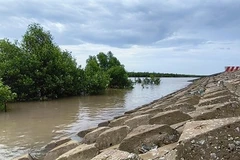
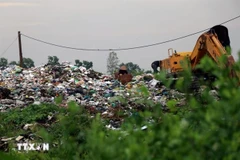
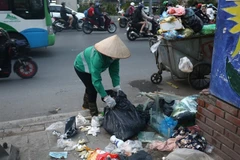
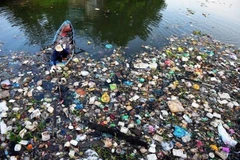
Discarded waste along a coastal road on Hon Son island, Lai Son Commune, Kien Hai district in the southern province of Kien Giang (Photo: VNA)
 Hanoi (VNS/VNA) - Overlapping andineffective coordination between ministries and agencies has been blamed forpoor solid waste management in Vietnam’s rural areas.
More than 60 million people, accounting forabout 73 percent of Vietnam’s population, are living in rural areas.
According to the Ministry of Natural Resourcesand Environment, more than 13 million tonnes of waste and about 7,500 tonnes ofpesticide containers are discarded in the country’s rural areas each year.
More than 80 percent of waste and almost all ofthe containers used for pesticides are not collected for proper treatment.Instead, they are discharged directly into the environment, resulting inserious environmental problems in rural areas.
A study led by Dr Tran Ngoc Ngoan, director ofthe Institute of Human Geography under the Vietnam Academy of Social Sciences,shows that the emergence of residential areas and industrial zones in ruralareas have reduced the area available for cultivation, leading to intensivefarming and increased use of chemical pesticide and fertilisers.
The overuse of pesticides and fertilisers has anegative impact on the surrounding water and soil, as crops can only absorbabout 40-50 percent of the fertilisers used.
Overuse of these products can increaseproduction but this also increases post-harvest waste like straw, husks andbran, most of which is burnt outdoors, threatening human heath and reducing airquality.
If fertiliser and pesticide containers are notcollected and treated properly, the remaining chemicals can have an impact onsurface water like ponds, lakes or rivers, underground water and the soil.
The study also pointed out that the country’s314.7 million poultry and 37 million cattle discharge about 84.5 million tonnesof waste per year. About half of the livestock waste is treated while the otherhalf is discharged into the environment in its raw form.
Ngoan said waste collection and treatment inrural areas was limited. Families in rural areas are used to throwing theirwaste into their gardens, or else joining with other families to pay someone tocollect rubbish and deposit it in a public place, such as a roadside or along acanal.
Under a national programme to develop new ruralareas, about 40 percent of communes established a waste collection team thattransfers the rubbish to a waste treatment firm.
However, rural families still have to pay thewaste collectors by themselves. In urban areas, environmental service firmsreceive funding from the State budget.
“Most of the waste from rural areas is dumped orburnt,” Ngoan said, adding that wastefrom rural areas would increase in quantity and variety, and that items thatcannot decompose like plastic waste “would create bigger pressure on theenvironment”
Vietnam has developed a legal framework andimproved policies to tackle rural waste. However, even the Government’smanagement bodies are still confused over their roles and responsibilities inhandling the issues.
The Ministries of Construction, Industry andTrade, Health, Agriculture and Rural Development and Natural Resources andEnvironment, and their branches in localities are responsible for managing solidwaste.
The Ministry of Natural Resources andEnvironment is in charge of every environmental issue. The Ministry ofConstruction is in charge of solid waste issues, but the solid waste that isgenerated by agricultural activities is overseen by the Ministry of Agricultureand Rural Development.
Hazardous solid waste, including any generatedthrough agricultural activities or in trade villages, is overseen by theenvironment ministry.
The agriculture ministry manages the use,collection and storage of chemical pesticides but the environment ministryhandles violations related to pesticides because they are classified ashazardous waste.
The departments of agriculture in cities andprovinces are assigned to handle environmental protection activities in agricultureand rural areas, but almost none of the departments nationwide have staffspecialising in environmental management.-VNS/VNA
More than 60 million people, accounting forabout 73 percent of Vietnam’s population, are living in rural areas.
According to the Ministry of Natural Resourcesand Environment, more than 13 million tonnes of waste and about 7,500 tonnes ofpesticide containers are discarded in the country’s rural areas each year.
More than 80 percent of waste and almost all ofthe containers used for pesticides are not collected for proper treatment.Instead, they are discharged directly into the environment, resulting inserious environmental problems in rural areas.
A study led by Dr Tran Ngoc Ngoan, director ofthe Institute of Human Geography under the Vietnam Academy of Social Sciences,shows that the emergence of residential areas and industrial zones in ruralareas have reduced the area available for cultivation, leading to intensivefarming and increased use of chemical pesticide and fertilisers.
The overuse of pesticides and fertilisers has anegative impact on the surrounding water and soil, as crops can only absorbabout 40-50 percent of the fertilisers used.
Overuse of these products can increaseproduction but this also increases post-harvest waste like straw, husks andbran, most of which is burnt outdoors, threatening human heath and reducing airquality.
If fertiliser and pesticide containers are notcollected and treated properly, the remaining chemicals can have an impact onsurface water like ponds, lakes or rivers, underground water and the soil.
The study also pointed out that the country’s314.7 million poultry and 37 million cattle discharge about 84.5 million tonnesof waste per year. About half of the livestock waste is treated while the otherhalf is discharged into the environment in its raw form.
Ngoan said waste collection and treatment inrural areas was limited. Families in rural areas are used to throwing theirwaste into their gardens, or else joining with other families to pay someone tocollect rubbish and deposit it in a public place, such as a roadside or along acanal.
Under a national programme to develop new ruralareas, about 40 percent of communes established a waste collection team thattransfers the rubbish to a waste treatment firm.
However, rural families still have to pay thewaste collectors by themselves. In urban areas, environmental service firmsreceive funding from the State budget.
“Most of the waste from rural areas is dumped orburnt,” Ngoan said, adding that wastefrom rural areas would increase in quantity and variety, and that items thatcannot decompose like plastic waste “would create bigger pressure on theenvironment”
Vietnam has developed a legal framework andimproved policies to tackle rural waste. However, even the Government’smanagement bodies are still confused over their roles and responsibilities inhandling the issues.
The Ministries of Construction, Industry andTrade, Health, Agriculture and Rural Development and Natural Resources andEnvironment, and their branches in localities are responsible for managing solidwaste.
The Ministry of Natural Resources andEnvironment is in charge of every environmental issue. The Ministry ofConstruction is in charge of solid waste issues, but the solid waste that isgenerated by agricultural activities is overseen by the Ministry of Agricultureand Rural Development.
Hazardous solid waste, including any generatedthrough agricultural activities or in trade villages, is overseen by theenvironment ministry.
The agriculture ministry manages the use,collection and storage of chemical pesticides but the environment ministryhandles violations related to pesticides because they are classified ashazardous waste.
The departments of agriculture in cities andprovinces are assigned to handle environmental protection activities in agricultureand rural areas, but almost none of the departments nationwide have staffspecialising in environmental management.-VNS/VNA
VNA