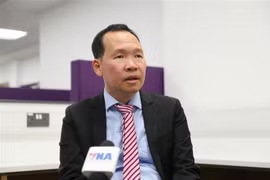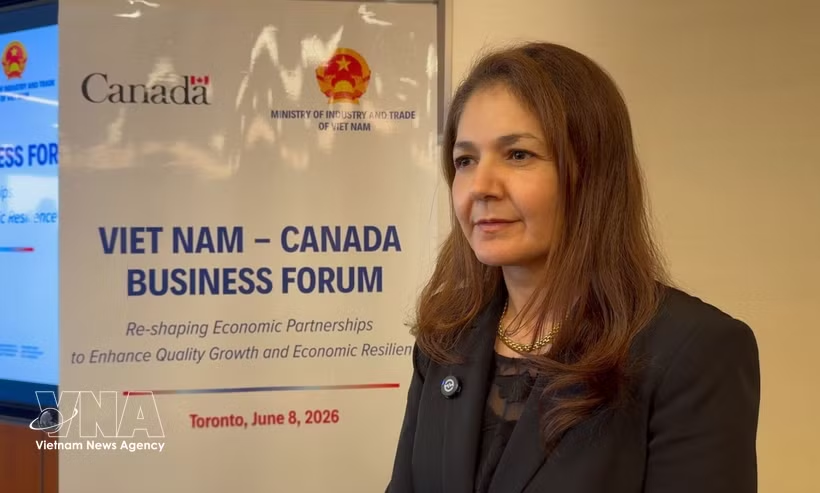
Hanoi (VNA) – Vietnam has boosted its global profile by maintaining positive relationships with major powers while staying true to its foreign policy of independence and self-reliance, according to Vina Nadjibulla, former Vice President for Research and Strategy at the Asia Pacific Foundation of Canada.
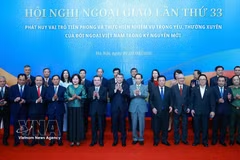
Those gains have made it easier for Vietnam and Canada to deepen substantive cooperation even as global uncertainty grows, she talked with the Vietnam News Agency on the 33rd Diplomatic Conference.
She credited pragmatic diplomacy with allowing Vietnam to build relationships with a range of partners without becoming overly dependent on any single country. That approach, she noted, has become more relevant as major-power rivalry heats up, the global economy fragments, and pressure mounts on countries to pick sides.
Nadjibulla, now Co-founder and CEO of the Centre for Strategic Statecraft (CSS), said the current geopolitical moment has pushed many nations to place greater emphasis on principles that mirror Vietnam’s diplomatic approach. As a result, Vietnam's experience holds lessons not only for Southeast Asia but also for the world.
Vietnam has shown how a country can maintain substantive cooperation with competing major powers while protecting its own national priorities, she said, while cautioning that keeping that balance will only get harder as geopolitical competition intensifies.
Assessing Vietnam’s role in its ASEAN strategy, she called the country one of Canada’s most important partners and a central pillar of Canada’s push to deepen engagement with the Indo-Pacific. Vietnam is now Canada’s largest trade partner inside ASEAN, and its fast-growing economy, expanding manufacturing base, and deep integration into global supply chains make it an increasingly important market and partner.
But she said the current trade imbalance shows that Canada still has plenty of room to grow exports, investment, and cooperation. Closing that gap, she argued, would create a more balanced and sustainable economic relationship.
In her view, the Comprehensive and Progressive Agreement for Trans-Pacific Partnership (CPTPP) provides a key foundation for deeper economic ties, and Vietnam’s turn as CPTPP chair in 2026 will open opportunities to work together on improving how the pact is rolled out.
She added that negotiations on a Canada-ASEAN free trade agreement (FTA) could offer another framework for broader trade and institutional cooperation. Vietnam’s value to Canada, she said, goes beyond its economic potential to include its strategic location, its diplomatic influence within ASEAN, and its support for an open international trading system.
As Canada looks to diversify markets, reduce excessive economic dependence, and build more resilient supply chains, Vietnam can serve not just as a key partner but as an anchor for Canada’s long-term presence in Southeast Asia, she said.
To unlock the relationship’s full potential, Nadjibulla identified building mutual awareness and understanding as the first priority. Even though two-way trade has climbed steadily, many Canadian firms still lack a full picture of Vietnam’s market, industrial strengths, and investment opportunities, while Vietnamese firms could gain from more exposure to Canadian technology, know-how, and partners.
She also urged the two countries to craft a more strategic economic agenda focused on supply chain resilience and economic security. Cooperation could widen in areas of complementary strength, including agriculture and food, clean energy, critical minerals, advanced manufacturing, digital technology, and transport infrastructure.
Vietnam and Canada should make better use of the opportunities and preferences built into the CPTPP while coordinating efforts to advance talks on a Canada-ASEAN FTA, she said. Both sides should also roll out practical steps to help small and medium-sized enterprises take advantage of trade deals and overcome regulatory, logistical, and market information hurdles.
Beyond economic cooperation, Nadjibulla sees plenty of room to bolster diplomatic coordination. Both countries are navigating an increasingly complex and fragmented international landscape while trying to keep constructive relations with various partners.
She noted that Canadian Prime Minister Mark Carney’s government has put trade diversification, domestic economic resilience and new strategic partnerships at the centre of its international agenda. These priorities fit into Vietnam’s foreign policy of independence, self-reliance, multilateralisation and diversification.
Vietnam and Canada can work more closely together as pragmatic middle powers through ASEAN-led mechanisms, CPTPP, and other multilateral forums. Both share an interest in regional stability, open economies, respect for international law, and an international system in which countries retain the freedom to pursue independent policies instead of being forced to align exclusively with any major power.
The essential foundation for a deeper Vietnam - Canada partnership is already in place. The next step, she said, is for both sides to devote more political attention to the relationship, reinforce institutional links, and build a sharper agenda focused on practical, win-win cooperation./.