Bac Ninh reserves industrial land for private tech firms

Bac Ninh is working to support domestic private sci-tech enterprises in accordance with the Party Central Committee's policy, with the goal of making the province a role model in promoting and assisting the private sector.

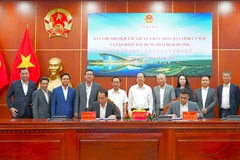
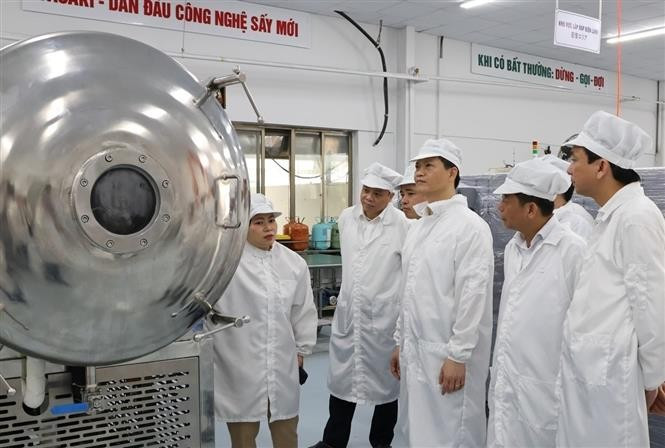
Chairman of the Bac Ninh provincial People’s Committee, Vuong Quoc Tuan (third from the right), visits the workshop of the Hanel Production, Processing and Import-Export Joint Stock Company (Hanel PT) on May 5. (Photo: VNA)

Bac Ninh (VNA) – At least 15–20% of the land in industrial parks and clusters in northern Bac Ninh province is expected to be allocated for domestic private enterprises operating in the science and technology sector.

During a field visit to several Vietnamese private enterprises in the science and technology sector on May 5, Chairman of the provincial People’s Committee Vuong Quoc Tuan praised the companies for their well-organised operations and proactive adoption of advanced technologies to yield positive business results.

Bac Ninh is committed to effectively implementing a “green channel” for administrative procedures to create the best possible conditions for enterprises to boost production and business activities, he noted.

He requested the Department of Industry and Trade and the Bac Ninh Industrial Zones Authority to require industrial park and cluster infrastructure developers reserve at least 15–20% of the land in those zones for domestic private sci-tech enterprises.
100714-bac-ninh-linh-hoat-sang-tao-trong-thu-hut-cac-du-an-dau-tu.jpg
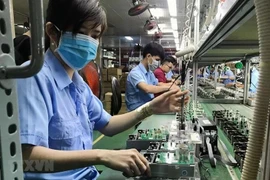
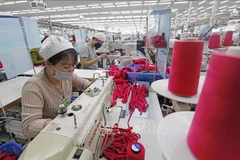
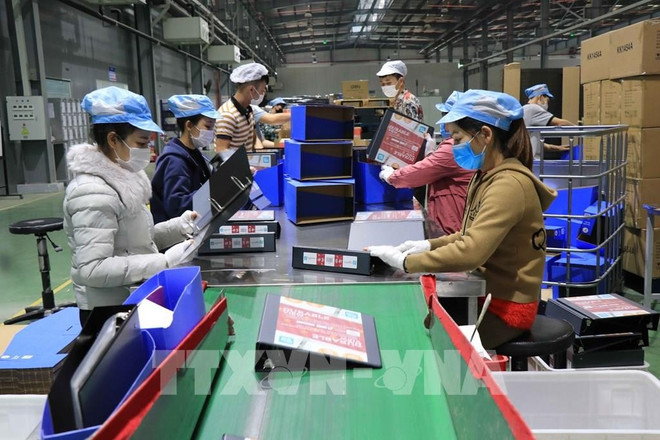
Workers at a factoiry in the Yen Phong Industrial Park, Bac Ninh province (Photo: VNA)

The Chairman highlighted the province’s strong focus on supporting such enterprises in accordance with the Party Central Committee's policy, with the goal of making Bac Ninh a role model in promoting and assisting private sci-tech firms. In the near future, Bac Ninh plans to establish industry-specific associations to enhance collaboration and mutual support among businesses for sustainable development.

The Department of Construction and local authorities have also been tasked with providing comprehensive information and incentive policies regarding social housing and worker housing projects for interested businesses. Meanwhile, the Bac Ninh Industrial Zones Authority will act as the key liaison between enterprises and local training institutions to strengthen the supply of skilled and high-quality human resources.

The Department of Industry and Trade will also collect all business feedback, serving as a bridge between enterprises and authorities, while continuing to develop supportive policies tailored to the needs of the business community./.

VNA

See more

Activities in Chan May Bay, part of the Chan May–Lang Co Economic Zone in Hue city. (Photo: VNA)

Hue steps up investment drive in Chan May–Lang Co Economic Zone

Covering more than 27,000ha, the Chan May–Lang Co Economic Zone is emerging as a key economic, urban, industrial and eco-tourism centre in southeastern Hue, with functional areas dedicated to seaports, industry, non-tariff activities, urban development and tourism.

The Ministry of National Defence's inter-agency inspection team visits La Gi Fish Port in Phuoc Hoi ward, Lam Dong province. (Photo: VNA)

Lam Dong's IUU fishing prevention efforts inspected

According to the Lam Dong provincial IUU Fishing Prevention Steering Committee, all 8,177 fishing vessels measuring at least 6 metres in length have been registered and updated in the national fisheries database VNFishbase.

A member of Minh Quang Cooperative in Hung Yen province works on a farm. (Photo: VNA)

Vietnam aims to link half of farm cooperatives with enterprises by 2030

The Ministry of Agriculture and Environment will promote links between cooperatives, enterprises, science and technology organisations and other economic entities along with carrying out programmes to develop concentrated agricultural, forestry and fisheries raw material areas and enhance value chain production.

The night-time economy is increasingly seen as an important avenue for Vietnam’s tourism sector to extend visitors’ stays (Photo: VNA)

Revitalising growth momentum for night-time economy

The night-time economy has moved beyond being merely an add-on service to become a new growth driver for tourism. Night-time activities can “awaken” familiar heritage spaces and breathe new life into them. Art, light and music experiences after dark can create distinctive attractions while meeting the desire of middle- and high-end visitors to explore cultural depth.

A livestream session promotes green-skinned pomelos grown in Cho Lach commune, Vinh Long province. (Photo: VNA)

E-commerce reshapes rules of game

Once fixed fees, payment fees, infrastructure charges and service packages are included, sellers may have to spend around 24.5-27.6% of their revenue on platforms. The figure shows that the era of easy selling and low costs in e-commerce has officially come to an end.

Ho Chi Minh City targets third-quarter growth of over 11% (Photo: VNA)

Ho Chi Minh City targets third-quarter growth of over 11%

Ho Chi Minh City will continue to implement drastic measures to achieve double-digit growth, targeting GRDP growth of at least 11.07% in the third quarter of 2026, 9.43% in the first nine months and 12.3% in the fourth quarter, with a view to completing the full-year goal of 10% or more.

MM Mega Market An Phu supermarket in Ho Chi Minh City is brightly decorated for the National Day holiday. (Photo: VNA)

Domestic consumption up over 13%, tourism continues strong growth

The total retail sales of goods and consumer service revenues in August were estimated at 679.8 trillion VND (26 billion USD), up 1.6% from the previous month and 14.9% year-on-year. In the January-August period, the figure reached 5.24 quadrillion VND, representing a 13.3% increase year-on-year.

A production line of Onaga Co., Ltd. (Japan) at HANSSIP (Photo: nhandan.vn)

Hanoi moves to maintain appeal to FDI inflows

In the first eight months of 2026, the capital city attracted more than 3.7 billion USD in FDI, equivalent to 83% of the plan set for the year. Newly registered FDI exceeded 572 million USD across 450 projects, up 175.78% in project numbers and 209.46% in capital compared to the same period last year. Additional registered capital topped 492 million USD, while capital contributions and share purchases exceeded 2.6 billion USD.

Saigon Marina IFC is the first private-sector project contributing to realising the goal of developing the Vietnam International Financial Centre in Ho Chi Minh City. (Photo: VNA)

VIFC offers various opportunities to attract forein investment

Turning the VIFC into an effective channel for international capital will require clear rules, quality projects and strong connections between investors and domestic businesses. Meeting these requirements will be key to transforming investor interest into concrete capital flows and investment projects in Vietnam.

Production line at Yadea Vietnam’s smart manufacturing plant, which has an investment of more than 100 million USD, in Tan Hung Industrial Park, Bac Ninh province. (Photo: VNA)

Development model for new era – An inevitable trend

International organisations broadly agree that shifting the growth model from reliance on traditional factors toward technology and innovation is no longer an option for Vietnam, but an imperative of the times.