Building smart vocational schools through digital transformation

Many vocational schools across the country, particularly in Ho Chi Minh City, are accelerating digital transformation initiatives aimed at shaping smart vocational schools.

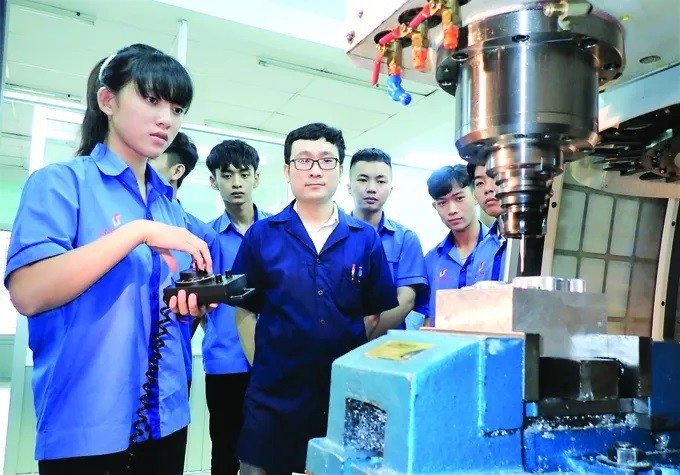
Students in a practice session at Ly Tu Trong College in Ho Chi Minh City (Photo: sggp.org.vn)


Hanoi (VNA)
- As Vietnam moves deeper into the digital era, the demand for a highly skilled workforce with digital competencies is growing.

To meet this challenge, many vocational schools across the country, particularly in Ho Chi Minh City, are accelerating digital transformation initiatives aimed at shaping smart vocational schools. These efforts are intended to enhance training quality and align education more closely with the need of the labour market.

At Ly Tu Trong College of Ho Chi Minh City (LTTC), classes are no longer confined to physical classrooms. Lecturers design digital learning materials, creating an online library that allows students to study flexibly from anywhere. Learners can engage in remote lessons while still mastering the operational processes of machinery through simulations on their computers.


Deputy Principal Dinh Van De noted that the school has invested heavily in digital teaching models, with the “flipped classroom” approach emerging as a highlight. Instead of beginning with lectures in class, lecturers prepare videos and theory materials online for students to review beforehand. Class time is then reserved for tackling complex problems, clarifying doubts, and deeper discussions.

According to Deputy Principal Phan Le Thu of Vien Dong College in Ho Chi Minh City, the school integrates artificial intelligence, big data, and automation into teaching. Blended learning, virtual simulations, and digital resources are employed to ensure students adapt quickly to the evolving labour market.

Elsewhere, institutions such as Cao Thang Technical College, Ho Chi Minh City College of Economics and Technology, and Thu Duc College of Technology have begun applying criteria to evaluate “digital colleges.”

Many are rolling out online learning systems, digital management platforms, shared open-education resources, and virtual reality labs.Despite progress, significant hurdles remain. According to Deputy Director Pham Vu Quoc Binh of the Directorate of Vocational Education and Training, Vietnam’s digital transformation programme for vocational education, approved in late 202,1, set a goal for 70% of vocational institutions to apply digital teaching and management by 2025.

Yet, after nearly three years, only just over half of the 1,545 institutions nationwide have implemented such changes.

The teaching workforce also reflects uneven readiness. Vietnam has nearly 72,000 vocational educators, but only 30% hold a master’s degree, and less than half have bachelor’s degrees.

Around 70% meet professional skill standards, with just half capable of delivering integrated teaching that blends theory and practice. Outdated curricula, slow updates to reflect new technologies, and obsolete equipment further complicate efforts to modernise training in high-tech fields.

Binh emphasised that schools must make extraordinary efforts to meet the 2025 target. This includes prioritising the digitalisation of teaching materials, strengthening the application of emerging technologies in both instruction and management, and focusing on areas of institutional strength to drive transformation.Experts believe digital transformation, combined with experiential learning, will be decisive in reshaping vocational education.

Tran Anh Tuan, Vice Chairman of the Ho Chi Minh City Vocational Education Association, stressed the need for holistic integration from digital governance to standardised data management.

He underlined that investment in technological infrastructure and modern equipment will be crucial to creating an effective and forward-looking training environment.

For Vietnam, the push toward smart vocational schools represents more than a technological shift. It is a strategy to ensure the country’s workforce can thrive in an economy where digital skills and adaptability are no longer optional, but essential./.


VNA

See more

Prime Minister Pham Minh Chinh and delegates visit booths showcasing products at TechFest Vietnam 2025. Photo: VNA

Vietnam to become attractive destination for tech talent, innovative startups: PM

TechFest Vietnam 2025, held from December 12 to 14, is expected to attract more than 60,000 participants both in person and online, with the participation of over 20 corporations, 50 investment funds, more than 100 supporting organisations and incubators, and delegates from Southeast Asia, Northeast Asia, Central Asia, the Middle East, North America, and Europe.

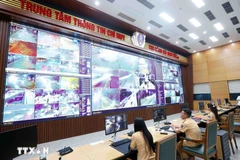
Police offiers mornitor the traffic through AI camera (Photo: VNA)

Applying the Internet of Things in smart transport

The project aims to build a unified, safe and efficient IoT platform to support the management, operation and exploitation of smart transport systems under the Ministry of Construction, with data shared across ministries and localities.

Through long-term commitment, Viettel has brought millions of Burundians into the mobile era and become the first operator to roll out 5G in the country, Viettel Burundi CEO Phan Truong Son noted. (Illustrative photo: VNA)

Viettel secures three prestigious international awards

Viettel has won honours in the “People & Culture” and “Best Operator in a Growth Market” categories at the 2025 World Communication Awards (WCA), alongside the “Best Digital Transformation Project” at the 2025 Global Telecoms Awards (Glotel).

A view of the Can Gio sea-encroaching urban area project (Photo: VNA)

Green-tech push for Can Gio

Vietnam has the capacity, ambition and technological foundation to join the group of leading sustainable coastal urban nations in the coming decade, experts said at a dialogue on "advancing to the sea with ESG++ megacities: breakthroughs through green technology", held on December 9 in Hanoi by the Vietnam Institute for Real Estate Studies (VIRES).

Minister of Science and Technology Nguyen Manh Hung speaks at the meeting (Photo: VNA)

Vietnam turns intellectual property into bankable assets in new law

About AI-generated content, the law draws a clear line: purely autonomous AI creations are not eligible for copyright or patent protection. Those who provide substantial creative input, such as ideas, curation, editing, or selection, qualify as authors or inventors.

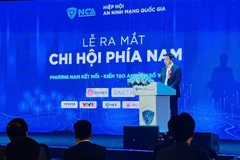
Lieutenant General Nguyen Minh Chinh, NCA Vice Chairman, speaks at the launch ceremony of the southern branch of the National Cybersecurity Association. (Photo: VNA)

National Cybersecurity Association opens branch in HCM City

The southern branch aims to become a coordinating body for cybersecurity tasks, workforce development, awareness-raising and the strengthening of digital defence capabilities across the region, contributing to the safe and sustainable growth of Vietnam’s digital economy.

Viettel exceeds target of 20,000 new 5G stations by more than three weeks. (Illustrative photo: VNA)

Viettel exceeds target of 20,000 new 5G stations by more than three weeks

Viettel plans to continue scaling up its network from now until the end of 2025, with an additional 23,500 stations scheduled for installation, nearly quadruple the number rolled out in 2024. Once completed, Viettel will operate Vietnam’s largest 5G network, with 30,000 stations covering 90% of outdoor areas and 70% of indoor spaces nationwide, from major cities to rural regions.

In Vietnam, demand for infrastructure supporting AI, cloud computing, and digital services is rising at an unprecedented level. (Illustrative photo: VNA)

Vietnam emerges as new hub for data centres

Data centres have surged to become the second most preferred alternative asset class in the region. Vietnam is no exception to this trend as the demand for infrastructure supporting AI, cloud computing, and digital services has risen at an unprecedented level.

Professor Kurt Kremer, from the Max Planck Institute for Polymer Research in Germany, speaks at the event. (Photo: VNA)

Vietnam has advantages to develop versatile humanoid robots: experts

At the symposium, international and Vietnamese experts also discussed the latest trends in robotics, from socially interactive humanoids and collaborative service robots to medical and rehabilitation systems, and examined major challenges surrounding AI safety and ethics to ensure that robotics evolves in a responsible, human-centred and sustainable manner.

The organisers present members of the judging panel of the UAV Cup PV GAS 2025. (Photo: VNA)

UAV Cup PV GAS 2025 promotes Vietnam’s home-grown UAV technology

Jointly organised by Hanoi University of Science and Technology’s Institute of Space and Underwater Technology (ISUT) and Petrovietnam Gas JSC (PV GAS), the competition aims to foster innovation among young people, enhance capabilities in UAV research, design and application, and seek practical technological solutions for smart agriculture, environmental monitoring, logistics, and emergency rescue.