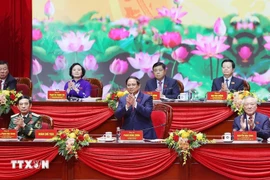
Hanoi (VNA) – Science, technology, innovation, and digital transformation are set to become the central drivers of Vietnam’s sustainable growth in the coming decades, heard the first Congress of the Government’s Party Organisation on October 13.
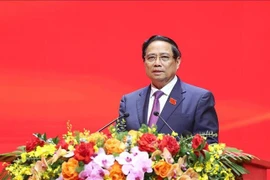
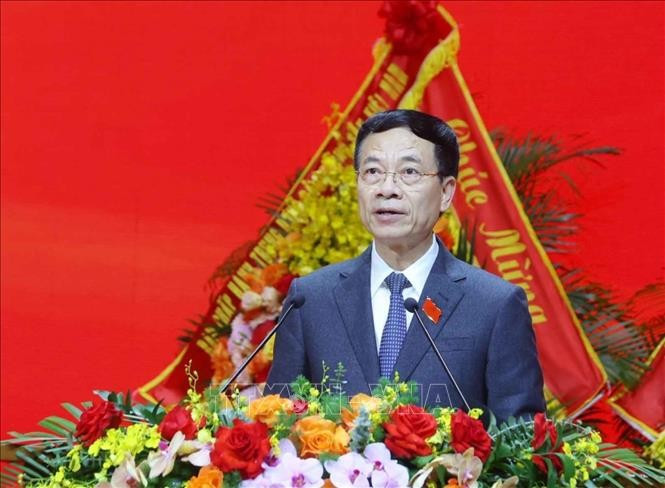
Minister of Science and Technology Nguyen Manh Hung, a member of the Party Central Committee, a member of the Government’s Party Committee, and Secretary of the Party Committee of the Ministry of Science and Technology, delivered a presentation titled “The Party’s leadership role in promoting science, technology, innovation, and digital transformation for a strong and prosperous Vietnam.”
He said agriculture has helped Vietnam escape poverty, while industry has propelled the country to middle-income status. To achieve the goal of becoming a developed nation with high income, the country must now rely on science and technology. No country has ever overcome the middle-income trap without shifting to a growth model based on science and technology, he stressed.
According to the minister, Vietnam’s approach is distinctive as it closely links science and technology with innovation and digital transformation. Science and technology provide knowledge; innovation transforms knowledge into practical value; and digital transformation amplifies knowledge, he said.
Hung noted that Vietnam’s institutional framework for science, technology, and innovation has become increasingly open, enabling, and globally compatible. Resolution No. 57-NQ/TW on breakthrough development in science, technology, innovation, and national digital transformation represents a major shift in vision and marks Vietnam’s transition to a knowledge-based economy.
To implement the resolution, 10 laws in the field of science and technology have been or are scheduled to be issued this year. Over the past five years, Vietnam has made important strides in science and technology, innovation, and digital transformation, reflected in higher international rankings and stronger institutional and infrastructure foundations. These achievements have laid the groundwork for translating scientific progress into economic growth in the coming period.
The State plans to allocate 3–4% of the annual budget—equivalent to about 3–4 billion USD—to mobilise total social investment of 10–15 billion USD for the sectors to contribute at least 5% to the country’s GDP growth.
The Ministry of Science and Technology will be responsible for evaluating the effectiveness of spending, using performance indicators as criteria for allocating future budgets to ministries, localities, and enterprises.
Hung said the sector will focus on mastering 11 groups of strategic technologies to establish Vietnam’s future strategic industries. “In today’s world, failing to master technology means failing to safeguard national sovereignty,” he emphasised.
Innovation will prioritise technological renewal in enterprises and foster creativity among all citizens. The goal is to build a national startup ecosystem and a culture that embraces innovation, encourages discovery, and tolerates failure.
Meanwhile, digital transformation will build a comprehensive digital nation comprising a digital government, a digital economy, and a digital society with digital citizens at its core.
Also delivering a presentation at the congress, Le Manh Hung, a member of the Government’s Party Organisation, and Secretary of the Party Committee and Chairman of the Vietnam National Industry - Energy Group (Petrovietnam), underscored the need to make breakthroughs in innovation. He emphasised mastering strategic technologies such as offshore energy, clean fuels, emission reduction, carbon storage, and new-generation intelligence.
He said Petrovietnam would boost investment in research and development, establish eco-industrial energy centres, and build a high-quality team of experts and scientists capable of meeting the demands of the new development phase. The group will also apply a modern system of performance indicators to measure the effectiveness of innovation activities.
Petrovietnam is also developing major digital platforms, including big data systems, artificial intelligence (AI), and generative AI applications, to enhance governance efficiency and competitiveness in the energy sector.
Hung noted that the group has proactively studied and implemented an improved corporate governance framework aligned with the model of an integrated industrial–energy conglomerate, while updating its development strategy./.