Business networking event held to promote Vietnam - China agricultural trade ties

According to China Customs, in the first half of 2025, China imported 1.35 billion USD worth of fruits from Vietnam, totaling nearly 1.37 million tonnes. Vietnam currently ranks as China’s largest fruit supplier, accounting for 13.6% of China’s total fruit import value and 28.7% of total import volume.

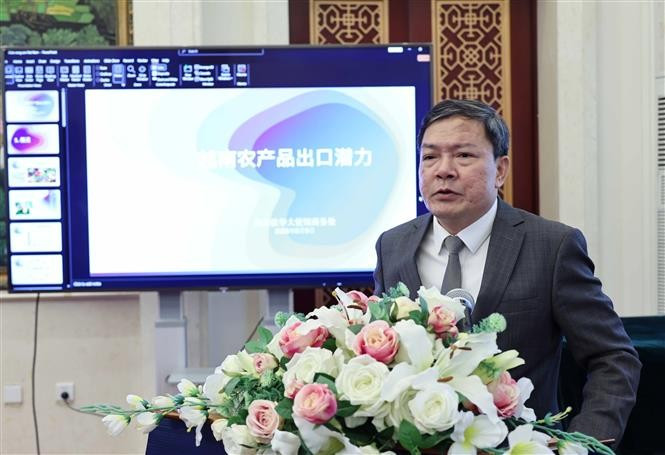
Vietnamese Trade Counsellor in China Nong Duc Lai speaks at the event. (Photo: VNA)

Beijing (VNA) - The Trade Office and the Embassy of Vietnam in China on August 5 organised a Vietnam–China agricultural trade promotion conference in Beijing to promote Vietnamese agricultural and aquatic products, particularly tropical fruits and processed foods, to major Chinese buyers and retailers.

The event brought together more than 40 Vietnamese and Chinese companies operating in agricultural import, retail, food distribution, and e-commerce.

Speaking at the event, Vietnamese Trade Counsellor in China Nong Duc Lai said that China remains Vietnam’s largest trading partner and top export destination for agricultural and aquatic products. China currently imports more than 230 billion USD worth of agricultural goods a year, with nearly ten product categories each exceeding 10 billion USD in import value - a market segment where Vietnam has a strong production and export advantage.

In recent years, Vietnam's agricultural product exports to China have expanded steadily in both scale and value. However, Lai noted that the marketing of products remains limited, and many Chinese consumers are still unfamiliar with Vietnamese agricultural brands. To bridge this gap, he emphasised the need for more product showcases, brand promotion efforts, and direct trade connections, especially in northern and central Chinese provinces.

Representatives of Chinese businesses praised the quality and market potential of Vietnamese fruits and aquatic products, highlighting popular items such as durian, jackfruit, bananas, coffee, cashews, and tra fish. Many expressed strong interest in building direct trade ties with Vietnamese suppliers, hoping to expand imports and bring more high-quality Vietnamese goods to Chinese consumers.

Several Chinese companies also called on the Vietnamese Government to support stronger bilateral trade cooperation, including facilitating customs procedures and creating more opportunities for direct business engagement.

According to Vietnam Customs, in 2024, Vietnam’s fruit and vegetable exports to China totaled 4.63 billion USD, accounting for 64.8% of Vietnam’s total fruit export value. Currently, 12 types of Vietnamese fruits are approved for export to China, including mango, dragon fruit, banana, longan, lychee, watermelon, rambutan, jackfruit, mangosteen, durian, passionfruit, and coconut.

In addition, both countries are actively working to further open the Chinese market for Vietnamese products, including citrus fruits, avocados, wax apples, and lychees.

According to China Customs, in the first half of 2025, China imported 1.35 billion USD worth of fruits from Vietnam, totaling nearly 1.37 million tonnes. Vietnam currently ranks as China’s largest fruit supplier, accounting for 13.6% of China’s total fruit import value and 28.7% of total import volume./.

VNA

See more

Ben Thanh Market in Ho Chi Minh City attracts a large numbers of domestic and international visitor.( Photo: VNA)

Vietnam targets 50 million international visitors by 2030

The Ministry of Culture, Sports and Tourism has outlined three scenarios for 2027–2030. Under the high-growth scenario, international arrivals would rise 15–18 percent annually to reach 45–50 million, while domestic tourism would reach around 160 million trips. Total tourism revenue is projected at 80–90 billion USD.

Factories and production facilities in the Chu Lai Open Economic Zone, Da Nang city, are equipped with modern production lines. (Photo: VNA)

Ready-built factories gain from new manufacturing FDI wave

Ready-built factories attracted 73% of new manufacturing FDI in northern Vietnam over the past two quarters, as foreign investment continued to surge at the region's industrial hubs during the first eight months of 2026. The trend points to growing demand for premises that can be put into operation quickly.

Vietnamese durian industry pivots from volume to value

Vietnamese durian industry pivots from volume to value

Durian has morphed from a high-value crop into a strategic Vietnamese export. But as output climbs and importing markets tighten rules on quality, food safety and traceability, the industry must pivot from volume growth to sustainable value chains, better quality and diversified markets.

A display area for Mid-Autumn Festival cakes at a supermarket (Photo: VNA)

Mid-Autumn Festival cake market heats up at affordable end

Industry insiders say competition is no longer just about the cake itself. Product quality, packaging, brand reputation, delivery services and personalisation are increasingly shaping consumer choices in a market crowded with both domestic and foreign players.

Minister of Foreign Affairs Le Hoai Trung (Photo published by VNA)

Vietnam, India set 25 billion USD trade goal

Vietnam and India agreed to make better use of complementary strengths, ease market access difficulties and facilitate business activities toward achieving the 25 billion USD bilateral trade target.

Delegates at the meeting between Vietnamese businesses operating in Cambodia and the Council for the Development of Cambodia (CDC) on September 14. (Photo: VNA)

Vietnamese businesses seek to expand investment in Cambodia

Vietnam currently has 223 investment projects in Cambodia with total registered capital of nearly 3.4 billion USD. Vietnamese companies operate in agriculture, particularly large-scale farming, finance and banking, telecommunications, aviation, processing, trade and services.

Children visit President Ho Chi Minh's hometown and learn about his childhood. (Photo: VNA)

Vietnam's tourism sector faces labour shortage

A 2026 survey by Hoteljob.vn found that nearly 90% of tourism businesses planned to recruit. In Ho Chi Minh City alone, 89.7% of businesses were hiring, while 71.8% said recruitment was difficult or very difficult. The biggest shortages were among frontline workers, particularly in housekeeping, engineering, food service, front-office operations, and kitchens.