China-ASEAN trade partnership shows resilience amid strong H1 growth

Latest figures from China's General Administration of Customs showed that China-ASEAN trade reached 4.34 trillion RMB (about 641 billion USD) in the January-June period, up 18.2% from a year earlier.

The talks held in Jakarta, Indonesia on July 15 on the China-ASEAN Comprehensive Strategic Partnership. (Photo: VNA)

​Beijing (VNA) – Trade between China and ASEAN expanded strongly in the first half of 2026, underscoring the resilience and dynamism of regional economic-trade ties, according to Xu Ningning, Chairman of the Regional Comprehensive Economic Partnership (RCEP) Industry Cooperation Committee.

Latest figures from China's General Administration of Customs showed that bilateral trade reached 4.34 trillion RMB (about 641 billion USD) in the January-June period, up 18.2% from a year earlier.​

The data reaffirmed ASEAN's position as China's largest trading partner for several consecutive years. Within the RCEP framework, China's trade with the Republic of Korea jumped 42.3% year-on-year, while trade with Japan rose 13.8%. Trade with Australia and New Zealand also remained on a steady upward trajectory. Xu said the China-ASEAN Free Trade Area continues to serve as a cornerstone of regional integration, while RCEP has further expanded the scope of economic cooperation, with the two mechanisms reinforcing each other to boost regional trade.

Xu noted that trade performance differed across ASEAN member states. Indonesia, Vietnam and Thailand emerged as the strongest contributors to bilateral trade growth, each posting increases of more than 20%, led by electronic products and components, as well as electrical machinery and equipment. Trade with Singapore and the Philippines also maintained solid growth, driven by rising exchanges in machinery, electrical products, minerals and other commodities.

He attributed the sustained expansion in bilateral trade to increasingly integrated regional supply chains and a well-established division of labour. China's broad manufacturing base continues to supply ASEAN with key industrial inputs, including electromechanical equipment, photovoltaic products and automotive components, while ASEAN exports minerals, speciality agricultural products and electronic materials, with intermediate goods making up a significant share of two-way trade.

Trade in new energy-related products is also gathering pace. Meanwhile, deeper integration under the China-ASEAN Free Trade Area and RCEP is creating fresh momentum through cross-border logistics and e-commerce.

Looking ahead, Xu said there remains substantial room to strengthen regional economic cooperation. He called for implementation of RCEP through streamlined customs procedures and lower trade barriers, faster rollout of the China-ASEAN FTA Version 3.0 to support higher-level market opening, and closer cooperation in digital trade, the green economy and new energy, alongside stronger support services to help small and medium-sized enterprises (SMEs) integrate into regional industrial chains./.


VNA

See more

An article published on July 9, 2026 by Auto Plus, one of France's leading automotive magazines, gives a positive assessment of VinFast's VF 2 mini electric car. (Photo published by VNA)

French magazine highlights VinFast's rapid growth

According to L'Automobile, VinFast sold 115,916 vehicles in the first six months of 2026, its highest figure since the company began operations. The result also made VinFast the first Vietnamese automaker to surpass 100,000 vehicle sales in the first half of a year.

Thailand–EU FTA talks advance in Brussels

Thailand–EU FTA talks advance in Brussels

The two sides agreed to expedite FTA negotiations and work toward resolving outstanding issues in agricultural products, industrial goods, government procurement, energy and raw materials, digital trade, and regulatory matters, including intellectual property.

Indonesia attracts 5.8 billion USD in foreign inflows after rate hikes

Indonesia attracts 5.8 billion USD in foreign inflows after rate hikes

Data from the central bank showed that after recording net foreign outflows in the first quarter of 2026, Indonesia's government bond market rebounded with net inflows of 17.7 trillion IDR. Meanwhile, cumulative foreign investment in Bank Indonesia Rupiah Securities reached 174 trillion IDR.

Firefighters strive to extinguish a forest fire in Kampar of Indonesia's Riau province on July 20, 2025. (Photo: Xinhua/VNA)

Indonesia strengthens forest fire prevention mechanisms

Under the approach, competent agencies will review existing regulations, strengthen inspections of fire prevention and firefighting systems, and implement measures including weather modification through cloud seeding, monitoring water levels in peatland areas, and pre-positioning personnel and equipment in high-risk locations.

Malaysia moves to enact landmark climate change law

Malaysia moves to enact landmark climate change law

Once passed, the bill will make Malaysia the second ASEAN country, after the Philippines, to enact a dedicated climate change law, and the 60th country in the world to have a standalone legal framework in this area.

Indonesia shifts strategy to combat online gambling

Indonesia shifts strategy to combat online gambling

Minister of Communication and Digital Affairs Meutya Hafid announced on July 14 that the new strategy marks a shift from focusing primarily on blocking gambling websites to a more comprehensive approach targeting the entire criminal ecosystem.

Passengers at the international airport in Bangkok, Thailand (Photo: Xinhua/VNA)

Thailand adjusts visa policy to balance tourism and security

The adjustments aim to ensure that entry facilitation measures for foreign visitors reflect current circumstances while closing security loopholes, preventing misuse, and reducing overlapping entitlements under the principle of “one country, one entitlement”.

​Indonesia's Finance Minister Purbaya Yudhi Sadew (Photo: VNA)

S&P retains Indonesia's BBB credit rating with stable outlook

According to S&P, Indonesia's economic fundamentals remain solid thanks to prudent fiscal and monetary policies, political stability, relatively low public debt compared with other countries in the same rating category, and positive medium-term growth prospects.

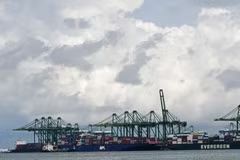
A port in Singapore. The country's GDP expanded by 5.7% year-on-year in the April–June period, easing from the 6.3% growth recorded in the first quarter (Photo: Xinhua/VNA)

Singapore's economic growth slows amid Middle East conflict

Singapore's core inflation remained unchanged at 1.4% in May from the previous month. However, economists warned that persistently high energy prices could continue to push up production and transportation costs, as well as the prices of imported goods, posing risks to the country's economic growth outlook.