Thailand adjusts visa policy to balance tourism and security

The adjustments aim to ensure that entry facilitation measures for foreign visitors reflect current circumstances while closing security loopholes, preventing misuse, and reducing overlapping entitlements under the principle of “one country, one entitlement”.

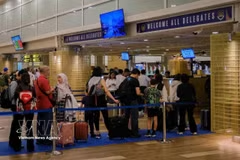
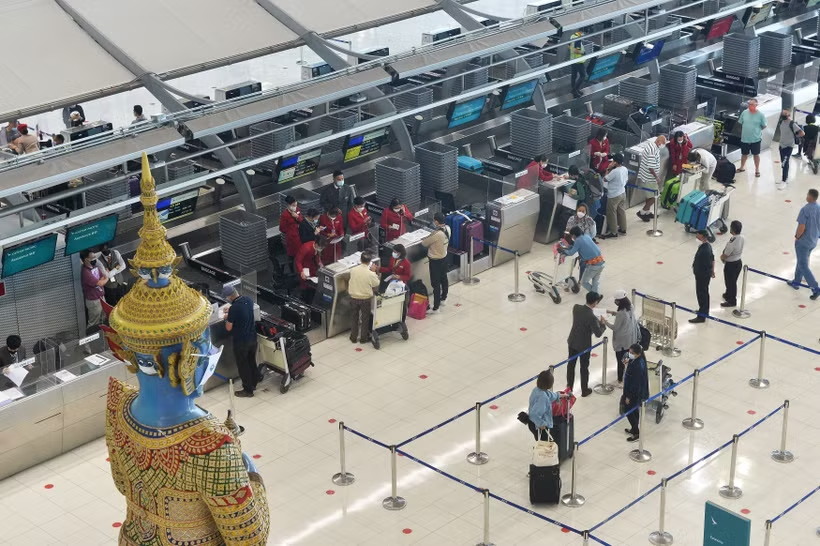
Passengers at the international airport in Bangkok, Thailand (Photo: Xinhua/VNA)

Bangkok (VNA) – Thailand's Cabinet has approved a further review of visa exemption measures and visa privileges to prevent the abuse of the country's visa policies, deputy government spokesperson Ploytalay Laksameesangchan said on July 14.

The adjustments aim to ensure that entry facilitation measures for foreign visitors reflect current circumstances while closing security loopholes, preventing misuse, and reducing overlapping entitlements under the principle of “one country, one entitlement”.

Under the revised policy, Thailand will end the current 60-day visa exemption for nationals of 93 countries and territories, taking into account economic and security considerations, international relations, and reciprocity.

Nationals of 59 countries and territories will instead be allowed visa-free entry for tourism for no more than 30 days. The scheme will also be extended to nationals of six additional countries – India, Croatia, Bulgaria, Cyprus, Malta, and the Maldives – bringing the total to 65 countries and territories. Citizens of Mauritius and Seychelles will be eligible for visa-free tourist stays of up to 15 days, Ploytalay said.

Meanwhile, citizens of Azerbaijan, Belarus, and Serbia will be eligible for visas on arrival (VoA) at designated entry points. Thailand will discontinue VoA for Indian nationals to avoid overlap with the visa exemption scheme.

Five related draft regulations will take effect 15 days after their publication in the Royal Gazette. Travellers who enter Thailand before the new rules come into force will be allowed to stay for the period granted under the previous regulations.

Ploytalay stressed that the changes are not intended to restrict tourism development but to make Thailand's visa system more standardised and transparent. The revised policy seeks to balance economic stimulus, travel facilitation, and international relations with national security while preventing the misuse of visa privileges for illegal activities./.
VNA

See more

​Indonesia's Finance Minister Purbaya Yudhi Sadew (Photo: VNA)

S&P retains Indonesia's BBB credit rating with stable outlook

According to S&P, Indonesia's economic fundamentals remain solid thanks to prudent fiscal and monetary policies, political stability, relatively low public debt compared with other countries in the same rating category, and positive medium-term growth prospects.

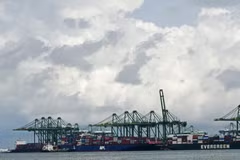
A port in Singapore. The country's GDP expanded by 5.7% year-on-year in the April–June period, easing from the 6.3% growth recorded in the first quarter (Photo: Xinhua/VNA)

Singapore's economic growth slows amid Middle East conflict

Singapore's core inflation remained unchanged at 1.4% in May from the previous month. However, economists warned that persistently high energy prices could continue to push up production and transportation costs, as well as the prices of imported goods, posing risks to the country's economic growth outlook.

 Thailand dismantles online gambling ring linked to World Cup 2026

Thailand dismantles online gambling ring linked to World Cup 2026

The bureau’s investigation targeted the "All Game 248" gambling website, which allegedly accepted bets on the FIFA World Cup 2026 and had been operating for about 18 months. During the operation, codenamed "All Game End Game," authorities arrested 12 suspects, including a former local politician, and the seizure of assets worth more than 13 million THB (418,000 USD).

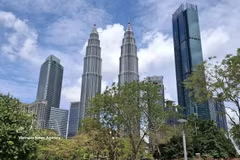
The Petronas Twin Towers in Kuala Lumpur, Malaysia (Photo:VNA)

Four key risks cloud Malaysia's economic outlook in H2 2026

The report identified prolonged global supply chain disruptions, a stronger US dollar, rising political uncertainty ahead of a possible early general election, and the proposed expansion of the FTSE Bursa Malaysia KLCI as the key risks.

Thailand, Malaysia launch new Sadao border checkpoint

Thailand, Malaysia launch new Sadao border checkpoint

The new Sadao Border Checkpoint, located in the Sadao Special Economic Development Zone, is Thailand's busiest land crossing by trade value, handling more than 471.5 billion THB (14 billion USD) in annual imports and exports and serving more than 6 million cross-border travellers each year.

Passengers wait to handle procedures at Nugah Rai International Airport in Bali, Indonesia. (Photo: VNA)

Indonesia tightens visa-free entry policy

Director General of Immigration Hendarsam Marantoko said the move forms part of a broader strategy to strengthen immigration management through digitalisation and enhanced screening of foreign nationals upon entry.

 Malaysia propels semiconductor industry

Malaysia propels semiconductor industry

Speaking at a seminar in Kuala Lumpur on July 13, Economy Minister Akmal Nasrullah Mohd Nasir said Malaysia's electrical and electronics (E&E) exports rose 39.7% year-on-year to 382.9 billion MYR (95.7 billion USD) in the first five months of 2026, or 48.2% of the country's total exports.

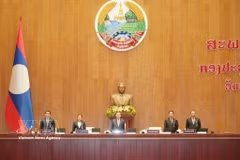
Officials at the closing sitting of the 10th Lao NA's first extraordinary session on July 10, 2026 (Photo: VNA)

Laos adopts coordinated steps to propel economic growth

Lao Prime Minister Sonexay Siphandone, addressing the first extraordinary session of the 10th Lao National Assembly from July 6-10, said the push is designed to hit the economic growth targets and macroeconomic benchmarks approved by the legislature.

Indonesia launches campaign to protect endangered rainforest elephants

Indonesia launches campaign to protect endangered rainforest elephants

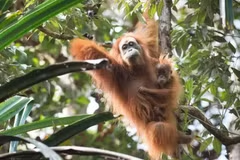
Conservation groups classify the Sumatran elephant as critically endangered on the International Union for Conservation of Nature (IUCN) Red List, while Bornean elephant populations have declined sharply because of deforestation, habitat fragmentation and increasing human-wildlife conflict.