Hanoi (VNA) - Many countries around the world have reopened their borders to fully vaccinated visitors in the hope of soon reviving their economies. And the "key" to such a decision is vaccine passports.
A vaccine passport can be understood as a certificate in paper or digital form that indicates an individual's COVID-19 vaccination status or COVID-19 test results. This would enable a person to travel between countries with mutual recognition of the certificate.
In fact, this is not a new idea. It first appeared nearly 150 years ago in a special context of the history of world epidemiology.
This concept has become popular in the context of the outbreak of the COVID-19 pandemic. Caused by SARS-CoV-2, this virus has spread death everywhere and has become a terrifying obsession to people.
History of vaccine passports
In the 1880s when smallpox appeared, students and teachers in the US were required to submit proof of smallpox vaccination before attending classes.
By 1897, when the Russian scientist Waldemar Haffkine successfully developed a vaccine against the plague, a vaccination requirement order was immediately applied by the British colonists in India.
 A vaccine passport proves that one has been fully injected against COVID-19. (Photo: The Regulatory Review)
To ensure that the disease did not break out at the pilgrimage sites of Hindus and Muslims, which made up the majority in India, the then government required people to get vaccinated and bring proof before entering these areas.
In the second half of the 20th century, air passengers, before boarding, must certify that they had been vaccinated against a corresponding disease at the time. If found infected, the passenger was subject to mandatory quarantine.
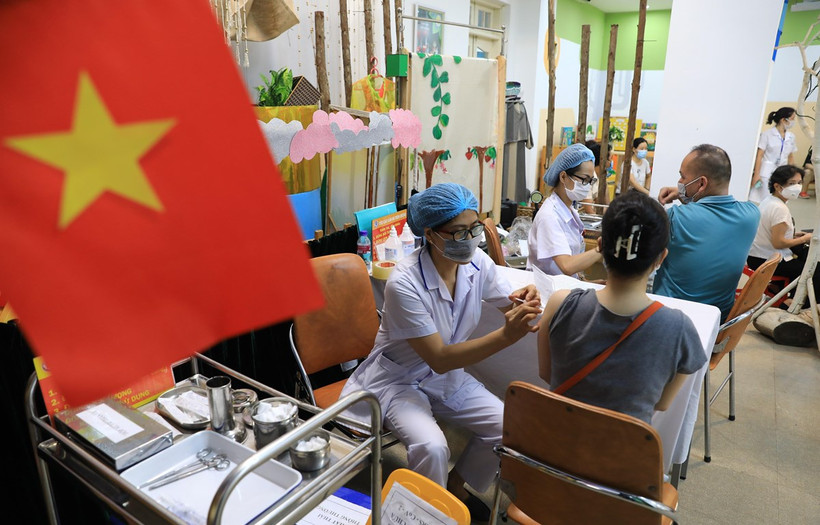
 The Vietnamese Government is trying to vaccinate the entire population against COVID-19. (Photo: VNA/VietnamPlus)
In today’s world, in response to the COVID-19 pandemic, many countries have chosen the vaccine passport solution. Most of these are presented in the form of a QR code sent to people’s smartphones or other similar authentication processes.
However, to minimise discrimination from those who have not or cannot be vaccinated, some vaccine passports include a testing result and/or a confirmation of recovery from COVID-19. In case of a citizen not having a smartphone, the authorities can allow him or her to replace an electronic passport with a paper one.
Countries open doors for vaccine passports
The World Travel & Tourism Council (WTTC) issued the ‘Safe Travels’ stamp in 2020 in an effort to recognise safe destinations around the world.
By September 2021, more than 400 destinations around the world, from Portugal to Puerto Rico, Sri Lanka, Slovenia, Tunisia, and Thailand had used this certification. The council considers the universally accepted standard good news for the global tourism industry.
 The vaccination certification system is researched and developed by the Vietnam National Administration of Tourism (VNAT). (Photo: VNAT)
It is worth mentioning that many EU members have even exempted citizens of nearly 20 "safe list" countries from medical quarantine if they have tested negative for COVID-19, even when they have yet to complete their vaccinations.
With an economy that is heavily dependent on tourism, from November 1 this year, Thailand will end the COVID-19 quarantine requirement for vaccinated travelers from 10 low-risk countries. The list of travelers eligible for quarantine exemption will be expanded from December.
Vietnam needs flexible regulations
Associate Professor Dr Tran Dac Phu, senior advisor at the Public Health Emergency Operations Centre under the Health Ministry, said the internationalisation of vaccine passports not only allows convenient travel for people between countries and regions, but also facilitates the restoration of economic development, trade and tourism, based on the principle of ensuring COVID-19 prevention and control measures for both visitors and people in host countries.
Vietnam does not need to wait until completing the vaccination for all adults nationwide to consider opening its door through the application of vaccine passports, he suggested.
 Illustrative photo (Source: VNA/VietnamPlus)
However, experts said that the recognition of vaccine passports between Vietnam and other countries should consider many different factors. These factors would include the kind of vaccines; the number of injections; the injection interval between the last injection to the entry; and the validity of the vaccine passport; among others.
Currently, Vietnam is applying a 7-day concentrated quarantine for arrivals with vaccine passports.
Phu also recommended that the recognition of the special passports should be considered with vaccines approved by the World Health Organization/reputable pharmaceutical agencies/developed countries or following the agreement of the two countries involved./.