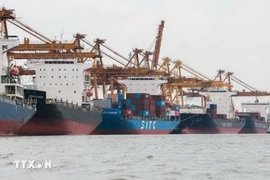
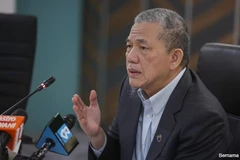
Bangkok (VNA) – The Thai Government should develop a national strategy to address circumvention and adjust production structures by adding value to agricultural and industrial products, aligning with global trends, according to an economist.
Basing on the US government's decision to impose a reciprocal tariff of 19% on Thai goods and his analysis of the country’s 24 main exports to the US, including smart phones, computers, tyres, chips, and transformers, Aat Pisanwanich, an expert in international economics and an advisor on ASEAN affairs at Intelligence Research Consultant, predicted that there may be a trade diversion effect for these goods in the near future.
His analysis found the US tariffs may reduce Thailand's exports by 8.16 billion USD. When factoring in the trade diversion effect, they could drop by 457 billion THB (14.14 billion USD) this year.
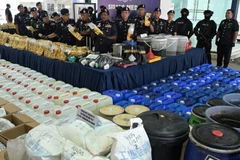
He called on the Government to swiftly develop a national strategy to address circumvention practices and the improper use of rules of origin, particularly for goods containing local content at a rate of less than 40%.
This initiative should include collaboration with the US Trade Representative to create digital traceability, a verification system for such goods.
The economist also urged authorities to create a new industrial production chain, enabling expansion and connection with other markets while securing Thailand's share in the US.
A significant overhaul of the production sector is essential, enhancing the value of agricultural and industrial products to align with global market trends, he stated, adding that a new investment framework should be introduced, requiring foreign investors to increase their procurement of materials from Thai small- and medium-sized enterprises and farmers./.
Thailand offers 150 mln USD green credit to SMEs
Thailand emits roughly 350 million tonnes of carbon dioxide equivalent annually, with the energy and industrial sectors accounting for more than 75% of this amount. Though this volume represents just 1% of global emissions, the Thai Government is eager to achieve carbon neutrality, a balance between carbon dioxide emissions and absorption, by 2050.