Beijing (VNA) – The four major orientations set out at the 3rd plenum of the 14th Party Central Committee reflect an important shift in Vietnam’s development thinking, from focusing on organisational reform to improving the operational capacity of the Party and political system, enhancing governance effectiveness, and promoting development based on knowledge and science-technology.
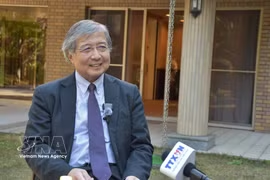
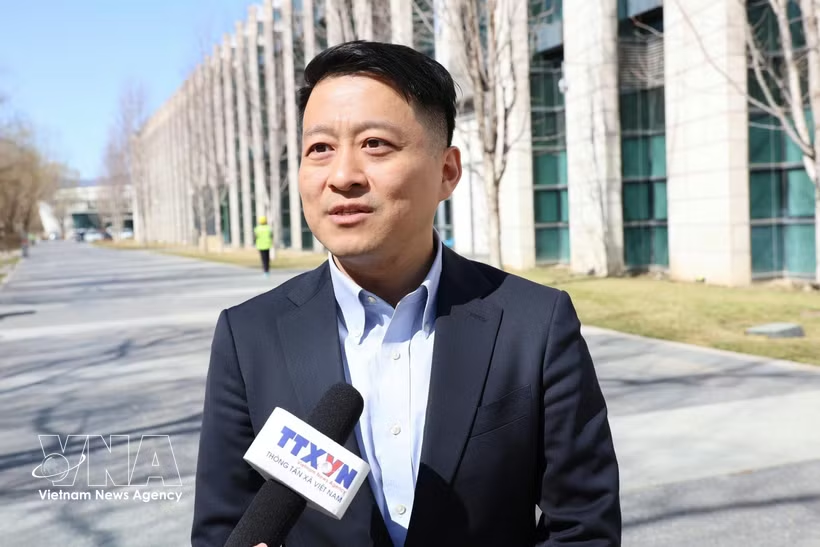
The assessment was made by Professor Qu Qiang from Minzu University of China, a commentator for China Global Television Network (CGTN), in a recent interview with Vietnam News Agency (VNA) correspondents in Beijing.
Assessing the significance of the orientations, Qu said the most notable change is Vietnam’s transition from “organisational restructuring” to “improving governance effectiveness.” Previously, reforms focused on streamlining the apparatus and reducing intermediary levels. With organisational reforms largely completed, the more important task is now to ensure the new system operates more effectively. He said organisational reform is only a prerequisite, while the ultimate goal is to strengthen leadership and governance capacity and better serve the people.
Regarding efforts to improve the operational capacity of the Party and political system, Qu likened the process to “upgrading the software” of the governance system. Organisational adjustments provide the initial foundation, but substantive improvements require better operating mechanisms, coordination capacity, and policy implementation.
On unified management of national resources, he said Vietnam needs to overcome fragmented resource management by viewing land, marine areas, urban spaces, infrastructure and data as part of an integrated whole, aligned with national strategies and regional development advantages. Better coordination in planning and resource management will facilitate major development projects, he noted.
Qu described knowledge- and science, technology-driven development as an important pathway for Vietnam to transform its growth model, moving from reliance on capital, natural resources and low-cost labour toward productivity, knowledge, data, technology, innovation and high-quality human resources. This, he said, will help Vietnam improve development quality and overcome the middle-income challenge on its path toward becoming a high-income country.
The scholar also highlighted proactive risk prevention as a shift from responding to problems after they emerge to forecasting and preventing them. Amid geopolitical competition, climate change and global supply-chain shifts, strengthening national resilience is crucial for sustainable development.
However, Qu noted that Vietnam will face challenges in ensuring the newly streamlined system operates in a coordinated manner. Powers and responsibilities must go hand in hand, with additional duties accompanied by adequate decision-making authority, financial resources and personnel.
The new governance structure also requires officials to develop stronger cross-sector coordination, strategic thinking and digital governance skills. Resources saved through streamlining should be redirected toward development investment, growth and improved living standards.
He suggested that the central level focus on strategic direction and institutional development; provincial authorities promote management innovation and organise development space; and the grassroots concentrate on directly serving people and businesses.
He stressed the need to remove bottlenecks, unlock resources and prioritise tasks capable of generating spillover effects. Personnel assessment should be based on performance, particularly the ability to resolve difficulties, promote development and serve the people.
Social oversight, transparency and broad public consensus are also essential to the reform process, he said, stressing that the ultimate measure of reform is not how the apparatus is arranged, but whether responsibilities are fulfilled, resources are unlocked and people genuinely feel the benefits of this process./.
See more
CPV has strategic planning capacity to prevent risks at early stage: Chinese scholar
The CPV leadership has recognised emerging risks and measures to address them, Cheng said, adding that this demonstrates such leadership not only has a long-term vision for the future but also possesses the strategic planning capacity needed to anticipate and mitigate risks at an early stage.
Lawmakers discuss customs reform linked to digital transformation, risk management
Continuing the agenda of its ongoing first extraordinary session, the 16th National Assembly (NA) on August 3 heard proposals and verification reports on two bills, including the Law amending and supplementing several articles of the Law on Customs, and the Law revising Article 6 and Appendix IV on the list of conditional business lines under the Law on Investment.
Bills seek to institutionalise Party policy on State compensation liability
Legislators on August 3 discussed the draft revised Law on Dissemination and Education of Law and the draft Law amending and supplementing a number of articles of the Law on State Compensation Liability as part of the first extraordinary session of the 16th National Assembly.
Institutional reform key to unlocking new development model: experts
Resolution No. 19-NQ/TW, adopted at the third plenum of the 14th Party Central Committee, identifies breakthroughs in institutions and reforms as the starting point for renewing Vietnam’s development model, alongside reforms in national governance, organisation and operations to build new development capacity.
Institutional framework must not hinder Vietnam's rapid, sustainable development: Top legislator
NA Chairman Tran Thanh Man said that under the Party’s leadership and through close coordination among the NA, the Government, and relevant agencies, institutional and legal reforms have achieved positive results, especially in renewing the law-making mindset and applying technology, digital transformation, and artificial intelligence.
First extraordinary session of 16th National Assembly opens
The first extraordinary session of the 16th National Assembly (NA) kicked off in Hanoi on August 3, with lawmakers set to consider and decide on a series of items, including 15 draft laws, four draft normative resolutions and a range of major issues concerning national development.
Over 43,000 legal normative documents reviewed
As of July 30, ministries, agencies and localities had conducted a preliminary review of more than 43,000 legal normative documents nationwide, identifying provisions that need to be amended, supplemented, replaced or annulled.
☀️ Morning digest on August 3
The following is a list of selected news summaries reported last night by the Vietnam News Agency.
22nd national conference on foreign affairs focuses on advancing local foreign affairs for development
Addressing the conference, Minister of Foreign Affairs Le Hoai Trung emphasised the role of local foreign affairs in realising the nation’s development goal, affirming that the national target of achieving 10% growth is a substantive requirement, with local foreign affairs playing an important role in realising this goal.
Legislation must pave the way for development: NA leader
For the NA, he said, success should not be measured simply by completing the legislative agenda, but by improving the quality of every law and resolution so that each legal instrument effectively addresses institutional obstacles and generates momentum for growth.
Proposal on establishment of centrally-run Bac Ninh city approved
Under Resolution No. 205/NQ-CP dated August 1, 2026, the Government assigned the Ministry of Home Affairs to coordinate with relevant ministries and agencies to fully incorporate comments from Government members into the submission, the proposal, and the draft National Assembly (NA) resolution on the establishment of the centrally-run city in accordance with regulations.
Address by Party General Secretary and State President at 33rd Diplomatic Conference
By upholding the tradition of Vietnam’s revolutionary diplomacy and bringing into full play collective wisdom, mettle and sense of responsibility, the entire diplomatic sector and external relations forces will remain united, proactive and creative in successfully fulfilling their tasks, contributing to maintaining peace, safeguarding the Fatherland, expanding development space and enhancing Vietnam’s international standing.
Congratulations sent to Switzerland on National Day
Party General Secretary and State President To Lam on August 1 sent a congratulatory message to President of the Swiss Confederation Guy Parmelin on the occasion of the 735th National Day of Switzerland (August 1, 1291 – 2026).
33rd Diplomatic Conference: Foreign affairs to help shape new era of national development
The 33rd Diplomatic Conference officially opened in Hanoi on August 1, with presentations from ministries, central agencies and local authorities offering in-depth analysis of practical developments and proposing breakthrough solutions across a wide range of sectors, contributing to the country's diplomatic agenda in a new era of development.
33rd Diplomatic Conference: Ministers stress need to safeguard national interests to the fullest
Vietnam must consistently pursue its foreign policy of independence, self-reliance, self-strengthening, peace, friendship, cooperation and development, and diversification and multilateralisation of external relations, while promoting deep, comprehensive and effective international integration to safeguard the national interests to the fullest extent.
33rd Diplomatic Conference: Top leader’s broad directions provide fresh impetus for new stage of development
To effectively carry out top leader To Lam's directions, the diplomatic sector’s first and most fundamental step is to further improve awareness and professional capacity across all spheres. Diplomats must gain a deep understanding of the Party's and the State's directions, fully grasp the country's development requirements in the current context, and stay abreast of new demands arising from the rapidly changing international environment.
Diplomatic achievements lay groundwork for upgrading Vietnam–Canada ties: diplomat
Among Vietnam's broader diplomatic achievements, relations with Canada stand out as one of the partnerships with the greatest potential for future development. The two countries share many common interests and complementary strengths, particularly in sustainable development, green transition, supply chain security, science-technology, and innovation.
33rd Diplomatic Conference: Vietnamese diplomacy shifts from paving the way to creating development resources
Vietnamese diplomacy is entering an important transition, shifting from expanding relations and enhancing the country’s international standing to mobilising resources for national development in the new era, said Vietnamese Ambassador to the US Nguyen Quoc Dung.
Vietnam's diplomacy must stay proactive, promote strategic standing in new era: Ambassadors
Vietnam's enhanced standing, capacity and confidence after four decades of Doi Moi (Renewal) provide a solid foundation for the diplomatic sector not only to maximise external resources for national development, but also to make active and responsible contributions to international peace and security.
Foreign affairs must play pioneering role, provide sound advice, take prompt action: Top leader
A good diplomat must first have firm political mettle and always take national interests as the compass for action. Every foreign affairs official must remember that behind them stand the Party, the country and the people, stressed Party General Secretary and State President To Lam.