33rd Diplomatic Conference: Vietnamese diplomacy shifts from paving the way to creating development resources

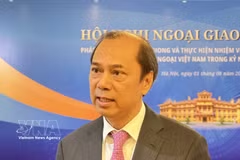
Vietnamese diplomacy is entering an important transition, shifting from expanding relations and enhancing the country’s international standing to mobilising resources for national development in the new era, said Vietnamese Ambassador to the US Nguyen Quoc Dung.

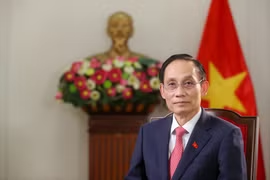
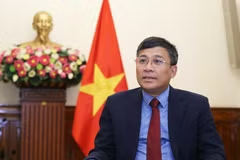
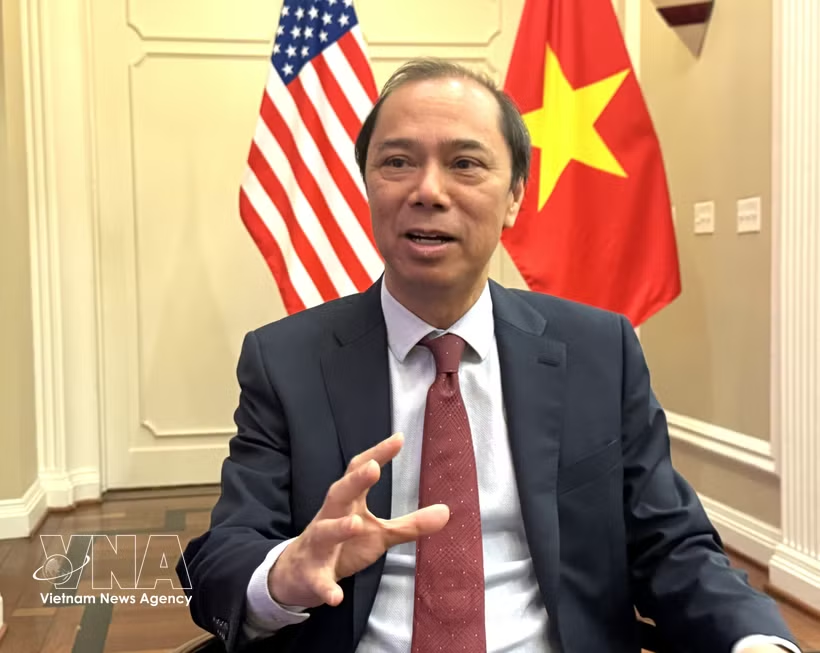
Vietnamese Ambassador to the US Nguyen Quoc Dung (Photo: VNA)

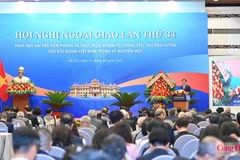
Washington D.C. (VNA) – As the 33rd Diplomatic Conference and the 22nd National Conference on External Affairs are taking place in Hanoi from August 1-7, Vietnamese Ambassador to the US Nguyen Quoc Dung said Vietnamese diplomacy is entering an important transition, shifting from expanding relations and enhancing the country’s international standing to mobilising resources for national development in the new era.

In an interview with Vietnam News Agency correspondents in Washington D.C., Dung stated that over nearly four decades, the thinking and criteria for assessing the effectiveness of foreign affairs have evolved rapidly alongside the country’s development. In the past, diplomacy focused on helping break the blockage and embargo, normalise and expand international relations, and create a favourable environment for the Doi Moi (Renewal) process. Today, the key task is to turn diplomatic achievements into development capacity, competitiveness, economic autonomy and resilience.

He stressed that diplomacy in the new period must go beyond expanding relations and strengthening political trust to mobilise technology, capital, knowledge, governance and markets to directly serve national development. At the same time, Vietnam’s core diplomatic principles remain unchanged, including steadfastly pursuing the foreign policy of independence and self-reliance, placing national interests first, maintaining a peaceful and stable environment, and proactively adapting to global changes.

In the context of science and technology, innovation, digital transformation and high-quality human resources emerging as new growth drivers, development-focused diplomacy should be placed at the centre, he said, highlighting economic diplomacy, science-technology diplomacy and innovation diplomacy as breakthrough areas to attract new projects, technologies, markets and resources for the country.

The ambassador noted that the effectiveness of foreign affairs should no longer be measured merely by the number of cooperation frameworks or high-level visits, but by the concrete resources, conditions and capabilities generated for Vietnam’s development, as well as the domestic economy’s capacity to absorb and utilise them.

Regarding Vietnam-US relations, Dung described the US as a particularly important partner in the fields of economy, finance, science and technology, and innovation. Under President Donald Trump’s second administration, trade, tariffs, economic security, advanced technology and supply chains have become key issues, presenting both opportunities and challenges for Vietnam.

It requires the Vietnamese Embassy in the US to strengthen its monitoring, forecasting, policy advisory and connectivity capabilities, and assess the impact of US policy developments on Vietnamese ministries, localities and businesses to promptly propose responses and solutions to expand cooperation, he said.

Development-focused diplomacy also depends on domestic preparedness, from clearly identifying needs for technology, investment and human resources to ensuring the capacity to receive and implement cooperation projects, he added.

The ambassador highlighted the Vietnamese community in the US, particularly intellectuals, experts and entrepreneurs, as an important resource for national development. He called for concrete cooperation programmes and clear mechanisms to turn their initiatives and connections into practical outcomes.

Dung also stressed the need to reform the operations of Vietnamese representative missions abroad, shifting from broad-based to targeted connectivity, strengthening host-country analysis, strategic forecasting and early warning capabilities, and establishing regular coordination with domestic agencies, localities and businesses.

Investing in diplomatic personnel, he said, is ultimately an investment in Vietnam’s capacity to mobilise external resources, safeguard national interests and achieve its development goals for 2030 and 2045./.

VNA
See more

Vietnam sends condolences over passing of Lao NA President

Vietnam sends condolences over passing of Lao NA President

In the message, the Vietnamese side described Comrade Saysomphone Phomvihane as an outstanding leader of the Lao Party, State and people, and a steadfast communist who devoted his life to the revolutionary cause of the LPRP and to building and developing a peaceful, independent, united and prosperous Laos.

National Assembly Chairman Tran Thanh Man leads a high-ranking delegation of the Party and State of Vietnam to pay tribute to Politburo member and President of the National Assembly of Laos Xaysomphone Phomvihane. (Photo: VNA)

Vietnamese top legislator pays tribute to Lao NA President

Writing in the book of condolences, the Vietnamese leader expressed his profound sorrow over the passing of Comrade Xaysomphone Phomvihane, describing it as a great loss to the Lao Party, State, NA and people, as well as to Vietnam, which had lost a great friend and loyal comrade who made important contributions to strengthening and developing the great friendship, special solidarity, comprehensive cooperation and strategic cohesion between the two countries.

General Secretary of the Communist Party of Vietnam (CPV) Central Committee and President To Lam on August 9 departs Hanoi for state visits to Australia and New Zealand. (Photo: VNA)

Top leader departs for state visits to Australia, New Zealand

General Secretary of the Communist Party of Vietnam (CPV) Central Committee and President To Lam's visits, from August 9-14, are made at the invitations of Governor-General of Australia Sam Mostyn and Governor-General of New Zealand Cindy Kiro.

General Secretary of the Communist Party of Vietnam Central Committee To Lam (R) hosts Australian Governor-General Sam Mostyn in Hanoi on September 10, 2025. (Photo: VNA)

New impetus for deeper Vietnam–Australia ties

Party General Secretary and State President To Lam's state visit comes as the Vietnam–Australia Comprehensive Strategic Partnership is booming. Leaders expect it will inject new momentum, making ties deeper, more substantive and more effective.

Vice Chairman of the National Assembly Nguyen Doan Anh (standing) presides over the session on August 8. (Photo: VNA)

National Assembly reviews bill on WMD non-proliferation

Most deputies agreed on the need for the law, saying it will help complete the legal framework for implementing Vietnam’s international commitments and proactively prevent, detect and stop the proliferation of nuclear, chemical and biological weapons and related delivery systems.

The ASEAN flag hoisting ceremony held in Hanoi on July 31, 2026 to mark the 59th founding anniversary of ASEAN and the 31st anniversary of Vietnam's accession to the bloc. (Photo published by VNA)

Vietnam to remain active player in shaping ASEAN’s future: minister

Entering a new era of national development with the aspiration of building a strong and prosperous country, the mindset of "growing alongside ASEAN" will guide Vietnam’s more proactive, positive, and substantive contributions to the ASEAN Community and the co-creation of the region’s shared future, noted Minister of Foreign Affairs Le Hoai Trung.

National Assembly Chairman Tran Thanh Man (R) and President of the National Assembly and Speaker of the House of Representatives of Thailand Sophon Zaram in Hanoi during the latter's official visit to Vietnam from August 5-7, 2026. (Photo: VNA)

Thailand's parliamentary leader concludes official visit to Vietnam

Thailand attaches great importance to its Comprehensive Strategic Partnership with Vietnam, and the two countries share a solid foundation of friendship, many common strategic interests and significant potential for cooperation, said President of the National Assembly and Speaker of the House of Representatives of Thailand Sophon Zaram.

Politburo member and Minister of Foreign Affairs Le Hoai Trung speaks at the 33rd Diplomatic Conference's closing session in Hanoi on August 7, 2026. (Photo: VNA)

33rd Diplomatic Conference wraps up in Hanoi

Foreign relations are no longer viewed simply as relations with the outside world but as an integral component of national comprehensive strength and a responsibility shared by the entire Party, people, armed forces and political system.

Lawmakers in a group discussion (Photo: VNA)

Lawmakers seek legal reforms to promote telecom infrastructure data sharing

A deputy of Ha Tinh province said there is currently no clear legal basis for sharing technical infrastructure data. While the issue may be less apparent under normal circumstances, it could hamper local coordination and response during storms, floods and other disasters when detailed infrastructure data is not readily available.

Consuls general of ASEAN countries in Ho Chi Minh City show calligraphy works presented to them at the gathering on August 7. (Photo: VNA)

Get-together celebrates 59th founding anniversary of ASEAN

​Despite differences in history, culture, languages, religions, levels of development, and social conditions, ASEAN member states have chosen to respect one another, build consensus, and pursue shared regional interests. It’s the unity in diversity that has shaped ASEAN’s identity, strength, resilience, and central role in the regional architecture.