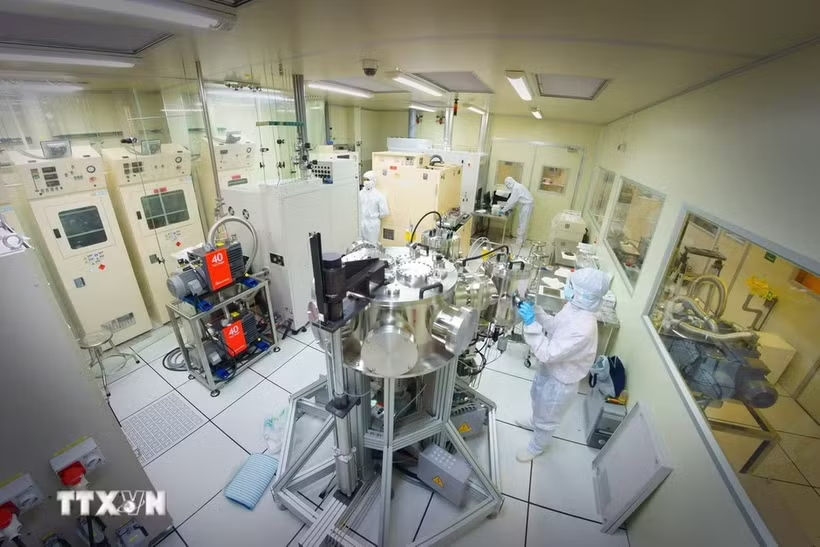
Hanoi (VNA) - More than 18 months after the Politburo issued Resolution No. 57-NQ/TW on breakthroughs in science, technology, innovation and national digital transformation, localities nationwide have rolled out concrete measures to translate it into practical programmes, mechanisms and initiatives supporting national development.
Shifting from process to measurable outcomes
A recent meeting of the Central Steering Committee on science, technology, innovation and digital transformation, chaired by Party General Secretary and State President To Lam, marked a new phase in implementing Resolution 57 following the committee’s restructuring.
He stressed that the reorganisation represented not merely an administrative adjustment but a strategic shift to meet the demands of the next development stage.
The meeting emphasised moving from monitoring implementation to managing outcomes. Each task must clearly define the problem to be solved, expected outputs, end users, responsible agencies and individuals, implementation conditions and evaluation criteria.
A task should only be considered complete when its results are in use and deliver measurable impact. Projects ready for implementation should proceed without delay, while unresolved issues must have clear timelines and responsibilities. New or unprecedented initiatives may be piloted under controlled conditions before wider rollout.
This reflects rising expectations for science and technology programmes. While institutional reforms and policy frameworks laid the foundation, success will now be judged by technologies, products and tangible contributions to socio-economic development.
General Secretary and President Lam also highlighted the need to transform Vietnam from a workforce reliant on routine labour to one driven by creativity, making high-quality human resources the country's greatest long-term asset.
Farmers should become digital farmers capable of using advanced agricultural technologies; workers should master modern equipment; entrepreneurs should lead innovation; and public officials should shift from administrative management to development-oriented governance.
Achieving this requires investment to focus on high-impact, scalable projects with clear applications rather than fragmented initiatives that fail to produce competitive technologies.
Research must be geared towards commercialisation and enhancing national competitiveness, with businesses involved from identifying challenges through research, testing and commercial deployment. The State should refine institutions, commission research, share risks and help create early markets, while universities and research institutes should be assessed by the practical value of their technologies and products.
These priorities provide a framework not only for central agencies but also for local governments to develop initiatives suited to local conditions.
Local implementation gathers pace
The national strategy is increasingly reflected in concrete local programmes aimed at developing skilled human resources, advancing strategic technologies, strengthening links between research institutions and businesses, and bringing innovation into practical application.
The central province of Gia Lai has emerged as one of the most active provinces by identifying quantum technology and semiconductors as strategic priorities.
It has hosted an International Conference on Quantum Technology and Semiconductors, launched the "Road to Vietnam Quantum" programme and designated 2026 as Gia Lai Quantum Year under the theme "Connecting Quantum – Mastering Technology – Driving Development.”
Provincial leaders said the focus on quantum technology is intended not to follow global trends but to prepare early by developing talent, research capacity and international partnerships in technologies expected to shape future growth. The province aims to advance science, technology, education and an innovation-friendly environment simultaneously.
Meanwhile, strengthening governance for atomic energy has become another priority. The seventh National Nuclear Regulatory Conference, held in Quang Ninh province, reviewed progress in radiation and nuclear safety management and identified priorities for 2026–2035.
Participants called for improvements in the legal framework, stronger regulatory capacity, workforce development aligned with International Atomic Energy Agency (IAEA) standards, and closer coordination among regulators, local authorities and international partners. These measures are considered essential for ensuring the safe, secure and internationally compliant expansion of atomic energy applications and Vietnam's nuclear power programme.
Alongside developing emerging technologies, many localities are seeking closer cooperation among government agencies, universities, research institutes and businesses.
At a scientific workshop on strengthening links between government, academia and industry, Lam Dong province outlined plans to establish a long-term cooperation mechanism with businesses at its centre. Rather than simply supporting research, the province aims to encourage demand-driven innovation.
Under this "co-creation" model, businesses would help define research priorities, provide co-investment, adopt research outcomes and commercialise new technologies. The State will coordinate policies and resources, while universities and research institutes would contribute expertise, technology solutions and skilled personnel. Success will be measured by commercialisation and socio-economic impact.
This approach mirrors the direction set by General Secretary and State President Lam, who called for businesses to participate throughout the innovation process and for research institutions to be evaluated based on the technologies and value they generate. The alignment between central policy and local implementation shows growing efforts to make research more responsive to development needs.
More than 18 months after Resolution 57 was introduced, implementation has entered a phase where concrete results matter most. While institutional reforms remain important, the effectiveness of science, technology, innovation and digital transformation will increasingly be judged by successful execution and the creation of products and technologies that deliver tangible value to the economy and society./.