Vietnam, Southeast Asia Semiconductor Association deepen semiconductor cooperation

Welcoming the SEMI Southeast Asia delegation, Deputy Prime Minister Ho Quoc Dung commended the association and its members for supporting Vietnamese ministries and agencies in advancing cooperation in science, technology, innovation and digital transformation, which he described as key drivers of the country's next phase of economic growth.

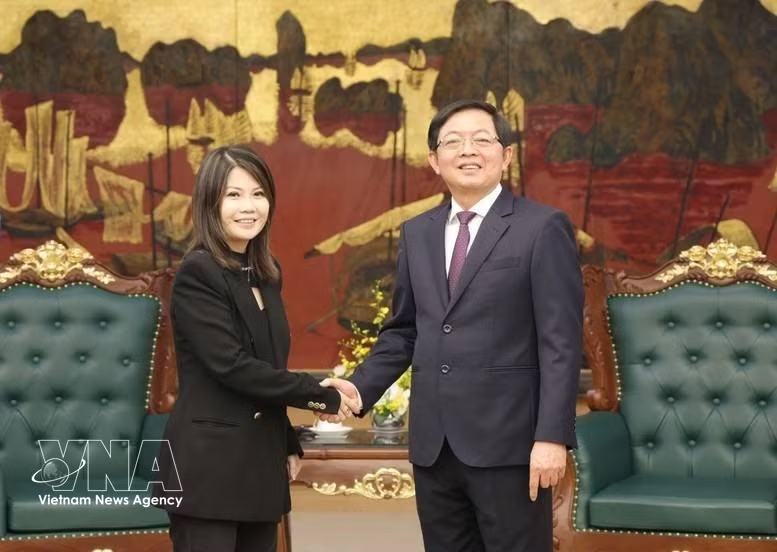
Deputy Prime Minister Ho Quoc Dung (right) receives Linda Tan, President of the Southeast Asia Semiconductor Association. (Photo: VNA)

Hanoi (VNA) - Deputy Prime Minister Ho Quoc Dung held a meeting in Hanoi on July 30 with Linda Tan, President of the Southeast Asia Semiconductor Association (SEMI Southeast Asia), and representatives of its member companies to discuss expanding cooperation in developing Vietnam's semiconductor industry and strengthening its integration into regional and global supply chains.

Welcoming the SEMI Southeast Asia delegation, the Deputy PM commended the association and its members for supporting Vietnamese ministries and agencies in advancing cooperation in science, technology, innovation and digital transformation, which he described as key drivers of the country's next phase of economic growth.

Deputy PM Dung said Vietnam aims to sustain double-digit economic growth between 2026 and 2045 as it strives to become a high-income country. To achieve this goal, the Government has identified science, technology, innovation and digital transformation as strategic priorities underpinning a new growth model.

He highlighted the semiconductor industry as one of Vietnam's priority sectors, expressing his hope that SEMI Southeast Asia would continue serving as a bridge between Vietnam and the global semiconductor business community.

The Deputy PM encouraged the association to connect its members with investment opportunities in Vietnam, expand partnerships with local enterprises, and provide policy advice and technical expertise to help Vietnam participate more actively in activities of the association as well as in regional and global semiconductor ecosystems.

He expressed his hope that SEMI Southeast Asia will promote Vietnam's investment environment to its more than 3,000 member companies and international partners, helping attract high-quality semiconductor investment projects. The Deputy PM stressed that cooperation in developing a highly skilled workforce, particularly semiconductor engineers, would be critical to supporting the industry's long-term growth.

He assigned the Ministry of Finance to work closely with SEMI Southeast Asia in preparing future cooperation programmes aimed at improving investment promotion efforts and attracting more investors in the semiconductor and innovation ecosystems.

Linda Tan reaffirmed SEMI Southeast Asia's commitment to supporting Vietnam's vision for building a globally competitive semiconductor industry. She said the Government's development strategy and the participation of relevant ministries at the meeting had given member companies a clearer understanding of Vietnam's priorities, needs and long-term commitment to the sector.

She thanked Vietnam's Ministry of Finance and National Innovation Centre for their coordination with SEMI Southeast Asia, which has contributed to the growth of the SEMI Expo into an important platform linking Vietnam with the global semiconductor ecosystem.

According to Tan, SEMI SEA will continue connecting Vietnam with the international semiconductor community, while its member companies remain committed to long-term cooperation and are ready to identify areas where they can further support the country's semiconductor development.

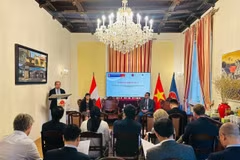
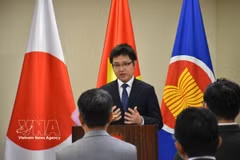
Also at the meeting, Dutch Deputy Ambassador to Vietnam Rick Slettenhaar praised the growing Vietnam–Netherlands partnership in the semiconductor sector. He noted that as a key player in the global semiconductor value chain, the Netherlands welcomes the increasing number of international semiconductor companies choosing Vietnam as an investment destination.

He said the Netherlands wishes to continue working with the Vietnamese Government to ensure that semiconductor incentive policies are implemented in a transparent, stable and predictable manner, thereby strengthening investor confidence among Dutch businesses./.
VNA

See more

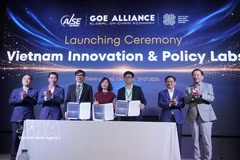
Representatives of participating organisations sign an agreement and officially launch the Vietnam Innovation & Policy Labs, an independent policy research and advisory organisation, at the Vietnam Global Innovation Connect (VGIC) 2026 in Ho Chi Minh City on July 29. (Photo: VNA)

Technology, talent to drive Vietnam’s digital leap forward: forum

The Vietnam Global Innovation Connect (VGIC) 2026 serves as a platform for dialogue among policymakers, enterprises, startups, investors and the global Vietnamese expert community to transform knowledge, technology and resources into practical initiatives and projects that contribute to the country's development.

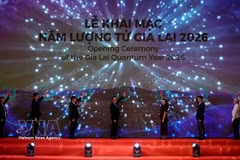
Delegates mark the launch of Gia Lai Quantum Year 2026. (Photo: VNA)

Gia Lai launches Quantum Year 2026

Held under the theme "Quantum Connectivity – Mastering Technology – Breakthrough Development", Quantum Year 2026 centres on four pillars: science, technology, education and training, and innovation ecosystem development.

AI offers both opportunities, challenges for Vietnam’s growth

AI offers both opportunities, challenges for Vietnam’s growth

Dr. Ho Duc Thang, a full-time member of the National Assembly’s Committee for Cultural and Educational, said productivity is the key to sustaining double-digit economic growth, and AI has greater potential to improve productivity than any previous technology.

Attracting sci-tech talent plays a critical role. (Photo: VNA)

Sci-tech seen as lever for Vietnam’s new growth phase

Raising the level of scientific and technological development is the only way to break out of the middle-income trap. Without it, Vietnam will remain stuck in low-value segments, said Dr. Le Xuan Sang, Deputy Director of the Institute of Vietnam and World Economy.

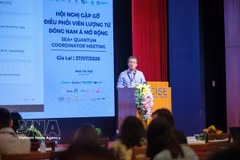
A speaker addresses the SEA+ Quantum Coordinator Meeting held in Gia Lai province on July 27. (Photo: VNA)

Regional conference strengthens Southeast Asia’s quantum technology ecosystem

Stronger networks linking government agencies, research institutes, universities, businesses and scientific organisations will provide a solid foundation for faster and more effective development of quantum technology, contributing to the sustainable development of each country and the region as a whole, said a Gia Lai official.

VAST Vice President Prof. Dr. Tran Tuan Anh speaks at an event in Vienna. (Photo published by VNA)

VAST expands global partnerships through science and people-to-people diplomacy

During a working visit to Austria from July 19-23, a VAST delegation led by Vice President Prof. Dr. Tran Tuan Anh held a series of meetings with leading research institutions and international organisations, including the International Institute for Applied Systems Analysis (IIASA), the Austrian Academy of Sciences, the Vienna University of Technology (TU Wien), and the International Atomic Energy Agency.

The Quantum Hackathon for Social Good 2026 (QC4SG 2026) kicks off in Quy Nhon, Gia Lai province, on July 24. (Photo: VNA)

Int’l quantum computing hackathon kicks off in Gia Lai

As a key activity within the technology component of the Gia Lai Quantum Year 2026, the event brings together nearly 100 contestants across 26 teams, including students, PhD candidates, young researchers, startups, and tech talents, alongside 50 domestic and international experts, mentors, and judges.

Speakers at the workshop held in Ho Chi Minh City on July 22 (Photo: VNA)

Vietnam urged to develop sovereign AI in digital era

Data has become a strategic asset and a key resource for socio-economic development, as well as a foundation of national competitiveness. As a result, effective data governance, utilisation and protection have become increasingly urgent for organisations and businesses.

(Illustrative photo; VietnamPlus)

Expert calls for secure national digital archives system

Building a national electronic archives system is not merely a matter of investing in technological infrastructure. It must be designed in an integrated manner from the outset, encompassing system architecture, governance procedures, and data protection mechanisms, to ensure long-term security, integrity, and data sovereignty.

The need to develop human resources for the atomic energy and nuclear power sectors is becoming increasingly urgent. (Illustrative photo from the Vietnam Government Portal)

Vietnam needs tens of thousands of nuclear power workers by 2035

According to the Agency for Radiation and Nuclear Safety under the Ministry of Science and Technology, human resources will be among the decisive factors determining whether the country can successfully implement its nuclear power programme on schedule.