Data, AI, resilient transformation shapes future of insurance industry

Market growth is no longer measured solely by revenue size or the number of contracts, but increasingly depends on service quality, risk management capabilities, innovation and the ability to build lasting trust with customers.

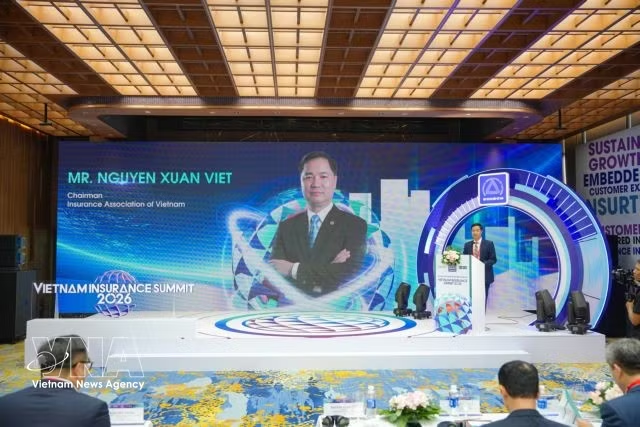
Nguyen Xuan Viet, Chairman of the Insurance Association of Vietnam, speaks at the summit. (Photo: VNA)

Hanoi (VNS/VNA) - The Vietnamese insurance industry is making use of global technological trends to meet the development requirements in the new era, where AI, data and resilient transformation have become a decisive factor for the sector's competitive edge and sustainable development, experts said at a summit on July 30.

Nguyen Xuan Viet, chairman of the Insurance Association of Vietnam (IAV), told attendees at the 2026 Vietnam Insurance Summit that the insurance industry is entering a new phase of development with higher demands.

Market growth is no longer measured solely by revenue size or the number of contracts, but increasingly depends on service quality, risk management capabilities, innovation and the ability to build lasting trust with customers, Viet said.

Meanwhile, the global economy continues to see uncertainties and new challenges, he noted. This means that customers not only want faster claims processing but also expect insurance companies to be able to support them in predicting and mitigating risks early.

Data and AI are therefore becoming core competencies in the modern insurance industry, according to Việt. When used effectively and responsibly, AI not only helps insurers improve operational efficiency, but also unlocks the potential for deeper customer understanding, the development of more relevant products and the provision of more proactive and personalised service.

“However, we must also recognise that technology is not the destination. The true value of the technology transformation lies in using technology to build trust, enhance service quality and develop a transparent, safe and sustainable insurance market.

"This is a journey that requires the collaboration of regulatory bodies, insurance companies, technology partners and the entire ecosystem,” he noted.

Ngo Viet Trung, director of the Ministry of Finance’s Insurance Supervision and Management Department, told the summit that domestic insurers have actively invested in data, AI and digital platforms to optimise operations, improve customer experience and develop new products and services.

He said that the department will continue to support the business community in the process of innovation, while gradually perfecting the legal framework for the research and application of AI and new technologies in insurance operations.

Trung also noted that the application of AI for the insurance sector – where customer trust is the foundation of development – needs to ensure transparency, accountability in decision-making, protection of personal data, information security and effective risk management mechanisms. These are also priorities for many regulatory bodies and insurance markets worldwide building a safe and sustainable digital insurance ecosystem.

“Our approach is to encourage innovation while managing risks, promoting the use of technology to improve operational efficiency, product development and service quality, while safeguarding policyholders' legitimate rights and interests and ensuring data security, cybersecurity and transparency in the use of AI," Trung said.

“We also believe that the development of AI is not just a matter for individual businesses, but requires close coordination among regulatory agencies, insurance and technology companies, research organisations and partners in the ecosystem."

He said sharing international experience, updating new trends and discussing management models and solutions will help develop the Vietnamese insurance market in a modern, transparent and sustainable direction.

At the summit, experts discussed how data and AI can be used to enhance resilience, while also examining the shift toward customer-centric, platform-based ecosystems. They also highlighted critical approaches to transforming insurance operations and business models in an increasingly digital landscape.

Sang Lee, president of Chubb Life Southeast Asia and New Zealand and country president of Chubb Life Vietnam, shared a strategic perspective on the imperative to reshape the insurance industry amid growing global uncertainties, rising customer expectations and an increasingly dynamic business landscape.

Lee highlighted three strategic priorities: better distribution, smarter use of platforms and data, and a more proactive claims model to enhance operational efficiency while delivering greater value to customers and business partners.

“Successful transformation is not driven by technology alone, but also requires a fundamental shift in business models, organisational capabilities and corporate culture to build a more resilient, customer-centric and future-ready insurance industry,” he said.

On the sidelines of the summit, which was organised by the IAV and IEC Group, an insurtech exhibition showcased cutting-edge solutions and emerging innovations from leading technology providers and industry partners./.

VNA
See more

An aircraft of Vietjet (Photo: VietnamPlus)

Vietjet resumes five routes to Da Lat

A Vietjet representative said the resumption of multiple routes will provide more convenient travel options for residents and tourists while restoring Lam Dong's direct air connectivity with economic and tourism centres across the country.

Delegates at the launch of the air route linking the Mekong Delta city of Can Tho and Da Lat in the central province of Lam Dong on August 19. (Photo: VNA)

Daily Can Tho-Da Lat flight service launched

VASCO, a member of Vietnam Airlines Group, officially launched an air route linking the Mekong Delta city of Can Tho and Da Lat in the central province of Lam Dong on August 19, expected to provide more travel options for people in the Mekong Delta while expanding tourism and trade links between the southern region and the Central Highlands.

Can Gio protective forest spans four communes — Can Gio, Binh Khanh, An Thoi Dong and Thanh An of Ho Chi Minh City - creating potential for the development of the carbon credit market. (Photo: VNA)

Ho Chi Minh City businesses eye opportunities from carbon market

Deputy Minister of Agriculture and Environment Le Cong Thanh said Vietnam is shifting from policy development and refinement to the implementation and operation of the carbon market. The domestic carbon exchange began pilot operations on June 29, 2026, providing a platform for trading greenhouse gas emission allowances and carbon credits.

Visitors learn about a robot model designed to care for the elderly at Qualcomm’s booth. (Photo: VNA)

Ho Chi Minh City hosts International Innovation Forum and Exhibition 2026

InnoEx 2026 focuses on major shifts reshaping the global economy, including artificial intelligence (AI), data, automation, green transition, international trade and new business models. It also provides a platform connecting businesses, startups, investors and solution providers, facilitating partnerships, investment and access to knowledge and technologies.

Vietjet launches a series of new routes connecting Vietnam with Cebu and Clark (Philippines), Chiang Mai (Thailand), and Osaka (Japan). (Photo: Vietjet)

Vietjet expands flight network in Philippines, Thailand

To celebrate these new services, from August 18 to 20, 2026, passengers can enjoy the opportunity to book Eco tickets from 0 VND (excluding taxes and fees), along with 20% off SkyBoss and Deluxe tickets using promo code HIVJ20, opening the door to exciting destinations across Asia.

Vietnamese manufacturers’ production capacity, product quality and reliability are helping strengthen their position in US retail supply chains (Illustrative image, Source: VNA)

US retailers widen sourcing drive in Vietnam

Despite tariff changes and major shifts in global supply chains, US buyers continue to value Vietnamese suppliers. In the first seven months of this year, the US remained Vietnam’s largest export market, with export turnover reaching 104.7 billion USD, up 23% year-on-year.

Vinachem affirms its position as a leading chemical enterprise at the Autumn Fair 2025 (Photo: VNA)

Vietnamese enterprises renew growth model to move up global value chains

The resolution identifies enterprises as the centre of the renewal process, urging them to shift from cost-based competition to productivity, technology, quality and market responsiveness; from operating independently to joining industrial ecosystems; and from participating in value chains to mastering and eventually leading them.

Key export sectors such as textiles – garments, footwear and furniture, along with many signature products of Da Nang, have strong potential to expand their markets through online export channels. (Photo: VNA)

Da Nang seeks to boost online exports

To help businesses go global, Da Nang is shifting from supporting individual online activities to developing an integrated ecosystem covering products, branding, platforms, payments, logistics, legal issues and market information. This is also part of the city’s e-commerce development orientation for 2026-2030, which identifies e-commerce as an important component of the digital economy.

Deputy Minister of Foreign Affairs Le Thi Thu Hang receives Rolf Mutzenich, a member of the Foreign Affairs Committee of the German Bundestag, in Hanoi on August 18. (Photo: baoquocte.vn)

Vietnam welcomes German firms’ expansion

Vietnam welcomes and stands ready to create favourable conditions for German businesses to expand their investment and operations in the country, particularly in infrastructure, smart seaports, renewable energy, high-speed railways, science and technology, and high-quality human resource training.