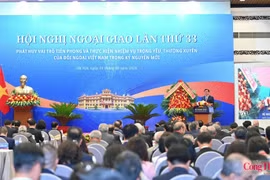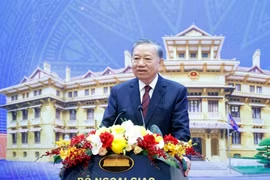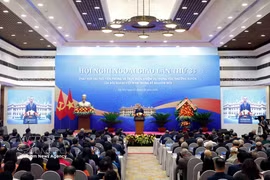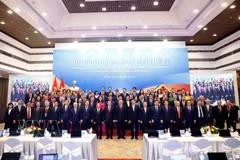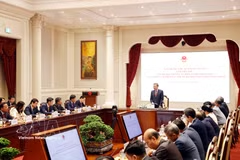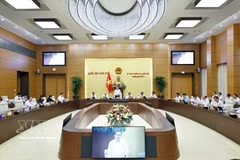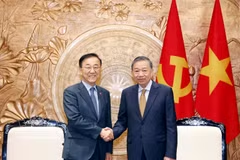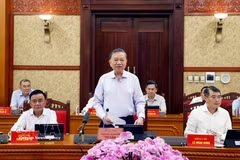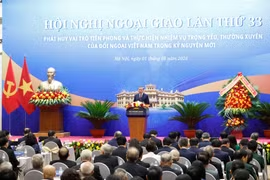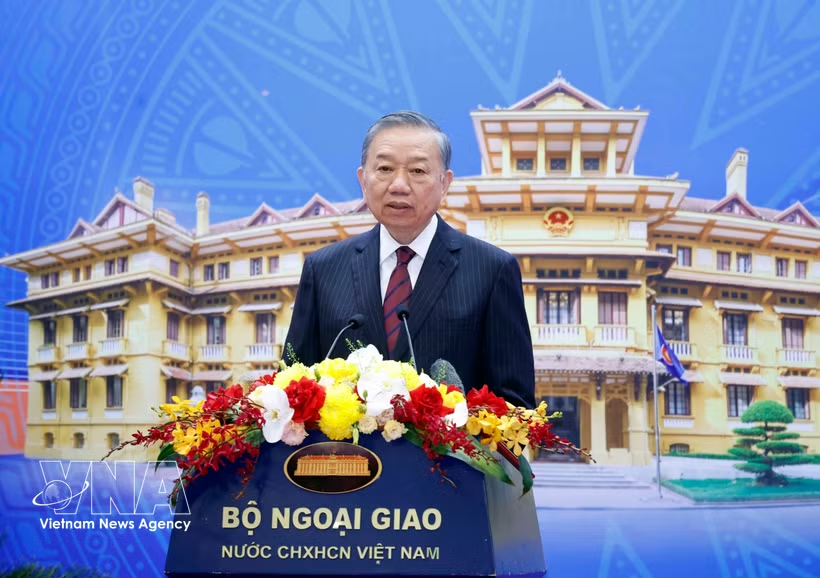
Hanoi (VNA) – The 33rd Diplomatic Conference, themed “Promoting the pioneering role and fulfilling the crucial and regular task of Vietnam's external affairs in the new era,” officially opened in Hanoi on August 1 morning in a hybrid format, with videoconferencing extended to localities across the nation and Vietnamese representative missions abroad.
Party General Secretary and State President To Lam attended and delivered a keynote address at the conference.
The Vietnam News Agency (VNA) would like to introduce a translation of his speech:
Distinguished leaders and former leaders of the Party and State, and the Vietnam Fatherland Front,
Distinguished leaders and former leaders of the Ministry of Foreign Affairs and the sector through different periods,
Distinguished delegates to the conference,
I am very pleased to attend the 33rd Diplomatic Conference today. On behalf of the Party and State leaders, and with my personal sentiments, I would like to extend to all delegates, officials, public employees and those engaged in external relations and diplomatic affairs at home and abroad my warmest greetings, cordial regards and best wishes. I wish our conference a great success.
This Diplomatic Conference is being held at an important juncture, as our country enters a new stage of development after more than 80 years since the nation’s founding and 40 years of renewal. For the first time, a Party Congress resolution has identified diplomacy and external relations as a “crucial and regular” task, meaning that foreign affairs are no longer simply an area of engagement with the outside world, but have become an integral component of the nation’s overall strength. External relations are not solely the responsibility of foreign affairs agencies, but a cause of the entire Party, people, armed forces and political system. Therefore, this Diplomatic Conference carries particularly special and far-reaching significance, going beyond the framework of a conference of the diplomatic sector and providing an important opportunity to discuss external relations work across the entire political system.
The 14th National Party Congress set out the country’s development directions for the new period. Resolution No. 59 of the 13th Party Central Committee’s Politburo on international integration and Resolution No. 06 of the Politburo on implementing the foreign policy set forth by the 14th National Party Congress have clearly defined major orientations. The Central Steering Committee for Foreign Affairs and International Integration has been established. The orientations are clear, and the leadership mechanisms are being consolidated. What is urgently needed now is to organise their implementation correctly, swiftly and with concrete results.
Therefore, the 33rd Diplomatic Conference must help the entire foreign affairs system clearly identify what has been accomplished and what remains slow; reach consensus on priority tasks and coordination methods; and determine the concrete results that must be achieved following the conference.
Dear comrades,
Since the 32nd Diplomatic Conference, the world has undergone rapid and complex changes, with some developments going beyond conventional forecasts. Against this backdrop, Vietnam’s foreign affairs and international integration have continued to be carried out proactively and in a coordinated manner, achieving many important results.
First, the diplomatic sector has worked closely with defence and security, contributing to maintaining a peaceful and stable environment; safeguarding independence, sovereignty, unity, territorial integrity and national interests; and ensuring that the country is not placed in a passive or unexpected situation.
Vietnam’s external relations have continued to expand in scope and rise in stature. Since the 32nd Diplomatic Conference, Vietnam has established or upgraded relations to comprehensive strategic partnerships with nine partners, strategic partnerships with 11 countries, and comprehensive partnerships with five countries.
These new frameworks reflect growing political trust in and the increasingly enhanced position of Vietnam, opening up greater opportunities for cooperation in the economy, science and technology, education, defence, security and people-to-people exchanges. Relations with neighbouring countries, major powers, ASEAN countries, important partners and traditional friends have continued to be consolidated. Coordination among various external relations channels has also become closer.
Multilateral diplomacy has also made significant strides. Vietnam successfully hosted the ASEAN Future Forum, the P4G Summit and the Signing Ceremony for the United Nations Convention against Cybercrime. It was re-elected to the United Nations Human Rights Council for the 2026-2028 term with the highest number of votes in the Asia-Pacific Group. Vietnam has also assumed a number of important positions at the United Nations and UNESCO, while making active contributions to peacekeeping and efforts to address common challenges facing the world and humanity.
Economic diplomacy has kept pace more closely with the country’s development requirements. Vietnam has signed 17 free trade agreements with more than 60 countries and territories. In 2025, total trade reached about 930 billion USD, placing Vietnam among the world’s 20 largest trading economies. Registered foreign investment topped 38 billion USD, while disbursed capital exceeded 27 billion USD, the highest level in five years. External relations have contributed to expanding markets, diversifying supply chains, and attracting capital, technology and knowledge.
Science and technology diplomacy has received greater attention. Vietnamese representative missions abroad have connected research centres, technology corporations, overseas Vietnamese experts and intellectuals with domestic needs. Cultural diplomacy and external information have promoted the image of Vietnam as a peaceful, stable, innovative and responsible country. Work relating to overseas Vietnamese has continued to strengthen the great national unity bloc, while citizen protection has been carried out promptly in complex areas.
These achievements affirm the soundness of Vietnam’s foreign policy of independence, self-reliance, self-strengthening, peace, friendship, cooperation and development; diversification and multilateralisation of external relations; and proactive, comprehensive, extensive and effective international integration. We remain steadfast in our goals and principles while adopting flexible approaches and steps; firmly safeguarding national interests, respecting international law, and working to earn the support of the Vietnamese people and international friends.
These results have been made possible by the focused and unified leadership of the Party Central Committee, directly the Politburo and the Secretariat; the State’s management and administration; close guidance from Party and State leaders; and the engagement of the entire political system. Coordination among the pillars of diplomacy, between the central and local levels, and between external relations and defence, security and development has become increasingly close.
In particular, the overall achievements would not have been possible without the important contributions of officials and personnel working in foreign affairs and diplomacy. In all circumstances and at all posts, you have consistently demonstrated steadfastness, responsibility and loyalty to the Fatherland, the Party, the State and the people, placing national interests above all and before all else. On behalf of the Party and State leaders, I warmly congratulate and commend you for these great and practical contributions.
Comrades,
We are pleased with the achievements made, but must not be complacent. The notable shortcomings at present do not lie primarily in a lack of policies or orientations, but rather in their concretisation and implementation.
Research and forecasting have at times failed to keep pace with developments. Some reports remain overly descriptive, without clearly identifying their impacts on Vietnam or proposing appropriate response options. The quality of policy advice is still uneven, while capacity for research into emerging issues involving technology, the digital economy, energy, supply chains and international law remains limited. Digital transformation in diplomacy has been slow, and data connectivity and sharing remain constrained.
The concretisation of a number of resolutions, conclusions, agreements and international commitments has also been slow. In some cases, follow-up has not been pursued to completion; responsibilities among agencies have not been clearly defined; and obstacles have not been addressed in a timely manner. In some places, fine political relations have yet to be translated adequately into markets, projects, technology and tangible benefits for people and businesses. Some activities still placed greater emphasis on the number of meetings held and documents signed than on the ultimate results achieved.
Inter-agency coordination has at times remained asynchronous. In some cases, multiple agencies have been involved without any single agency assuming ultimate responsibility. Some bottlenecks have been identified but slow to be resolved due to overlapping regulations, lengthy procedures or reluctance to make decisions. Coordination between central and local authorities, and between representative missions abroad and ministries, sectors and businesses, has not been sufficiently close. In some places, preparations have not been made in time to capitalise on opportunities generated by external relations.
Comrades,
The world is undergoing rapid and highly complex changes. Strategic competition among major powers is becoming increasingly intense. The economy, trade, technology, data, energy and supply chains are becoming ever more closely intertwined with politics and security. Conflicts continue, while international law and multilateral institutions are under mounting pressure. Climate change, energy security, food security, water security and transnational crime are directly affecting all countries.
Science and technology are transforming modes of production and governance, as well as the balance of power. Artificial intelligence, semiconductors, biotechnology, digital infrastructure and new energy sources are creating major opportunities while also giving rise to new risks. Countries that master technology, data and high-quality human resources will gain an advantage, while those slow to transform risk falling further behind.
Nevertheless, peace, cooperation and development remain common aspirations. The Asia-Pacific continues to be a dynamic development centre, while ASEAN maintains an important role. Many countries wish to expand cooperation with Vietnam. The achievements of 40 years of Doi Moi, together with political stability, market potential, human resources and growing international reputation, have created new favourable conditions for the country. The overseas Vietnamese community is also growing stronger, with increasingly greater potential to contribute to national construction and development.
The key is to identify opportunities early and turn them into tangible results. We cannot simply wait for favourable conditions to come, nor can we act only after events have unfolded. The more complex the situation, the calmer and more proactive we must remain, never retreating into a defensive posture; we must be confident without being complacent, bold without being reckless, and flexible while firmly upholding principles. We must expand cooperation while simultaneously strengthening strategic autonomy, internal strength and resilience.
Now is the time for foreign affairs to play a pioneering role: identify developments early, provide sound policy advice and act promptly; contribute to safeguarding the Fatherland from an early stage and from afar; pave the way, connect and mobilise resources for development. Pioneering also means following through on tasks to the end, proactively removing obstacles and taking responsibility for results.
First, it is necessary to continue to renew thinking and improve the quality of research, forecasting and strategic advice.
The world is changing rapidly; if our thinking is slow to change, our actions will also be slow. Research must stay one step ahead, helping Party and State leaders identify trends, opportunities and risks at an early stage, anticipate possible scenarios and avoid strategic surprises. We must accurately assess the world, clearly understand the country, and correctly identify our interests and capabilities.
Research must focus on issues that have direct and long-term impacts on Vietnam’s security and development, including strategy adjustments by major powers; shifts in economic, technological and political power centres; and fluctuations in trade, finance, energy and water resources. AI, semiconductors, the digital economy, green transition, cybersecurity and data security must be studied early and in depth. Research should place particular emphasis on identifying opportunities and proposing concrete actions.
Every report must clearly answer following questions: What is happening? How will it affect Vietnam? What should be done? What should be done first, and who should do it? Reports should be concise, provide new information, offer clear assessments and contain actionable recommendations. Exchanges between research institutions and field agencies, and between domestic agencies and representative missions abroad, must be strengthened, and measures must be taken to make full use of networks of overseas Vietnamese experts, businesses and people.
Renewing thinking requires courage in making recommendations and proposals. Policy advisors must dare to raise issues, stand by sound recommendations and take responsibility for their views. Greater strength and potential require us to be confident, proactive and responsible, while always remaining sincere, humble and respectful towards partners.
Second, it is essential to deepen and enhance the effectiveness of external relations.
The established and upgraded partnership frameworks must be translated into action programmes and projects with measurable outcomes. Upgrading a relationship marks the beginning of a new chapter, not the completion of the task. Following every high-level visit, there must be an implementation plan; every agreement must clearly specify the lead agency, responsibilities, timelines and monitoring mechanism, as well as concrete outcomes.
The priorities in foreign affairs have been clearly identified. In every relationship, importance must be attached to trust, sincerity and long-term interests; differences must be addressed appropriately so that an individual issue does not affect the overall relationship.
The effectiveness of a relationship does not lie in the frequency of contacts or the name given to its framework. The key measures are a strengthened peaceful environment, safeguarded national interests, expanded markets, new projects, enhanced technology and human resources, and tangible benefits for the people.
Third, there is a must to deepen development-focused diplomacy, with substantive effectiveness as the key measure.
The targets set for 2030 and 2045 are highly ambitious. External relations must directly support the renewal of the growth model, improve productivity and competitiveness, and strengthen the economy’s autonomy. Economic diplomacy must follow projects until tangible results are achieved.
Priority should be given to mobilising resources for science and technology, innovation, digital transformation, development of the private sector and higher-quality foreign investment. Vietnam should selectively attract projects in high technology, semiconductors, artificial intelligence, digital infrastructure, clean energy, biotechnology and modern agriculture, while linking investment with technology transfer, human resources training and greater participation by Vietnamese businesses in global value chains and supply chains.
Every Vietnamese representative mission abroad must understand the country’s needs and the strengths of its host locality, identify the right partners and follow projects through. Ministries, sectors and localities must prepare projects, mechanisms, sites, human resources and the necessary conditions to receive investment. External opportunities can only become resources when domestic conditions are ready. This is a shared responsibility of overseas representative missions, domestic agencies, businesses and citizens.
Science and technology diplomacy must become a regular task. We need to build networks of technology partners, connect research institutes, universities, businesses and experts; monitor new trends, standards and policies; and bring appropriate knowledge and technologies to Vietnam. Diplomacy must seek not only capital, but also knowledge, talent and best practices.
At the same time, we must improve work concerning overseas Vietnamese, cultural diplomacy, external information, consular affairs and citizen protection. Conditions should be created for overseas Vietnamese to maintain close ties with and contribute to the homeland, while intellectual, entrepreneur and expert networks should be brought into full play. Consular services must be convenient and transparent; citizen protection must be swift, proper and responsible. All foreign affairs must ultimately serve the country and the people.
Fourth, attention should be paid to elevating multilateral diplomacy and implementing comprehensive, synchronous and effective international integration.
Vietnam should continue to promote its role at the United Nations, ASEAN, APEC and Mekong subregional cooperation mechanisms, while contributing to peacekeeping, food security, water security, climate change response, energy transition and sustainable development. Preparations for hosting APEC Year 2027 must begin early, covering substantive content, initiatives, infrastructure, human resources and efforts to secure support from partners.
The implementation of Politburo Resolution No. 59 must link international integration with institutional reform and the strengthening of domestic capabilities. International commitments must be reviewed, incorporated into domestic laws and implemented seriously, thereby driving reforms and enhancing national competitiveness. We must pursue deeper integration without dependence, open our doors while maintaining autonomy, and absorb the best of global knowledge and experience to enrich Vietnam’s identity and strength.
Fifth, it is important to strongly renew coordination, inspection and implementation mechanisms, and focus on removing bottlenecks that are slowing progress.
The Central Steering Committee for Foreign Affairs and International Integration must promote its role in strategic leadership and direction, and unified coordination; and address major, new, difficult and inter-sectoral issues that fall beyond the authority of any single agency. The Ministry of Foreign Affairs, as the standing body of the committee, must strengthen its work in policy advice, coordination, and follow-up, proactively identify delays and propose measures to remove obstacles.
Each agency must proactively resolve matters under its responsibility. Inter-sectoral issues must have a designated focal point, while matters beyond the authority of an agency must be reported to competent authorities. There must be no situation in which multiple agencies are involved but no one assumes ultimate responsibility. Heads of agencies must closely monitor progress and take responsibility for results.
A unified database on international treaties, agreements and commitments should be developed, specifying timelines, deliverables, lead agencies and coordination responsibilities. Data among ministries, sectors, localities and representative missions abroad must be interconnected, regularly updated and securely managed to support task monitoring, direction and administration.
Sixth, it is also essential to attach particular importance to building a contingent of diplomatic officials with adequate qualities, capabilities and credibility, meeting requirements in the new period.
President Ho Chi Minh taught that “cadres are the root of all work.” Even with sound resolutions and effective mechanisms, work will remain stagnant if officials lack a firm grasp of their tasks, responsibility and willingness to coordinate. We must do well at every stage, from recruitment, training and evaluation to assignment and utilisation, with qualities, capabilities and work performance serving as the key criteria. We need to soon build a pool of highly capable experts specialising in key geographical areas and emerging fields, while developing mechanisms to attract and make effective use of talent both within and outside the diplomatic sector.
Previous generations have set shining examples of patriotism, political mettle, self-learning, and diplomatic style and artistry. Today’s diplomats must cherish and uphold this legacy while mastering new knowledge and technologies, foreign languages, international law, and the economies and cultures of partner countries. A good diplomat must first and foremost possess firm political mettle and always take national interests as the guiding principle for action. Every official engaged in foreign affairs must always remember that behind them stand the Party, the country and the people.
Dear comrades,
Regarding the discussion agenda, the conference should clarify three issues. (i) how major global developments through 2030 will affect the goals of national development and defence; and which scenarios require early preparation. (ii) which tasks set out in Politburo Resolutions No. 06 and No. 59 should be prioritised; which are lagging, and why. Following the review of 20 years of implementing Resolution No. 36 on overseas Vietnamese affairs, the Politburo will soon issue a new resolution on this matter. You should incorporate the new resolution into the conference agenda for delegates to study, discuss and thoroughly understand. (iii) what must be done to translate frameworks of relations, international commitments and agreements into markets, projects, technologies, human resources and new capabilities for national development.
Presentations should be concise, provide new information and focus directly on practical issues. Any difficulties raised must be accompanied by solutions. Proposals for new tasks must clearly identify their basis, resources and implementing agencies. Issues on which different views remain should be discussed frankly and thoroughly in the common interest.
In terms of outcomes, the conference must produce concrete deliverables. First, it should focus on the implementation of the two resolutions on external relations and international integration, with priority tasks, timelines and responsibilities clearly identified. It should then compile a list of important treaties, agreements, commitments and projects that are behind schedule; categorising those that can be handled independently, those requiring inter-agency coordination and those requiring higher-level approval. The conference should also identify priority markets, projects, technologies, partners and human resources; contribute to the one-year review of the implementation of Resolution No. 59; and prepare for a comprehensive foreign affairs strategy at a new height.
Each ministry, sector, locality and representative mission must review its respective responsibilities. Immediately after the conference, its conclusions must be translated into action plans, with tasks assigned to the right people, deadlines set and regular monitoring conducted. Matters that can be addressed immediately should be acted upon without delay; outstanding issues must be reported; and matters beyond the authority of an agency must be submitted together with proposed solutions.
The outcomes of foreign affairs should not be measured solely by the number of visits, meetings or documents signed. We must assess whether the peaceful environment has been strengthened; whether national interests have been safeguarded; whether relations with partners have become deeper and more sustainable; which commitments have been fulfilled; which bottlenecks have been removed; what resources have been brought to the country; and whether people and businesses are receiving better services. We must neither overemphasise figures nor rely on vague assessments.
I ask the Ministry of Foreign Affairs, as the standing body of the Central Steering Committee for Foreign Affairs and International Integration, to take the lead in consolidating the outcomes of the conference, monitoring implementation and periodically reporting results to the competent authorities. Coordinating agencies must provide complete information and take responsibility for progress. Only through such efforts can the conference bring about real change, ensure that resolutions are translated into reality, and turn the achievements of external relations into strength and resources for national development.
Comrades,
The tasks ahead are demanding, but also highly honourable. I am confident that by upholding the tradition of Vietnam’s revolutionary diplomacy and bringing into full play collective wisdom, mettle and sense of responsibility, the entire diplomatic sector and external relations forces will remain united, proactive and creative in successfully fulfilling their tasks, contributing to maintaining peace, safeguarding the Fatherland, expanding development space and enhancing Vietnam’s international standing.
I wish the conference every success!
I wish you all good health and success!./.
VNA