New growth drivers offer Vietnam's agriculture chance to accelerate

According to Deputy Minister of Agriculture and Environment Dang Ngoc Diep, agricultural, forestry and fishery exports fetched an estimated 35.88 billion USD in the first six months of 2026, up 6% year-on-year. The sector's GDP expanded by more than 3.8%, exceeding the government's 3.7% target. The results were underpinned by stable production, particularly in key industries.

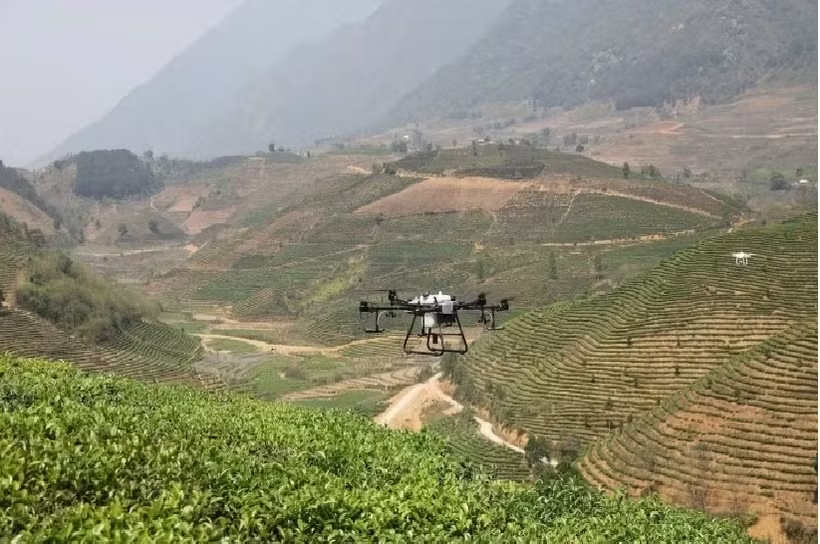
Using drones in agricultural production in Lai Chau province. (Photo: nhandan.vn)

Hanoi (VNA) - Vietnam's agricultural sector maintained stable production, robust export growth and a healthy trade surplus in the first half of 2026, reinforcing its role as a pillar of the national economy.

However, climate change and growing uncertainty in global trade are expected to weigh on growth in the months ahead, making it essential to unlock new drivers for the sector. Science and technology, digital transformation and green transition are increasingly seen as the key to accelerating agricultural growth.

Stable production underpins export growth

According to Deputy Minister of Agriculture and Environment Dang Ngoc Diep, agricultural, forestry and fishery exports fetched an estimated 35.88 billion USD in the first six months of 2026, up 6% year-on-year. The sector's GDP expanded by more than 3.8%, exceeding the government's 3.7% target. The results were underpinned by stable production, particularly in key industries.

During the 2026 winter-spring rice crop, farmers cultivated more than 2.9 million hectares, down nearly 38,000 hectares from a year earlier. Higher yields, however, rose by 120 kg per hectare, lifting output to around 20.5 million tonnes, a year-on-year increase of more than 88,000 tonnes.

Livestock and fisheries also remained important contributors to growth, with total fishery output reaching nearly 5 million tonnes, up 3.6% year-on-year, reaffirming their role as major growth engines.

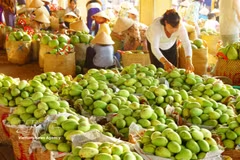
Supported by stable production, agricultural exports continued to expand. In the first half of the year, seafood exports reached 5.7 billion USD, up 11.4%; fruit and vegetables generated 3.6 billion USD, up 17.7%; while wood and wood products earned 8.5 billion USD, up 4.4%.

Livestock products recorded the strongest performance, with exports surging 34.6%, the highest among segments.

Despite continued global economic uncertainty, Vietnam maintained growth in major export markets. Exports to China rose by 23.1%, while shipments to Japan increased by 1.6%.

Dang Phuc Nguyen, General Secretary of the Vietnam Fruit and Vegetable Association, said exports of fruit and vegetables have benefited from steady demand in China and smoother customs clearance procedures.

He added that businesses have become more proactive in meeting phytosanitary requirements, traceability rules, planting area and packing facility codes. The expansion of officially approved fruit exports under bilateral protocols had also encouraged greater investment in production areas and more sustainable supply chains, strengthening the competitiveness of Vietnamese products.

Unlocking new growth drivers

To achieve its 4% growth target for 2026, experts held that the agricultural sector must unlock new momentum through science and technology, digital transformation and green development.

The Ministry of Agriculture and Environment is implementing strategic technology initiatives, including the development of next-generation crop, livestock and aquaculture varieties, domestic veterinary vaccines, biological products and digital data infrastructure to support production management.

These efforts are expected to improve climate resilience through drought- and salt-tolerant crop varieties, stronger disease surveillance and real-time forecasting and production management.

According to Nguyen Van Long, Director of the ministry's Department of Science and Technology, the ministry has proposed 15 strategic technology projects and identified 13 products with the potential to become strategic technologies. It is also promoting cooperation among government agencies, research institutions, businesses and farmers in research and technology transfer.

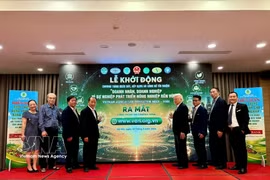
In digital transformation, Vietnam officially launched its national agricultural traceability system on July 1, enhancing transparency, quality control, export support and the competitiveness of Vietnamese agricultural products.

Nevertheless, stronger support will be needed to help exporters expand into new markets and adapt to the global shift towards greener trade.

Do Quoc Hung, Acting Director of the Ministry of Industry and Trade's Department of Foreign Market Development, said environmental and sustainability requirements, including the EU Deforestation Regulation (EUDR) and Environmental, Social and Governance (ESG) standards, are becoming the biggest medium- and long-term challenges for exporters.

He held that Vietnam therefore needs a comprehensive green transition ecosystem, including carbon measurement centres, certification systems and green financing mechanisms. The country should also develop green production clusters to lower compliance costs through economies of scale, Hung added./.

VNA

See more

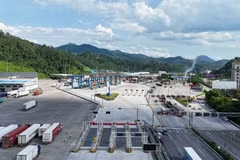
An overview of the smart Youyi Guan-Huu Nghi border gate pair (Photo published by VNA)

Law expected to facilitate cross-border trade

Deputy Director of the Department of Customs Nguyen Thanh Hung said the draft law establishes a legal framework to convert fragmented customs documents into standardised digital data, enabling AI to process and analyse information for automated customs clearance.

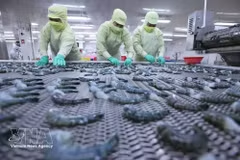
Freezing black tiger shrimp for export at a processing plant of the Minh Phu Seafood Corporation. (Illustrative photo: VNA)

EVFTA deliver tangible gains for Vietnam-EU trade after six years

Reflecting on the agreement's sixth anniversary, EuroCham Chairman Bruno Jaspaert said that nearly half of all EU-Vietnam trade over the past three decades has taken place under the EVFTA, underscoring the rapid acceleration of economic integration once market access barriers were removed.

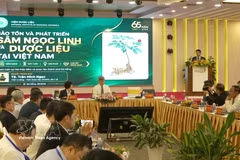
Delegates attend the international scientific conference, "Ngoc Linh Ginseng – From National Product to Global Brand," in Da Nang on August 2. (Photo: VNA)

Ngoc Linh ginseng sets sights on global brand recognition

Dr. Tran Minh Ngoc, Director of the National Institute of Medicinal Materials under the Ministry of Health, said Ngoc Linh ginseng (Panax vietnamensis) is an endemic species found only in Vietnam's Ngoc Linh mountain range at elevations of 1,500–2,100 metres.

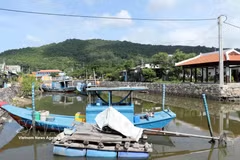
The canal in front of Long Son Big House has become cleaner thanks in part to environmental clean-up efforts by Long Son Petrochemicals Co., Ltd. (Photo: VNA)

FDI firm spreads sustainable value through community commitment

A subsidiary of Thailand’s SCG Chemicals, LSP manages one of Vietnam’s largest foreign direct investment (FDI) projects, with an initial investment of more than 5 billion USD. The company is also investing an additional USD 500 million to integrate ethane into its feedstock portfolio.

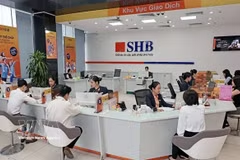
Transactions at a branch of SHB in Hanoi. (Photo: VNA)

Deeper reforms needed to achieve target of 2 million firms

If Vietnam can create the institutions, funding channels and support systems that allow businesses to develop at different stages, the target of 2 million active enterprises by 2030 could mark not just a numerical milestone, but the emergence of a more resilient engine of growth.

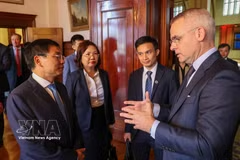
An overview of the meeting between the Da Nang delegation and officials of the Czech Ministry of Industry and Trade. (Photo: VNA)

Vietnam, Czech Republic step up local investment, trade cooperation

Representatives of the Czech side spoke highly of the potential for cooperation with Da Nang and affirmed their readiness to help connect Czech enterprises with Vietnamese partners, thereby promoting stronger bilateral investment and trade ties in the years to come.

Deputy Prime Minister Nguyen Van Thang (L) and René van Vlerken, CEO of Euronext Amsterdam in the Netherlands on July 31, 2026. (Photo: VNA)

Netherlands ready to support Vietnam in deeper integration into global financial markets

The working sessions between Deputy PM Nguyen Van Thang and Dutch partners helped strengthen the foundation of financial cooperation between Vietnam and the Netherlands, opening up opportunities for experience sharing, market connections and new initiatives in finance, technology and innovation, thereby making positive contributions to the comprehensive partnership.

Luxury riverside apartment complex near Ho Chi Minh City centre remains in high demand. (Photo: VNA)

Real estate data seen as key to market transparency

The biggest risk facing the real estate market is liquidity, while the biggest risk associated with technology lies with its users. Technology can only deliver its full value when it addresses practical market and human needs.

Secretary of the Hanoi Party Committee Tran Duc Thang (L) meets with Central Retail Vietnam CEO Olivier Bernard R. Langlet on July 30. (Photo: hanoimoi.vn)

Hanoi welcomes Central Retail Vietnam's plans to expand modern retail investment

Central Retail Vietnam will continue investing in its supermarket network while increasing the share of Vietnamese products in its distribution system. The group will also deepen support for farmers, cooperatives and producers across the supply chain, from cultivation and harvesting to packaging and product standardisation.

Deputy Prime Minister Nguyen Van Thang speaks at the Vietnam-Netherlands Business Roundtable in Amsterdam on July 30. (Photo: VNA)

Dutch businesses upbeat about Vietnam's growth prospects

Dutch businesses welcomed Vietnam's reform agenda and showed strong interest in expanding collaboration in finance and international financial services, semiconductors, artificial intelligence, logistics, ports, shipbuilding, water management, renewable energy and green transition.