Ho Chi Minh City (VNA) – Six years after the EU-Vietnam Free Trade Agreement (EVFTA) entered into force on August 1, 2020, the European Chamber of Commerce in Vietnam (EuroCham) says the pact has fundamentally reshaped bilateral economic ties, turning political commitments into high-value trade integration, strengthening business confidence and firmly positioning Vietnam in global value chains.
Trade integration gathers pace
Official data from Vietnam's Department of Customs and the National Statistics Office (NSO) show that cumulative two-way trade between Vietnam and the European Union exceeded 900 billion USD between January 1995 and June 2026.
Notably, 383.8 billion USD, or 42.6% of total bilateral trade over the past three decades, was generated during the six years following the EVFTA's implementation in August 2020.
Reflecting on the agreement's sixth anniversary, EuroCham Chairman Bruno Jaspaert said that nearly half of all EU-Vietnam trade over the past three decades has taken place under the EVFTA, underscoring the rapid acceleration of economic integration once market access barriers were removed.
Six years ago, the EVFTA was an ambitious political commitment. Today, its impact is tangible and measurable, he said.
According to Jaspaert, the agreement has reshaped trade flows, strengthened business confidence and established Vietnam as one of Europe's most important economic anchors in Asia. As the voice of the European business community in Vietnam, EuroCham will continue promoting growth through evidence-based policy advocacy and constructive public-private dialogue.
He added that the agreement's value is also reflected in the growing number of European companies incorporating Vietnam into their long-term business strategies.
Among European firms actively engaged in bilateral trade, half reported direct benefits from EVFTA tariff preferences.
EuroCham's Business Confidence Index (BCI) for the second quarter of 2026 found that 55% of surveyed European businesses now regard Vietnam as either a core operational hub or a priority growth market, while another 22% consider the country an important component of their regional network.
Sector-specific data indicate that companies in trade, logistics and consumer goods have benefited the most. One in four surveyed firms in these sectors reported cost savings of 16-30%, twice the average across all industries.
Logistics providers noted that wider utilisation of EVFTA preferences by customers had driven steady growth in freight forwarding, warehousing and supply chain distribution services.
A European importer participating in the survey said more than 80% of its EU-Vietnam trade now benefits from EVFTA tariff preferences. While lower tariffs have only modestly improved profit margins, reduced import costs have enabled the company to lower prices, strengthen competitiveness in Vietnam and create additional room for growth.
Foundation for high-value investment
While merchandise trade has expanded rapidly, European foreign direct investment (FDI) has grown at a more measured pace. European investors continue to place strong emphasis on regulatory predictability, administrative efficiency and robust legal safeguards when making long-term investment decisions.
EuroCham said this highlights the strategic importance of securing full ratification of the EU-Vietnam Investment Protection Agreement (EVIPA) by all EU member states.
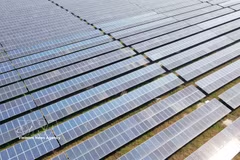
Whereas the EVFTA liberalises trade, the EVIPA would establish a strong legal framework and modern dispute settlement mechanisms, creating a secure foundation for high-quality European investment in clean energy, digital infrastructure and advanced manufacturing.
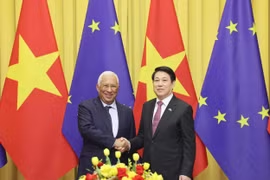
EuroCham Vice Chairman Jean-Jacques Bouflet said that following the elevation of EU-Vietnam relations to a Comprehensive Strategic Partnership in January 2026, the EVFTA has become the cornerstone of a new era of economic diplomacy.
Its legacy extends well beyond trade volumes, he noted.
By demonstrating that an ambitious free trade agreement between Europe and an emerging Asian economy can generate tangible economic benefits, the EVFTA has become a valuable model for broader regional and cross-regional partnerships.
Vietnam is helping pave the way for deeper EU-ASEAN cooperation by building the trust needed to transform trading partners into indispensable collaborators in an increasingly uncertain global economy.
Unlike earlier-generation free trade agreements, Bouflet said, the EVFTA goes beyond tariff reductions to cover customs cooperation, technical standards, intellectual property, sustainable development and regulatory transparency.
As environmental standards, product traceability requirements and supply chain due diligence continue to evolve under initiatives such as the European Green Deal, the Carbon Border Adjustment Mechanism (CBAM) and the EU Deforestation Regulation (EUDR), companies' ability to understand and comply with these rules will become an increasingly decisive factor in maintaining competitiveness.
Vietnam's export advantages will increasingly depend on effective compliance, he said. Simplifying customs procedures, accelerating tax refunds, digitalising documentation and clarifying rules of origin would enable more businesses, particularly small and medium-sized enterprises (SMEs), to take full advantage of the EVFTA.
Although Vietnam maintains a substantial trade surplus with the EU, Bouflet stressed that the partnership should not be viewed as a zero-sum relationship.
Instead, the EVFTA has created a highly complementary economic ecosystem in which each side builds on its comparative strengths.
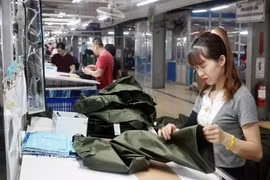
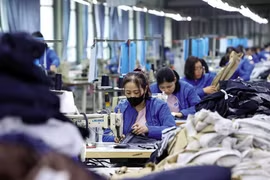
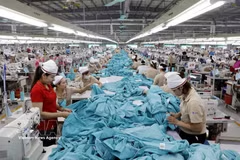
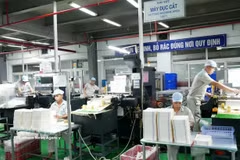
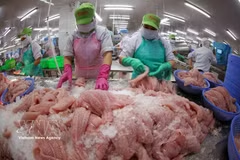
Europe supplies high-value technologies, advanced machinery and pharmaceuticals that directly enhance Vietnam's industrial productivity, while Vietnam's strengths in electronics, engineering, textiles and garments, footwear, furniture and agricultural products reinforce European supply chains and serve millions of consumers across the bloc.
Against this backdrop, EuroCham sees considerable scope for expanding cooperation and encourages Vietnam to increase imports of high-value European technologies to support industrial modernisation and move further up global value chains.
The EU currently accounts for around 12% of Vietnam's total exports but only 4% of its imports. Greater adoption of advanced European technologies would not only help rebalance bilateral trade but also strengthen Vietnam's long-term competitiveness and accelerate the upgrading of its industrial base within global value chains./.
VNA