Trade drives growth momentum for Vietnam's economy in seven months

Deputy Minister of Industry and Trade Nguyen Sinh Nhat Tan said Vietnam's total trade may exceed 1 trillion USD in 2026, supported by effective use of new-generation free trade agreements (FTAs).

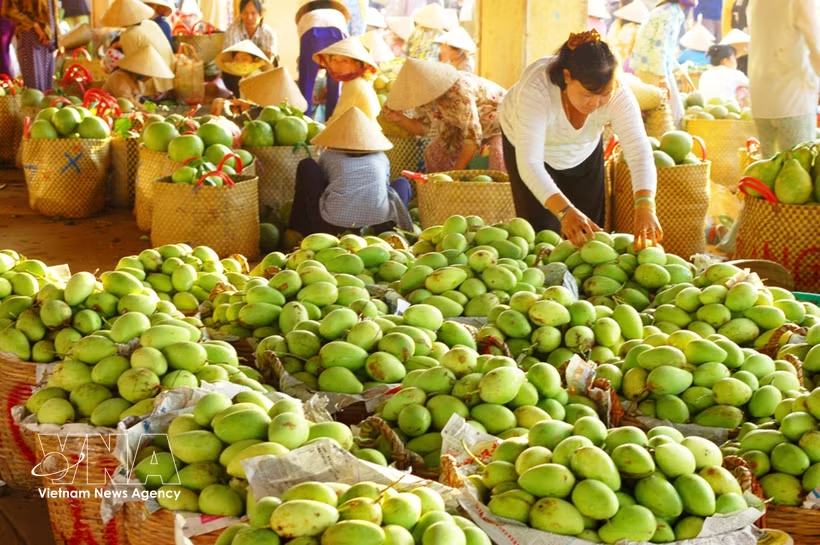
Mango is one of key export products of Dong Thap (Photo: VNA)

Hanoi (VNA) - Vietnam's economy posted encouraging results in the first seven months of 2026, with trade remaining a key growth driver.

Total import-export turnover was estimated at 659 billion USD, up 28% year-on-year.

Exports reached 320 billion USD, rising 21.9%, while imports climbed 34.5% to 339 billion USD, reflecting resilient production, trade and international market integration, as well as rising demand for imported machinery and production inputs.

Deputy Minister of Industry and Trade Nguyen Sinh Nhat Tan said Vietnam's total trade may exceed 1 trillion USD in 2026, supported by effective use of new-generation free trade agreements (FTAs).

By July, more than 1.2 million certificates of origin had been issued under FTAs, covering nearly 100 billion USD in exports, or 28% of total export value. Several FTAs recorded preferential tariff utilisation rates of 30–50%.

Industrial production also continued to underpin growth. Many localities posted strong industrial production index, including Quang Ngai at 14.06%, Hai Phong at 15% and Hanoi 9.4%.

Nationally, GDP grew 7.94% in the first quarter and 8.39% in the second, bringing first-half growth to 8.18%. Although the stronger second-quarter performance signals improving momentum, it remains well below the pace needed to achieve the annual target.

Business confidence also improved. Nearly 169,800 enterprises entered the market in the first six months, up 11.2% year-on-year and exceeding the 151,100 firms that exited. Newly registered capital reached 1,352.6 trillion VND, up 64.8%.

These results underscore the continued importance of investment, production and exports, and domestic consumption as the economy's traditional growth pillars.

However, according to the National Statistics Office, achieving 10% GDP growth this year will require GDP to expand 11.16% in the third quarter, lifting nine-month growth to 9.19%, followed by 12.09% growth in the fourth quarter. Overall, the economy must grow about 11.7% in the second half.

Meeting this target will be challenging amid global uncertainty, uneven demand in major markets and intensifying competition. Public investment is expected to remain the primary growth engine, with faster disbursement generating spillover effects across construction, building materials, transport, trade and services.

Nguyen Thi Mai Hanh, head of the National Accounts Department at the National Statistics Office, said public investment has significant potential to drive growth in the second half as major infrastructure projects accelerate. She stressed that bottlenecks related to procedures, land clearance, construction materials and project implementation must be resolved promptly.
vnanet-potal-thuc-day-xuat-khau-sang-thi-truong-vuong-quoc-anh-8754031-1.jpg
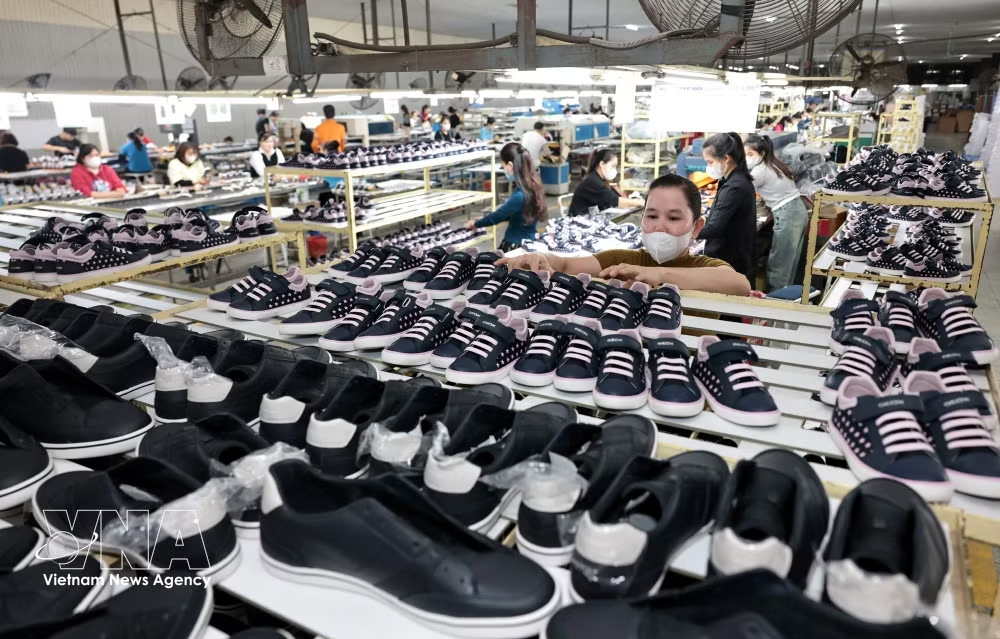
Leather and shoes are an export item to the British market (Photo: VNA)

Meanwhile, Le Duy Binh, Director of Economica Vietnam, noted that retail sales and consumer service revenue growth of more than 10% indicates strengthening domestic demand, supported by stable macroeconomic conditions and sound economic fundamentals.

Economists also identified science and technology, innovation, the digital economy and digital transformation as increasingly important growth drivers. Wider adoption of artificial intelligence, big data, cloud computing, the Internet of Things and automation can improve productivity, reduce costs and strengthen supply chains.

The expansion of e-commerce, digital payments, digital finance and online platforms is also creating new growth opportunities. While these sectors mainly enhance efficiency in the short term, they are expected to drive structural transformation over the medium and long term.

Green growth and the energy transition are opening additional investment opportunities. Vietnam's net-zero commitment and the global shift towards sustainable supply chains are attracting renewable energy, clean technology, green manufacturing and circular economy projects. Developing supportive policies, modern energy infrastructure and effective financing will be key to turning this potential into a new source of competitiveness.

Flexible coordination between fiscal and monetary policies, alongside administrative reform, improved business conditions and a stronger investment climate, will also be essential to sustaining market confidence, encouraging investment and supporting Vietnam's ambition of achieving double-digit growth in 2026./.

VNA

See more

The canal in front of Long Son Big House has become cleaner thanks in part to environmental clean-up efforts by Long Son Petrochemicals Co., Ltd. (Photo: VNA)

FDI firm spreads sustainable value through community commitment

A subsidiary of Thailand’s SCG Chemicals, LSP manages one of Vietnam’s largest foreign direct investment (FDI) projects, with an initial investment of more than 5 billion USD. The company is also investing an additional USD 500 million to integrate ethane into its feedstock portfolio.

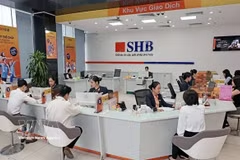
Transactions at a branch of SHB in Hanoi. (Photo: VNA)

Deeper reforms needed to achieve target of 2 million firms

If Vietnam can create the institutions, funding channels and support systems that allow businesses to develop at different stages, the target of 2 million active enterprises by 2030 could mark not just a numerical milestone, but the emergence of a more resilient engine of growth.

An overview of the meeting between the Da Nang delegation and officials of the Czech Ministry of Industry and Trade. (Photo: VNA)

Vietnam, Czech Republic step up local investment, trade cooperation

Representatives of the Czech side spoke highly of the potential for cooperation with Da Nang and affirmed their readiness to help connect Czech enterprises with Vietnamese partners, thereby promoting stronger bilateral investment and trade ties in the years to come.

Deputy Prime Minister Nguyen Van Thang (L) and René van Vlerken, CEO of Euronext Amsterdam in the Netherlands on July 31, 2026. (Photo: VNA)

Netherlands ready to support Vietnam in deeper integration into global financial markets

The working sessions between Deputy PM Nguyen Van Thang and Dutch partners helped strengthen the foundation of financial cooperation between Vietnam and the Netherlands, opening up opportunities for experience sharing, market connections and new initiatives in finance, technology and innovation, thereby making positive contributions to the comprehensive partnership.

Luxury riverside apartment complex near Ho Chi Minh City centre remains in high demand. (Photo: VNA)

Real estate data seen as key to market transparency

The biggest risk facing the real estate market is liquidity, while the biggest risk associated with technology lies with its users. Technology can only deliver its full value when it addresses practical market and human needs.

Secretary of the Hanoi Party Committee Tran Duc Thang (L) meets with Central Retail Vietnam CEO Olivier Bernard R. Langlet on July 30. (Photo: hanoimoi.vn)

Hanoi welcomes Central Retail Vietnam's plans to expand modern retail investment

Central Retail Vietnam will continue investing in its supermarket network while increasing the share of Vietnamese products in its distribution system. The group will also deepen support for farmers, cooperatives and producers across the supply chain, from cultivation and harvesting to packaging and product standardisation.

Deputy Prime Minister Nguyen Van Thang speaks at the Vietnam-Netherlands Business Roundtable in Amsterdam on July 30. (Photo: VNA)

Dutch businesses upbeat about Vietnam's growth prospects

Dutch businesses welcomed Vietnam's reform agenda and showed strong interest in expanding collaboration in finance and international financial services, semiconductors, artificial intelligence, logistics, ports, shipbuilding, water management, renewable energy and green transition.

Vietnam's coffee cherries (Photo: VNA)

Vietnamese coffee exports shine in EC’s agri-food trade report

Vietnam and Argentina emerged as notable exceptions in the European Commission’s (EC) latest agri-food trade report. Imports from Argentina increased 10% thanks to higher sunflower seed shipments, while imports from Vietnam climbed 9%, driven by robust coffee exports.

Agricultural and OCOP products from Nhan Co commune in Lam Dong province have their information digitised, are labelled with QR codes for traceability, and put on e-commerce platforms. (Photo: VNA)

New e-commerce law strengthens accountability across digital marketplace

Instead of focusing mainly on protecting consumers as previously, the Law on E-commerce clearly defines the legal responsibilities of all participants in the digital marketplace, including e-commerce platforms, businesses, online sellers, key opinion leaders (KOLs), key opinion consumers (KOCs) and affiliate marketers.

Canadian importers view Vietnamese coffee and cocoa products at a trade promotion event in Canada. (Photo: VNA)

Vietnamese retailer helps expand market access in Canada

Established in 1981 as a family-run grocery store, Lucky Supermarket and Dong Phuong Group have grown into one of the largest Asian food retail and distribution networks in Western Canada. Over the past 45 years, the business has evolved beyond serving the Vietnamese community to become an important distribution channel for Vietnamese agricultural products, food and consumer goods.