Law expected to facilitate cross-border trade

Deputy Director of the Department of Customs Nguyen Thanh Hung said the draft law establishes a legal framework to convert fragmented customs documents into standardised digital data, enabling AI to process and analyse information for automated customs clearance.

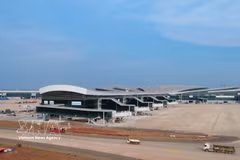
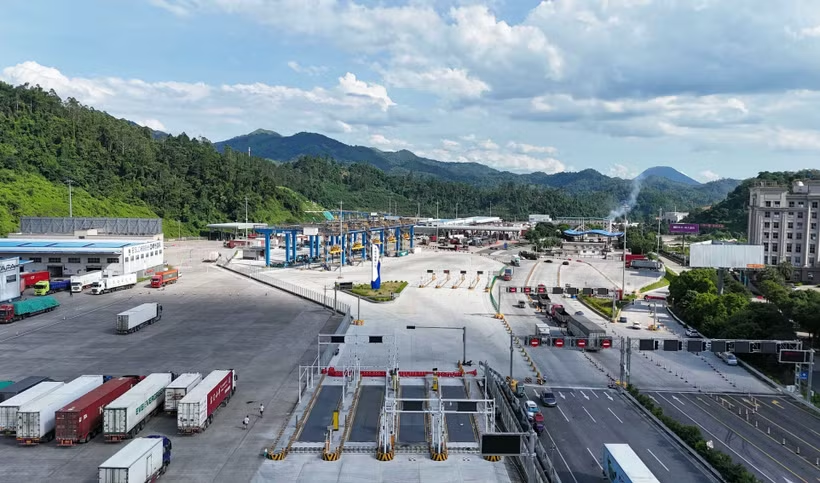
An overview of the smart Youyi Guan-Huu Nghi border gate pair (Photo published by VNA)

Hanoi (VNA) – The draft law amending and supplementing a number of articles of the Law on Customs, recently reviewed by the National Assembly Standing Committee at its fourth session, aims to modernise customs management by shifting from goods-based inspections to a compliance-based system driven by data and artificial intelligence (AI).

Businesses would no longer be treated primarily as subjects of inspection but as voluntary compliance partners receiving greater support from customs authorities.

Deputy Director of the Department of Customs Nguyen Thanh Hung said the draft law establishes a legal framework to convert fragmented customs documents into standardised digital data, enabling AI to process and analyse information for automated customs clearance.

Under the proposal, an AI-powered system would compare customs declarations with national databases and enterprises' compliance histories in real time before assigning shipments to green, yellow or red inspection channels.

The process would be fully automated, eliminating subjective human intervention and improving transparency. For highly compliant businesses in the green channel, goods could be cleared within seconds, reducing clearance times and opportunities for administrative harassment.

The draft law also addresses legal gaps in the 2014 Law on Customs arising from the rapid growth of cross-border e-commerce.

Instead of focusing primarily on individual buyers, it places greater legal responsibility on e-commerce platforms, which would be required to connect their systems with customs authorities and provide advance information on orders and payment transactions. Buyers in Vietnam would also have to complete electronic identity verification.

Greater transparency in goods, payment and identity data would enable customs authorities to make clearance decisions as soon as shipments arrive, helping reduce congestion while preventing businesses from splitting orders to exploit tax exemptions, thereby protecting State revenue and ensuring fair competition.

The draft also seeks to reduce compliance costs in line with the Politburo's Resolution No. 68-NQ/TW on private sector development.

It proposes abolishing several administrative requirements related to customs brokerage agencies and their employees. Instead, the Ministry of Finance would issue more flexible regulations based on professional capacity, helping expand a network of qualified customs brokers while reducing administrative burdens for businesses.

The maximum storage period for goods at bonded warehouses and duty-free shops would be extended to 24 months, with procedures for periodic extensions abolished. Goods stored at container freight stations (CFS) could remain for up to 180 days under an automated monitoring system, giving businesses greater flexibility in managing supply chains and reducing warehousing costs.

The draft also removes most requirements for warehouse, seaport and logistics operators to submit periodic paper reports. Instead, businesses would connect warehouse layout and cargo location data directly to customs authorities through digital systems. Continuous data-based supervision is expected to reduce physical inspections and increase cargo throughput at ports by at least 30%.

Hung said the draft law establishes only long-term principles, while issues requiring frequent updates, including e-commerce, customs procedures, risk management and compliance management, would be detailed in Government decrees and regulations issued by the Minister of Finance.

Kim Long Bien, head of the Legal Affairs Division under the Department of Customs, said delegating technical regulations to the Ministry of Finance would improve policy responsiveness. However, he stressed that greater decentralisation must be accompanied by transparent oversight to ensure implementing regulations remain consistent with the amended Law on Customs and do not create hidden technical barriers for businesses./.

VNA
See more

Using drones in agricultural production in Lai Chau province. (Photo: nhandan.vn)

New growth drivers offer Vietnam's agriculture chance to accelerate

According to Deputy Minister of Agriculture and Environment Dang Ngoc Diep, agricultural, forestry and fishery exports fetched an estimated 35.88 billion USD in the first six months of 2026, up 6% year-on-year. The sector's GDP expanded by more than 3.8%, exceeding the government's 3.7% target. The results were underpinned by stable production, particularly in key industries.

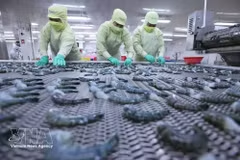
Freezing black tiger shrimp for export at a processing plant of the Minh Phu Seafood Corporation. (Illustrative photo: VNA)

EVFTA deliver tangible gains for Vietnam-EU trade after six years

Reflecting on the agreement's sixth anniversary, EuroCham Chairman Bruno Jaspaert said that nearly half of all EU-Vietnam trade over the past three decades has taken place under the EVFTA, underscoring the rapid acceleration of economic integration once market access barriers were removed.

Delegates attend the international scientific conference, "Ngoc Linh Ginseng – From National Product to Global Brand," in Da Nang on August 2. (Photo: VNA)

Ngoc Linh ginseng sets sights on global brand recognition

Dr. Tran Minh Ngoc, Director of the National Institute of Medicinal Materials under the Ministry of Health, said Ngoc Linh ginseng (Panax vietnamensis) is an endemic species found only in Vietnam's Ngoc Linh mountain range at elevations of 1,500–2,100 metres.

The canal in front of Long Son Big House has become cleaner thanks in part to environmental clean-up efforts by Long Son Petrochemicals Co., Ltd. (Photo: VNA)

FDI firm spreads sustainable value through community commitment

A subsidiary of Thailand’s SCG Chemicals, LSP manages one of Vietnam’s largest foreign direct investment (FDI) projects, with an initial investment of more than 5 billion USD. The company is also investing an additional USD 500 million to integrate ethane into its feedstock portfolio.

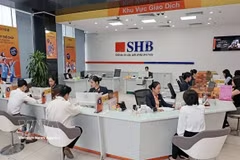
Transactions at a branch of SHB in Hanoi. (Photo: VNA)

Deeper reforms needed to achieve target of 2 million firms

If Vietnam can create the institutions, funding channels and support systems that allow businesses to develop at different stages, the target of 2 million active enterprises by 2030 could mark not just a numerical milestone, but the emergence of a more resilient engine of growth.

An overview of the meeting between the Da Nang delegation and officials of the Czech Ministry of Industry and Trade. (Photo: VNA)

Vietnam, Czech Republic step up local investment, trade cooperation

Representatives of the Czech side spoke highly of the potential for cooperation with Da Nang and affirmed their readiness to help connect Czech enterprises with Vietnamese partners, thereby promoting stronger bilateral investment and trade ties in the years to come.

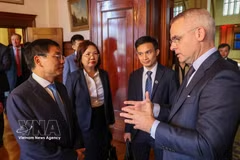
Deputy Prime Minister Nguyen Van Thang (L) and René van Vlerken, CEO of Euronext Amsterdam in the Netherlands on July 31, 2026. (Photo: VNA)

Netherlands ready to support Vietnam in deeper integration into global financial markets

The working sessions between Deputy PM Nguyen Van Thang and Dutch partners helped strengthen the foundation of financial cooperation between Vietnam and the Netherlands, opening up opportunities for experience sharing, market connections and new initiatives in finance, technology and innovation, thereby making positive contributions to the comprehensive partnership.

Luxury riverside apartment complex near Ho Chi Minh City centre remains in high demand. (Photo: VNA)

Real estate data seen as key to market transparency

The biggest risk facing the real estate market is liquidity, while the biggest risk associated with technology lies with its users. Technology can only deliver its full value when it addresses practical market and human needs.

Secretary of the Hanoi Party Committee Tran Duc Thang (L) meets with Central Retail Vietnam CEO Olivier Bernard R. Langlet on July 30. (Photo: hanoimoi.vn)

Hanoi welcomes Central Retail Vietnam's plans to expand modern retail investment

Central Retail Vietnam will continue investing in its supermarket network while increasing the share of Vietnamese products in its distribution system. The group will also deepen support for farmers, cooperatives and producers across the supply chain, from cultivation and harvesting to packaging and product standardisation.

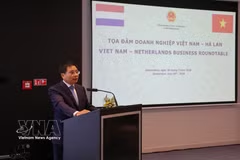
Deputy Prime Minister Nguyen Van Thang speaks at the Vietnam-Netherlands Business Roundtable in Amsterdam on July 30. (Photo: VNA)

Dutch businesses upbeat about Vietnam's growth prospects

Dutch businesses welcomed Vietnam's reform agenda and showed strong interest in expanding collaboration in finance and international financial services, semiconductors, artificial intelligence, logistics, ports, shipbuilding, water management, renewable energy and green transition.

Vietnam's coffee cherries (Photo: VNA)

Vietnamese coffee exports shine in EC’s agri-food trade report

Vietnam and Argentina emerged as notable exceptions in the European Commission’s (EC) latest agri-food trade report. Imports from Argentina increased 10% thanks to higher sunflower seed shipments, while imports from Vietnam climbed 9%, driven by robust coffee exports.